Division of Gastroenterology and Hepatology, Department of Internal Medicine, University of Michigan Health System, Ann Arbor, Michigan, USA.
Division of Gastroenterology and Hepatology, Department of Medicine, University of Arizona College of Medicine, Phoenix, Arizona, USA.
Aliment Pharmacol Ther. 2023 May;57(9):1014-1027. doi: 10.1111/apt.17424. Epub 2023 Feb 23.
BACKGROUND & AIMS: Non-alcoholic fatty liver disease (NAFLD) can develop in individuals who are not overweight. Whether lean persons with NAFLD have lower mortality and lower incidence of cirrhosis, cardiovascular diseases (CVD), diabetes mellitus (DM) and cancer than overweight/obese persons with NAFLD remains inconclusive. We compared mortality and incidence of cirrhosis, CVD, DM and cancer between lean versus non-lean persons with NAFLD.
This is a retrospective study of adults with NAFLD in a single centre from 2012 to 2021. Primary outcomes were mortality and new diagnosis of cirrhosis, CVD, DM and cancer. Outcomes were modelled using competing risk analysis and Cox proportional hazards regression analysis.
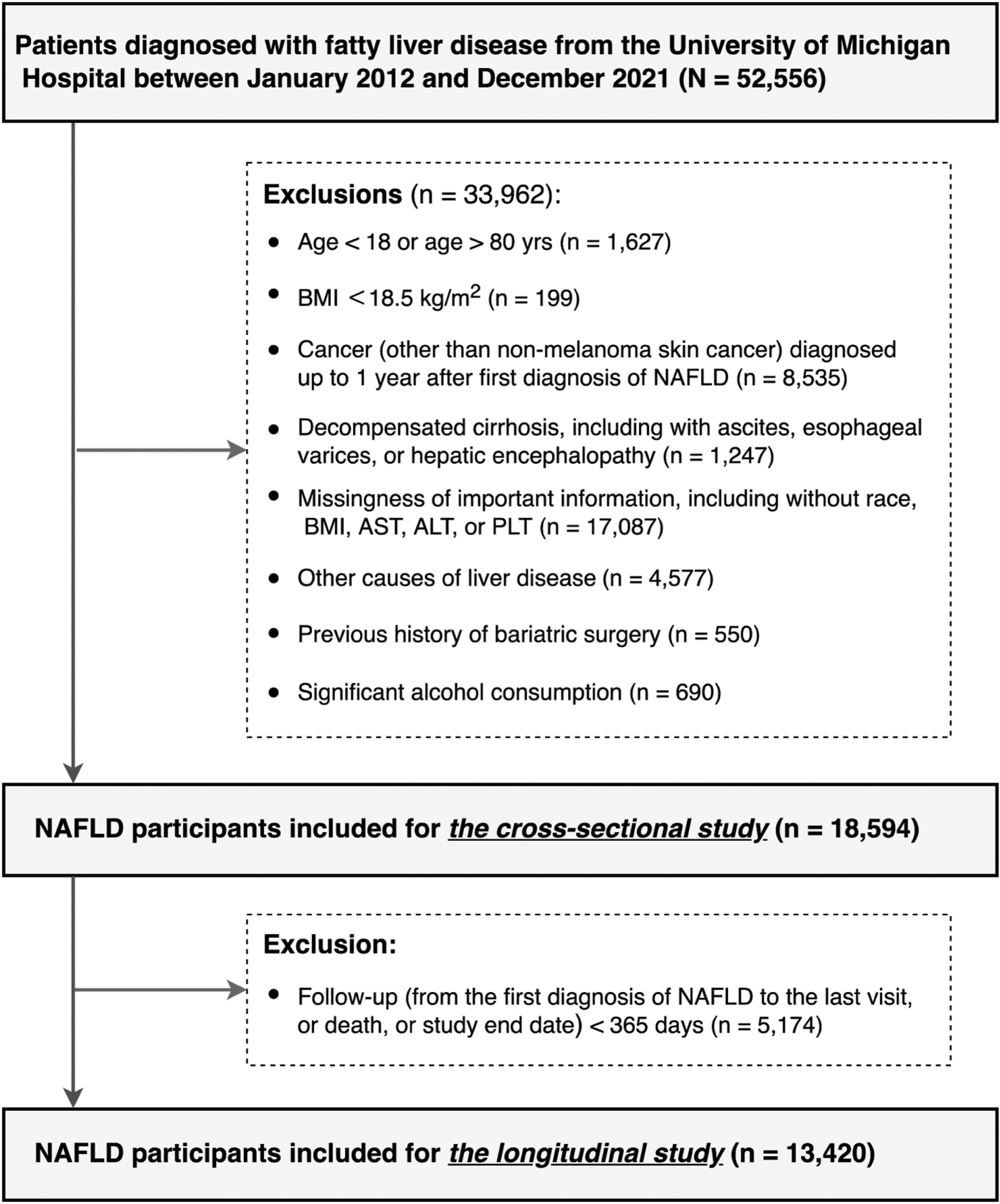
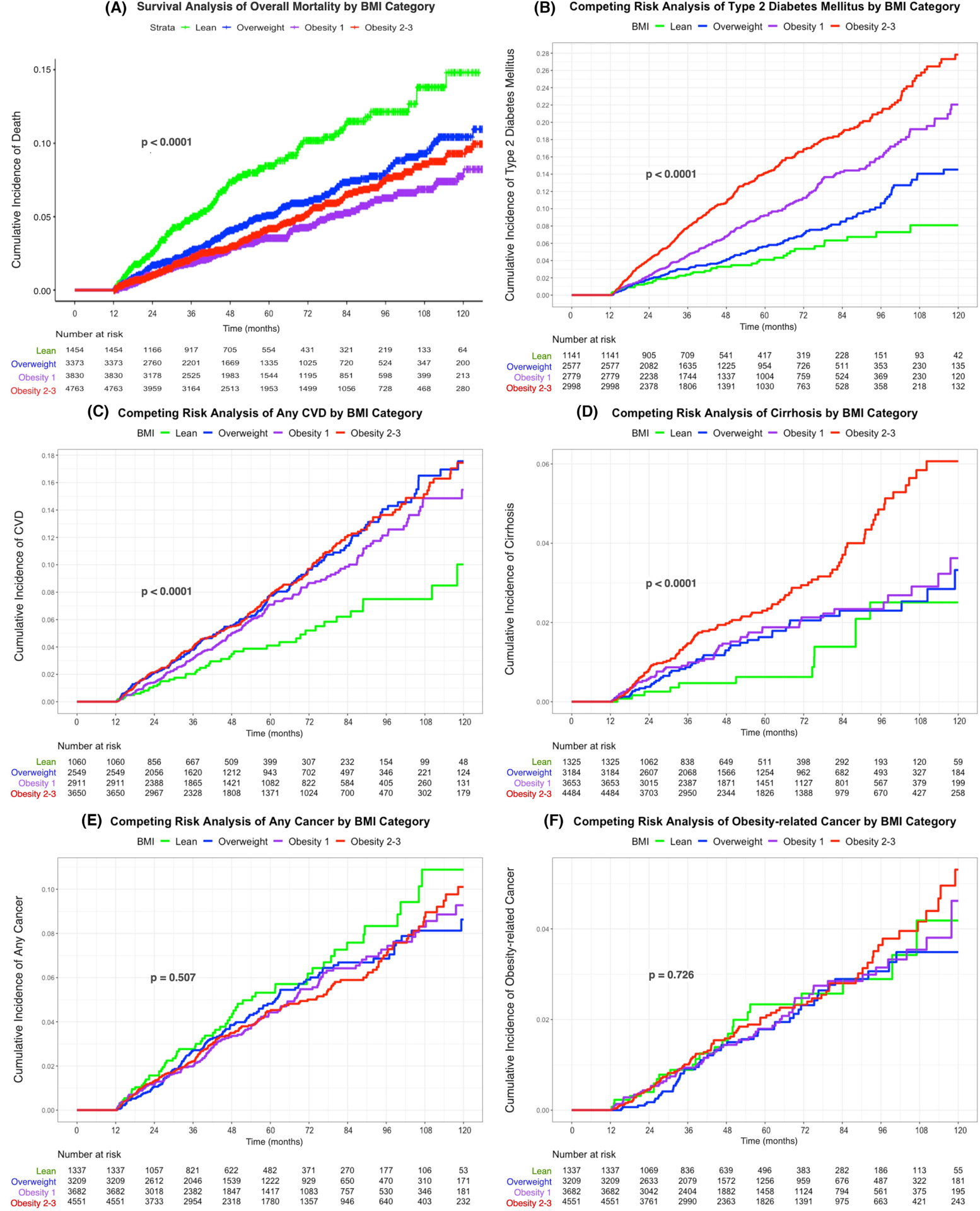
A total of 18,594 and 13,420 patients were identified for cross-sectional and longitudinal analysis respectively: approximately 11% lean, 25% overweight, 28% class 1 obesity and 35% class 2-3 obesity. The median age was 51.0 years, 54.6% were women. The median follow-up was 49.3 months. Lean patients had lower prevalence of metabolic diseases at baseline and lower incidence of cirrhosis and DM than non-lean patients and no difference in CVD, any cancer or obesity-related cancer during follow-up. However, lean patients had significantly higher mortality with incidence per 1000 person-years of 16.67, 10.11, 7.37 and 8.99, respectively, in lean, overweight, obesity class 1 and obesity class 2-3 groups respectively.
Lean patients with NAFLD had higher mortality despite lower incidence of cirrhosis and DM, and similar incidence of CVD and cancer and merit similar if not more attention as non-lean patients with NAFLD.
非酒精性脂肪性肝病(NAFLD)可发生于非超重人群。瘦型 NAFLD 患者的死亡率和肝硬化、心血管疾病(CVD)、糖尿病(DM)和癌症的发生率是否低于超重/肥胖型 NAFLD 患者仍不确定。我们比较了瘦型与非瘦型 NAFLD 患者的死亡率和肝硬化、CVD、DM 和癌症的发生率。
这是一项对 2012 年至 2021 年期间单一中心的成人 NAFLD 患者进行的回顾性研究。主要结局为死亡率和肝硬化、CVD、DM 和癌症的新诊断。使用竞争风险分析和 Cox 比例风险回归分析对结局进行建模。
共对 18594 例和 13420 例患者进行了横断面和纵向分析:约 11%为瘦型,25%为超重型,28%为 1 类肥胖型,35%为 2-3 类肥胖型。中位年龄为 51.0 岁,54.6%为女性。中位随访时间为 49.3 个月。瘦型患者基线时代谢性疾病的患病率较低,肝硬化和 DM 的发生率低于非瘦型患者,但在随访期间,CVD、任何癌症或肥胖相关癌症的发生率无差异。然而,瘦型患者的死亡率显著更高,每 1000 人年的发生率分别为 16.67、10.11、7.37 和 8.99,分别在瘦型、超重型、1 类肥胖型和 2-3 类肥胖型组。
尽管瘦型 NAFLD 患者肝硬化和 DM 的发生率较低,但死亡率较高,且 CVD 和癌症的发生率与非瘦型 NAFLD 患者相似,因此瘦型 NAFLD 患者应得到与非瘦型患者相同或更多的关注。