Si Jiaping, Hu Xinyi, Du Yu, Wei Mengyao, Xu Lehan, Li Bing, Chen Xiaoyan, Li Xuan
Stomatology Hospital, School of Medicine, Zhejiang University, Hangzhou, China.
Department of Stomatology, Children's Hospital of Fudan University, National Children's Medical Center, Shanghai, China.
Front Pediatr. 2023 Feb 1;10:1028968. doi: 10.3389/fped.2022.1028968. eCollection 2022.
To evaluate the effects of rapid maxillary expansion (RME) on mid-facial depth in early mixed dentition and to investigate the relationship between change in mid-facial depth and maxillary sinus and nasal cavity.
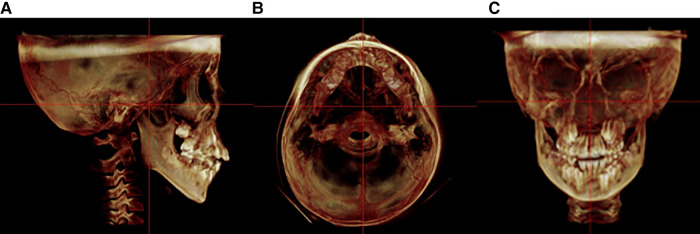
A total of 35 patients with mixed dentition treated with a Haas expander were included in this retrospective study. All patients underwent a cone-beam computed tomography scan before and after rapid maxillary expansion. The Wilcoxon signed-rank test was performed to evaluate the changes in maxillary width, facial depth, maxillary sinus, and nasal cavity volume before and after expansion. Multiple linear regression analysis was applied to evaluate the correlations among them.
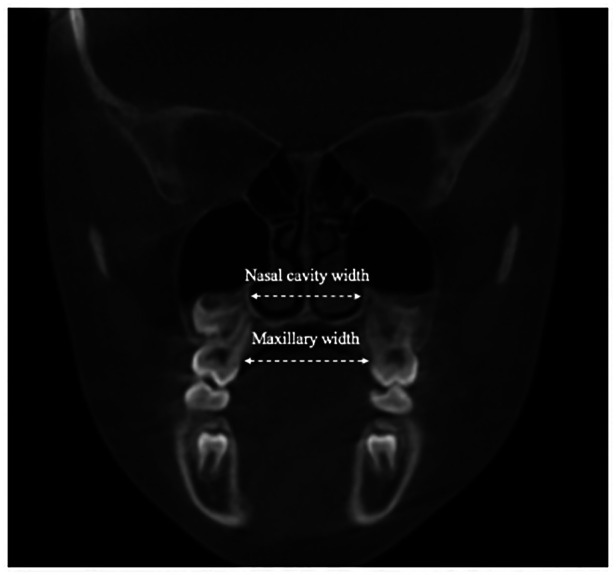
The hard and soft tissue facial depth in the middle third increased significantly ( < 0.001). The gain on the outer sagittal plane (1.04-1.52 mm) was slightly bigger than that on the inner sagittal plane (0.91-1.30 mm). Maxillary width and nasal cavity width increased 3.42 ± 0.93 mm ( < 0.001) and 2.25 ± 0.77 mm ( < 0.001), respectively, after treatment. A gain was also achieved in both nasal cavity volume (2,236.15 mm, < 0.001) and maxillary sinus volume (1,227.33 mm, < 0.001). Multiple linear regression analysis showed that with the increase in maxillary sinus volume, the facial depth increased as well ( = 0.455-0.683, < 0.05). Also, statistically significant correlations were found between nasal width and nasal cavity volume ( = 0.384, < 0.05).
The depth of the middle third face increased significantly. The facial depth increase was related to the enlargement of maxillary sinus volume, while the nasal cavity volume gain was related to the nasal width increase. This indicated that RME might enhance the fullness of the mid-face and facilitate the patency of nose breathing.
评估快速上颌扩弓(RME)对早期混合牙列中面部深度的影响,并研究中面部深度变化与上颌窦和鼻腔之间的关系。
本回顾性研究纳入了35例使用哈斯扩弓器治疗的混合牙列患者。所有患者在快速上颌扩弓前后均接受了锥形束计算机断层扫描。采用Wilcoxon符号秩检验评估扩弓前后上颌宽度、面部深度、上颌窦和鼻腔容积的变化。应用多元线性回归分析评估它们之间的相关性。
中面部的硬组织和软组织深度显著增加(<0.001)。矢状面外侧的增加量(1.04 - 1.52 mm)略大于矢状面内侧的增加量(0.91 - 1.30 mm)。治疗后,上颌宽度和鼻腔宽度分别增加了3.42±0.93 mm(<0.001)和2.25±0.77 mm(<0.001)。鼻腔容积(2,236.15 mm,<0.001)和上颌窦容积(1,227.33 mm,<0.001)也有所增加。多元线性回归分析表明,随着上颌窦容积的增加,面部深度也增加(=0.455 - 0.683,<0.05)。此外,鼻腔宽度与鼻腔容积之间也存在统计学上的显著相关性(=0.384,<0.05)。
中面部深度显著增加。面部深度增加与上颌窦容积增大有关,而鼻腔容积增加与鼻腔宽度增加有关。这表明快速上颌扩弓可能会增强中面部的丰满度并促进鼻呼吸通畅。