• 文献检索
  • 文档翻译
  • 深度研究
  • 学术资讯
  • Suppr Zotero 插件Zotero 插件
  • 邀请有礼
  • 套餐&价格
  • 历史记录
应用&插件
Suppr Zotero 插件Zotero 插件浏览器插件Mac 客户端Windows 客户端微信小程序
定价
高级版会员购买积分包购买API积分包
服务
文献检索文档翻译深度研究API 文档MCP 服务
关于我们
关于 Suppr公司介绍联系我们用户协议隐私条款
关注我们

Suppr 超能文献

核心技术专利:CN118964589B侵权必究
粤ICP备2023148730 号-1Suppr @ 2026

文献检索

告别复杂PubMed语法,用中文像聊天一样搜索,搜遍4000万医学文献。AI智能推荐,让科研检索更轻松。

立即免费搜索

文件翻译

保留排版,准确专业,支持PDF/Word/PPT等文件格式,支持 12+语言互译。

免费翻译文档

深度研究

AI帮你快速写综述,25分钟生成高质量综述,智能提取关键信息,辅助科研写作。

立即免费体验

中国临床护士对谵妄及其亚型评估的知识、态度和实践以及决定因素:一项多中心横断面研究。

Knowledge, attitude, and practice toward delirium and subtype assessment among Chinese clinical nurses and determinant factors: A multicentre cross-section study.

作者信息

Zhou Wen, Zheng Qiulan, Huang Miao, Zhang Chuanlai, Zhang Huan, Yang Li, Wu Taiqin, Gan Xiuni

机构信息

Department of Nursing, Second Affiliated Hospital of Chongqing Medical University, Chongqing, China.

The Second Department of Nursing School, Chongqing Medical University, Chongqing, China.

出版信息

Front Psychiatry. 2023 Feb 1;13:1017283. doi: 10.3389/fpsyt.2022.1017283. eCollection 2022.

DOI:10.3389/fpsyt.2022.1017283
PMID:36819944
原文链接:https://pmc.ncbi.nlm.nih.gov/articles/PMC9929153/
Abstract

BACKGROUND

Delirium, a confused transient state of consciousness, can be divided into hyperactive, hypoactive, mixed, and no motor subtypes, according to different clinical manifestations. Several studies have investigated delirium subtypes in the knowledge dimension, but few studies have investigated delirium subtype in the attitude and practice dimensions. The barriers, knowledge sources, and practice details regarding subtype assessment are unclear.

OBJECTIVES

This study had three objectives. First, we planned to investigate the KAP status regarding delirium and subtypes for nurses. Second, we wanted to identify factors affecting clinical nurses' KAP scores. Third, this study expected to explore more details regarding delirium and subtypes assessment, including assessment barriers, assessment instruments, and knowledge sources.

METHODS

This multicentre cross-section study was conducted in 10 tertiary hospitals in three provinces, China, from January to April 2022. We investigated 477 nurses from six departments with a high prevalence. The self-developed KAP questionnaire regarding delirium and subtypes assessment had four parts: knowledge, attitude, practice, and source. Its reliability and validity were verified effectively by 2-round Delphi expert consultation.

RESULTS

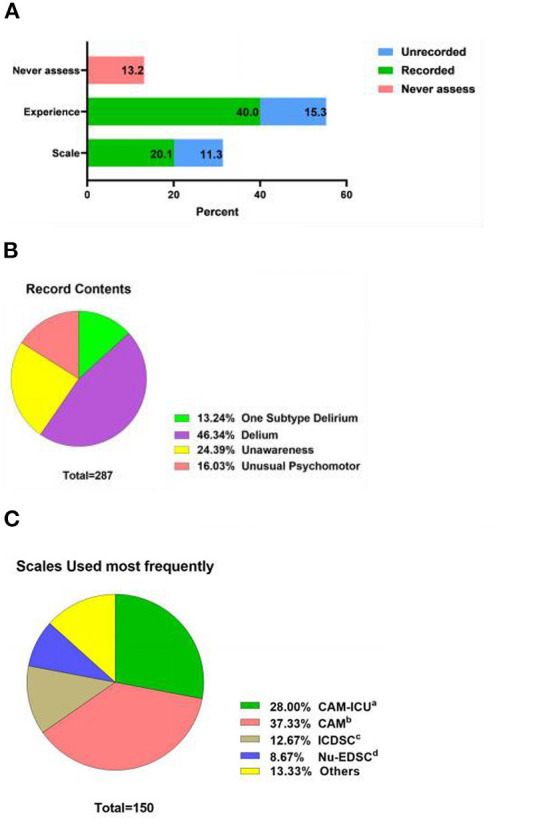
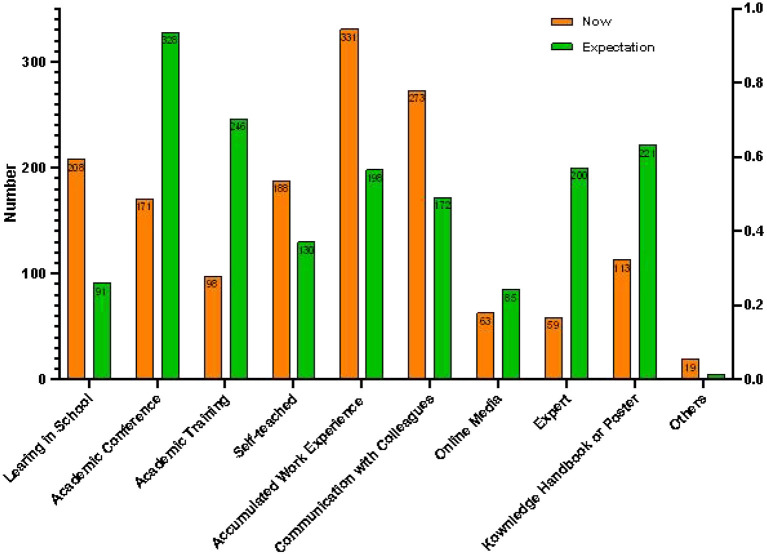
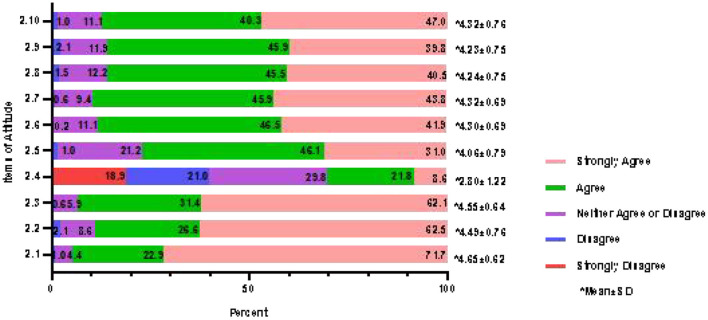
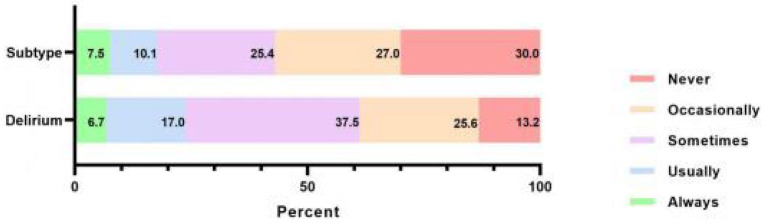
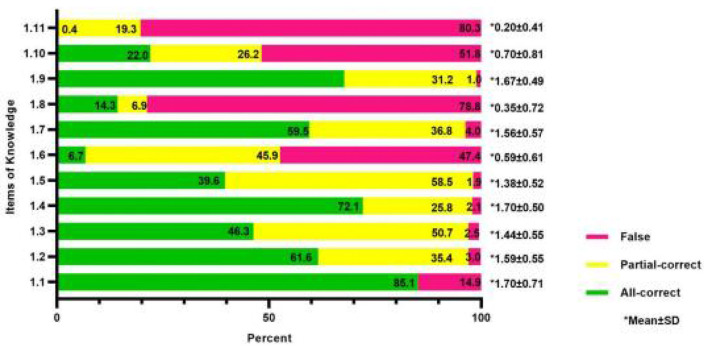
A total of 477 nurses from the general intensive care unit (ICU), specialty ICU, orthopedics, thoracic surgery, operating room, and geriatrics were 28.3, 22.4, 22.2, 10.5, and 5.2%, respectively. The total KAP score regarding delirium and subtypes assessment was 60.01 ± 6.98, and the scoring rate was 73.18%. The scoring rate for knowledge, attitude, and practice was 58.55, 83.94, and 51.70%, respectively. More than half (54.1%) were unaware of the delirium subtypes assessment instruments. A total of 451 (94.6%) participants recognized the importance of nursing work for delirium prevention. A total of 250 (52.4%) nurses occasionally or sometimes assessed delirium subtypes, and 143 (30.0%) never assessed for delirium subtypes. We found that age, department, technical title, familiarity with delirium, familiarity with delirium subtypes, delirium training, and subtype training affected the total KAP scores. ICU nurses achieved the highest scores.

CONCLUSION

Chinese nurses' KAP status regarding delirium and subtypes assessment were barely acceptable, and the attitude score was positive, but knowledge and practice needed improvement. Meanwhile, the department was one of the significant KAP factors, and ICU nurses did better in delirium and subtype assessment in knowledge and practice dimension than other departments. Systematic and scientific training processes including subtype content and assessment tools are required. Experience still drives nurses' assessments of delirium and subtype. Adding the delirium assessment into routine tasks should be considered.

摘要

背景

谵妄是一种意识混乱的短暂状态,根据不同临床表现可分为多动型、少动型、混合型和无运动型亚型。多项研究在知识维度对谵妄亚型进行了调查,但在态度和实践维度对谵妄亚型的研究较少。关于亚型评估的障碍、知识来源和实践细节尚不清楚。

目的

本研究有三个目标。第一,我们计划调查护士对谵妄及其亚型的知识、态度和实践(KAP)状况。第二,我们想确定影响临床护士KAP评分的因素。第三,本研究期望探索关于谵妄及其亚型评估的更多细节,包括评估障碍、评估工具和知识来源。

方法

本多中心横断面研究于2022年1月至4月在中国三个省份的10家三级医院进行。我们调查了来自六个高患病率科室的477名护士。自行编制的关于谵妄及其亚型评估的KAP问卷有四个部分:知识、态度、实践和来源。通过两轮德尔菲专家咨询有效地验证了其信效度。

结果

来自综合重症监护病房(ICU)、专科ICU、骨科、胸外科、手术室和老年医学科的477名护士分别占28.3%、22.4%、22.2%、10.5%和5.2%。关于谵妄及其亚型评估的KAP总分为60.01±6.98,得分率为73.18%。知识、态度和实践的得分率分别为58.55%、83.94%和51.70%。超过一半(54.1%)的人不知道谵妄亚型评估工具。共有451名(94.6%)参与者认识到护理工作对预防谵妄的重要性。共有250名(52.4%)护士偶尔或有时评估谵妄亚型,143名(30.0%)护士从未评估过谵妄亚型。我们发现年龄、科室、职称、对谵妄的熟悉程度、对谵妄亚型的熟悉程度、谵妄培训和亚型培训影响KAP总分。ICU护士得分最高。

结论

中国护士对谵妄及其亚型评估的KAP状况勉强可以接受,态度得分呈阳性,但知识和实践方面需要改进。同时,科室是影响KAP的重要因素之一,ICU护士在谵妄及其亚型评估的知识和实践维度上比其他科室表现更好。需要系统科学的培训过程,包括亚型内容和评估工具。经验仍然主导护士对谵妄及其亚型的评估。应考虑将谵妄评估纳入日常工作。
https://cdn.ncbi.nlm.nih.gov/pmc/blobs/9dfb/9929153/9b3774777004/fpsyt-13-1017283-g0005.jpg
https://cdn.ncbi.nlm.nih.gov/pmc/blobs/9dfb/9929153/d7437b57621a/fpsyt-13-1017283-g0001.jpg
https://cdn.ncbi.nlm.nih.gov/pmc/blobs/9dfb/9929153/328617841497/fpsyt-13-1017283-g0002.jpg
https://cdn.ncbi.nlm.nih.gov/pmc/blobs/9dfb/9929153/b686c6a6b589/fpsyt-13-1017283-g0003.jpg
https://cdn.ncbi.nlm.nih.gov/pmc/blobs/9dfb/9929153/a4eda5761a68/fpsyt-13-1017283-g0004.jpg
https://cdn.ncbi.nlm.nih.gov/pmc/blobs/9dfb/9929153/9b3774777004/fpsyt-13-1017283-g0005.jpg
https://cdn.ncbi.nlm.nih.gov/pmc/blobs/9dfb/9929153/d7437b57621a/fpsyt-13-1017283-g0001.jpg
https://cdn.ncbi.nlm.nih.gov/pmc/blobs/9dfb/9929153/328617841497/fpsyt-13-1017283-g0002.jpg
https://cdn.ncbi.nlm.nih.gov/pmc/blobs/9dfb/9929153/b686c6a6b589/fpsyt-13-1017283-g0003.jpg
https://cdn.ncbi.nlm.nih.gov/pmc/blobs/9dfb/9929153/a4eda5761a68/fpsyt-13-1017283-g0004.jpg
https://cdn.ncbi.nlm.nih.gov/pmc/blobs/9dfb/9929153/9b3774777004/fpsyt-13-1017283-g0005.jpg

相似文献

1
Knowledge, attitude, and practice toward delirium and subtype assessment among Chinese clinical nurses and determinant factors: A multicentre cross-section study.中国临床护士对谵妄及其亚型评估的知识、态度和实践以及决定因素:一项多中心横断面研究。
Front Psychiatry. 2023 Feb 1;13:1017283. doi: 10.3389/fpsyt.2022.1017283. eCollection 2022.
2
Knowledge, attitude and practice regarding hypoactive delirium among ICU nurses: A nationwide cross-sectional study.重症监护病房护士对活动减退型谵妄的认知、态度和实践:一项全国性横断面研究。
Nurse Educ Pract. 2023 Oct;72:103749. doi: 10.1016/j.nepr.2023.103749. Epub 2023 Aug 19.
3
Development and validation of nurse's assessment ability questionnaire in delirium subtypes: Based on Delphi expert consensus.基于德尔菲专家共识的谵妄亚型护士评估能力问卷的编制与验证。
PLoS One. 2024 Jan 23;19(1):e0297063. doi: 10.1371/journal.pone.0297063. eCollection 2024.
4
Nurses' knowledge, attitude, and practice regarding the use of physical restraints in children in the intensive care setting in China: A cross-sectional multicentre study.中国重症监护环境中护士对儿童使用身体约束的知识、态度和实践:一项横断面多中心研究。
Aust Crit Care. 2023 Jul;36(4):515-520. doi: 10.1016/j.aucc.2022.04.007. Epub 2022 May 21.
5
Ophthalmic nurses' knowledge, attitude, and practice toward venous thromboembolic prevention: a dual-center cross-sectional survey.眼科护士对静脉血栓栓塞预防的知识、态度和实践:一项双中心横断面调查。
PeerJ. 2023 Aug 28;11:e15947. doi: 10.7717/peerj.15947. eCollection 2023.
6
Knowledge, attitude, and practice of critical care nurses and their influence on acute skin failure patients in China: A multicenter cross-sectional study.中国重症监护护士的知识、态度和实践及其对急性皮肤衰竭患者的影响:一项多中心横断面研究。
Jpn J Nurs Sci. 2024 Apr;21(2):e12582. doi: 10.1111/jjns.12582. Epub 2024 Jan 12.
7
Knowledge, attitude and practice regarding nursing interruptions among Chinese nurses: A nationwide cross-sectional survey.中国护士对护理工作中断的认知、态度及实践:一项全国性横断面调查。
Int J Nurs Sci. 2019 Dec 16;7(1):66-73. doi: 10.1016/j.ijnss.2019.12.004. eCollection 2020 Jan 10.
8
Knowledge, attitude and practice of registered nurses toward ICU patients' transfer anxiety in China: A cross-sectional study.中国注册护士对ICU患者转运焦虑的认知、态度及行为:一项横断面研究。
Heliyon. 2024 Apr 5;10(8):e29318. doi: 10.1016/j.heliyon.2024.e29318. eCollection 2024 Apr 30.
9
Knowledge, attitude, and practice regarding postoperative delirium among cardiac surgery nurses: A cross-sectional multi-centre study.心脏外科护士术后谵妄知识、态度和实践的横断面多中心研究。
J Clin Nurs. 2023 Aug;32(15-16):5046-5055. doi: 10.1111/jocn.16751. Epub 2023 May 12.
10
Educational intervention on delirium assessment using confusion assessment method-ICU (CAM-ICU) in a general intensive care unit.在普通重症监护病房使用意识模糊评估法-重症监护病房(CAM-ICU)对谵妄进行教育干预。
J Clin Nurs. 2018 Nov;27(21-22):4028-4039. doi: 10.1111/jocn.14525. Epub 2018 Jul 30.

引用本文的文献

1
Decoding the adolescent non-suicidal self-injury: understanding with interpretable machine learning insights.解码青少年非自杀性自伤行为:借助可解释的机器学习见解进行理解
BMC Public Health. 2025 Sep 1;25(1):2994. doi: 10.1186/s12889-025-24354-z.
2
Investigation of the factors affecting delirium evaluation by intensive care nurses: a cross-sectional descriptive study.重症监护护士谵妄评估影响因素的调查:一项横断面描述性研究。
BMC Nurs. 2025 Jul 24;24(1):968. doi: 10.1186/s12912-025-03638-0.
3
Appraising the Factors Associated with Delirium Care Behaviours and Barriers to Their Assessment Among Clinical Nurses: A Cross-Sectional Study.

本文引用的文献

1
How do predisposing factors differ between delirium motor subtypes? A systematic review and meta-analysis.诱发因素在不同谵妄运动亚型之间有何差异?系统评价和荟萃分析。
Age Ageing. 2022 Sep 2;51(9). doi: 10.1093/ageing/afac200.
2
Knowledge, attitudes and practices of ICU nurses regarding subsyndromal delirium among 20 hospitals in China: a descriptive cross-sectional survey.中国 20 家医院 ICU 护士对亚综合征性谵妄的知识、态度和实践:描述性横断面调查。
BMJ Open. 2022 Sep 20;12(9):e063821. doi: 10.1136/bmjopen-2022-063821.
3
Risk factors, time to onset and recurrence of delirium in a mixed medical-surgical ICU population: A secondary analysis using Cox and CHAID decision tree modeling.
评估临床护士中与谵妄护理行为相关的因素及其评估障碍:一项横断面研究。
Int J Environ Res Public Health. 2024 Nov 27;21(12):1582. doi: 10.3390/ijerph21121582.
4
Factors Influencing Nurses' Knowledge About Delirium in Acute Care Settings in Hail Region, Saudi Arabia: A Cross-Sectional Study.沙特阿拉伯哈伊勒地区急性护理环境中影响护士谵妄知识的因素:一项横断面研究。
Risk Manag Healthc Policy. 2024 Dec 21;17:3257-3266. doi: 10.2147/RMHP.S494402. eCollection 2024.
5
A Cross-Sectional Survey on Nurses' Utilization of Risk Assessment and Screening for Postoperative Delirium in Older Patients Following Hip Fracture Surgery in Tertiary Hospitals in Jiangsu Province, China.中国江苏省三级医院髋部骨折手术后老年患者术后谵妄风险评估与筛查护士应用情况的横断面调查
Risk Manag Healthc Policy. 2024 Oct 19;17:2457-2464. doi: 10.2147/RMHP.S481087. eCollection 2024.
6
Self-efficacy of ICU nurses in delirium care: an analysis of the current status and influencing factors.重症监护病房护士在谵妄护理中的自我效能感:现状及影响因素分析
BMC Nurs. 2024 Oct 21;23(1):773. doi: 10.1186/s12912-024-02379-w.
7
Knowledge, Attitudes and Practices Among Anesthesia and Thoracic Surgery Medical Staff Toward Ai-PCA.麻醉与胸外科医务人员对人工智能辅助患者自控镇痛的知识、态度和实践
J Multidiscip Healthc. 2024 Jul 10;17:3295-3304. doi: 10.2147/JMDH.S468539. eCollection 2024.
8
Delirium Knowledge, Risk Factors, and Attitude Among the General Public in Saudi Arabia: A Cross-Sectional Study.沙特阿拉伯普通公众的谵妄知识、风险因素及态度:一项横断面研究。
Cureus. 2024 Apr 29;16(4):e59263. doi: 10.7759/cureus.59263. eCollection 2024 Apr.
9
Dietary knowledge-attitude-practice status in hemodialysis patients: a latent profile analysis.血液透析患者饮食知识-态度-实践状况:潜在剖面分析。
BMC Public Health. 2024 Mar 18;24(1):836. doi: 10.1186/s12889-024-18066-z.
10
College students' knowledge, attitudes, and practices of garbage sorting and their associations: a cross-sectional study of several universities in Beijing, China.大学生垃圾分类的知识、态度和行为及其关联:中国北京几所大学的横断面研究
Front Public Health. 2024 Feb 16;12:1328583. doi: 10.3389/fpubh.2024.1328583. eCollection 2024.
综合内科-外科重症监护病房人群中谵妄的危险因素、发病时间及复发情况:一项使用Cox模型和CHAID决策树模型的二次分析
EXCLI J. 2022 Jan 4;21:30-46. doi: 10.17179/excli2021-4381. eCollection 2022.
4
Phenotypes and subphenotypes of delirium: a review of current categorisations and suggestions for progression.谵妄的表型和亚表型:对现有分类的综述及进展建议。
Crit Care. 2021 Sep 15;25(1):334. doi: 10.1186/s13054-021-03752-w.
5
Delirium.谵妄。
Nat Rev Dis Primers. 2020 Nov 12;6(1):90. doi: 10.1038/s41572-020-00223-4.
6
Postoperative delirium: perioperative assessment, risk reduction, and management.术后谵妄:围手术期评估、风险降低和管理。
Br J Anaesth. 2020 Oct;125(4):492-504. doi: 10.1016/j.bja.2020.06.063. Epub 2020 Aug 11.
7
Treatment of Delirium in Older Persons: What We Should Not Do!老年人谵妄的治疗:我们不应该做什么!
Int J Mol Sci. 2020 Mar 31;21(7):2397. doi: 10.3390/ijms21072397.
8
Risk factors and outcomes among delirium subtypes in adult ICUs: A systematic review.成人 ICU 中不同类型谵妄的危险因素和结局:系统评价。
J Crit Care. 2020 Apr;56:257-264. doi: 10.1016/j.jcrc.2020.01.017. Epub 2020 Jan 15.
9
Innovative ICU Solutions to Prevent and Reduce Delirium and Post-Intensive Care Unit Syndrome.创新的 ICU 解决方案,预防和减少谵妄和 ICU 后综合征。
Semin Respir Crit Care Med. 2019 Oct;40(5):673-686. doi: 10.1055/s-0039-1698404. Epub 2019 Dec 11.
10
[Evidence-Based Clinical Practice Guidelines: Delirium Management in Hospitalized Older Patients].[基于证据的临床实践指南:住院老年患者谵妄的管理]
Hu Li Za Zhi. 2019 Jun;66(3):72-82. doi: 10.6224/JN.201906_66(3).09.