Barsoumian Hampartsoum B, He Kewen, Hsu Ethan, Bertolet Genevieve, Sezen Duygu, Hu Yun, Cortez Maria Angelica, Welsh James W
The University of Texas MD Anderson Cancer Center.
Shandong First Medical University, Shandong Academy of Medical Sciences, Shandong Cancer Hospital and Institute.
Res Sq. 2023 Feb 13:rs.3.rs-2570782. doi: 10.21203/rs.3.rs-2570782/v1.
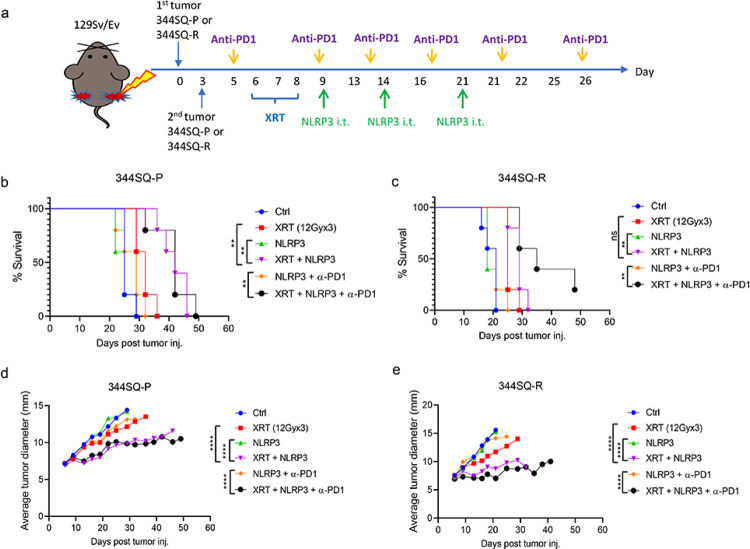
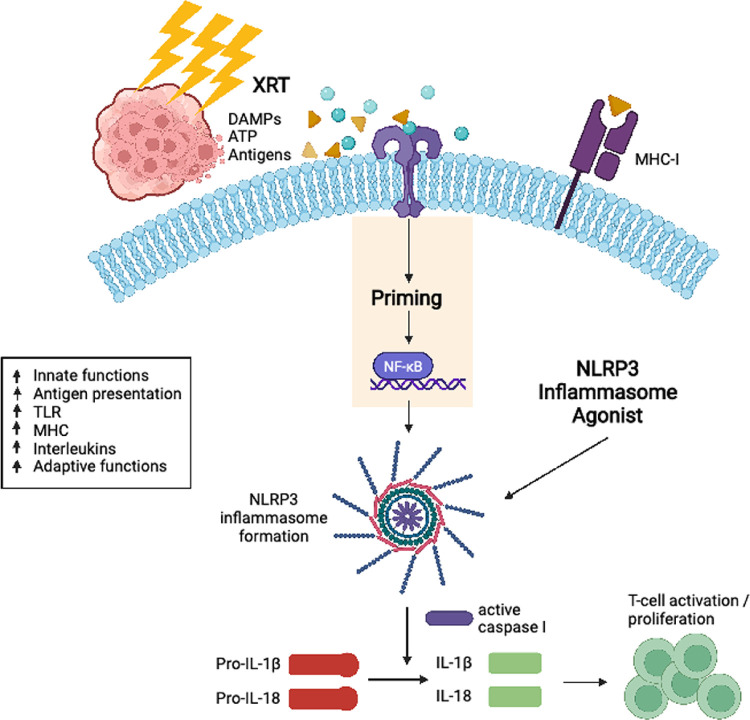
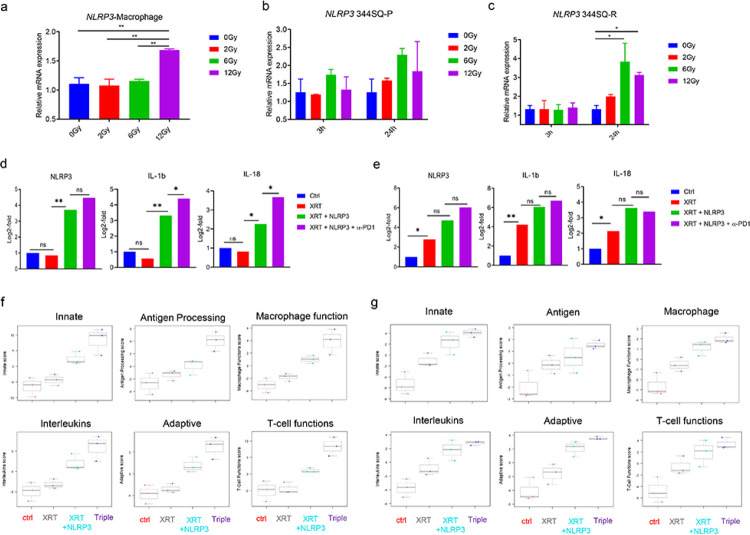
Radiotherapy (XRT), a well-known activator of the inflammasome and immune priming, is in part capable of reversing resistance to anti-PD1 treatment. Although NLRP3 is typically observed for its role in exacerbating XRT-induced tissue damage, the NLRP3 inflammasome can also be protective and augment the effect of XRT when used in proper dosing and sequencing. However, whether NLRP3 agonist boosts radiation-induced immune priming and promote abscopal responses in anti-PD1 resistant model is still unknown. Therefore, in this study, we paired intratumoral injection of an NLRP3 agonist with XRT to stimulate the immune system in both wild type (344SQ-P) and anti-PD1 resistant (344SQ-R) murine-implanted lung adenocarcinoma models. We found that the combination of XRT + NLPR3 agonist enhanced control of implanted lung adenocarcinoma primary as well as secondary tumors in a radiological dose-dependent manner, in which 12Gy x 3 fractions of stereotactic XRT was better than 5Gy x 3, while 1Gy x 2 did not improve the NLRP3 effect. Survival and tumor growth data also showed significant abscopal response with the triple therapy (12Gyx3 + NLRP3 agonist + α-PD1) in both 344SQ-P and 344SQ-R aggressively growing models. Multiple pro-inflammatory cytokines (IL-1b, IL-4, IL-12, IL-17, IFN-γ and GM-CSF) were elevated in the serum of mice treated with XRT + NLRP3 or triple therapy. The Nanostring results showed that NLRP3 agonist is capable of increasing antigen presentation, innate function, and T-cell priming. This study can be of particular importance to treat patients with immunologically-cold solid tumors whom are also refractory to prior checkpoint treatments.
放射疗法(XRT)是一种众所周知的炎性小体激活剂和免疫启动剂,部分能够逆转对抗PD1治疗的耐药性。虽然通常观察到NLRP3在加剧XRT诱导的组织损伤中起作用,但当以适当的剂量和顺序使用时,NLRP3炎性小体也可以起到保护作用并增强XRT的效果。然而,NLRP3激动剂是否能增强辐射诱导的免疫启动并促进抗PD1耐药模型中的远隔效应仍不清楚。因此,在本研究中,我们将瘤内注射NLRP3激动剂与XRT相结合,以刺激野生型(344SQ-P)和抗PD1耐药(344SQ-R)小鼠植入性肺腺癌模型中的免疫系统。我们发现,XRT + NLPR3激动剂的联合治疗以放射剂量依赖性方式增强了对植入性肺腺癌原发肿瘤和继发肿瘤的控制,其中12Gy×3分次立体定向XRT优于5Gy×3,而1Gy×2并未改善NLRP3的效果。生存和肿瘤生长数据还显示,在344SQ-P和344SQ-R快速生长模型中,三联疗法(12Gyx3 + NLRP3激动剂 + α-PD1)具有显著的远隔效应。在用XRT + NLRP3或三联疗法治疗的小鼠血清中,多种促炎细胞因子(IL-1b、IL-4、IL-12、IL-17、IFN-γ和GM-CSF)升高。纳米串结果表明,NLRP3激动剂能够增加抗原呈递、固有功能和T细胞启动。这项研究对于治疗对先前检查点治疗也难治的免疫冷实性肿瘤患者可能特别重要。