Tsamos Athanasios, Evsevleev Sergei, Fioresi Rita, Faglioni Francesco, Bruno Giovanni
Bundesanstalt für Materialforschung und-Prüfung (Federal Institute for Materials Research and Testing), 12205 Berlin, Germany.
Department of Farmacy and Biotechnology (FABIT), University of Bologna, 40126 Bologna, Italy.
J Imaging. 2023 Jan 19;9(2):22. doi: 10.3390/jimaging9020022.
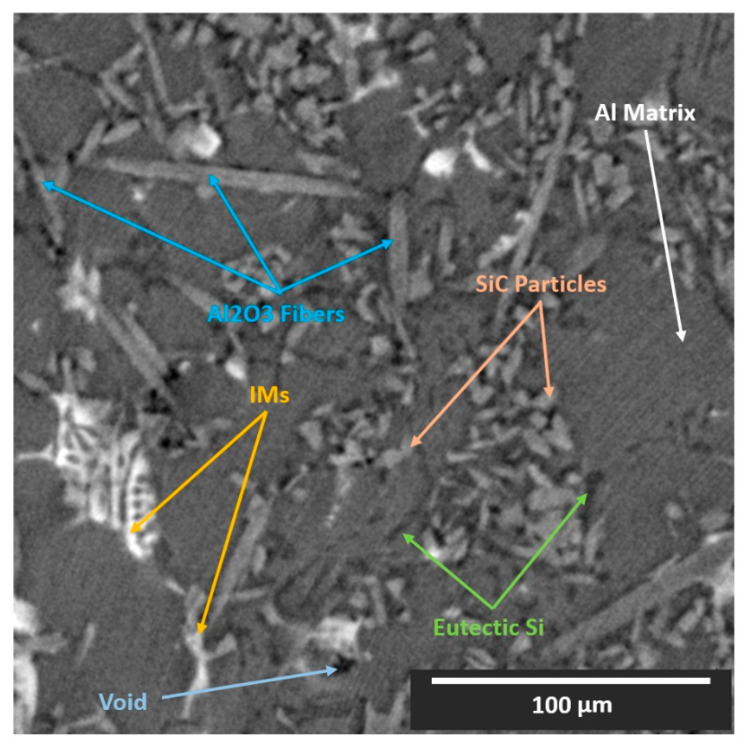
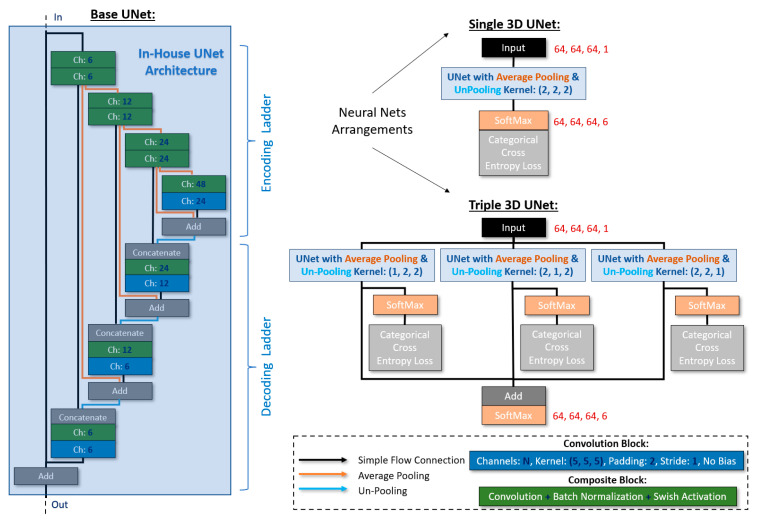
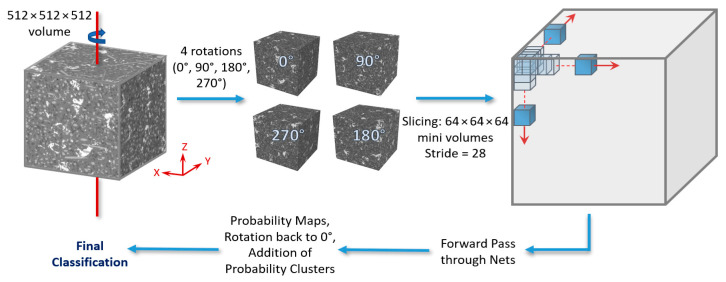
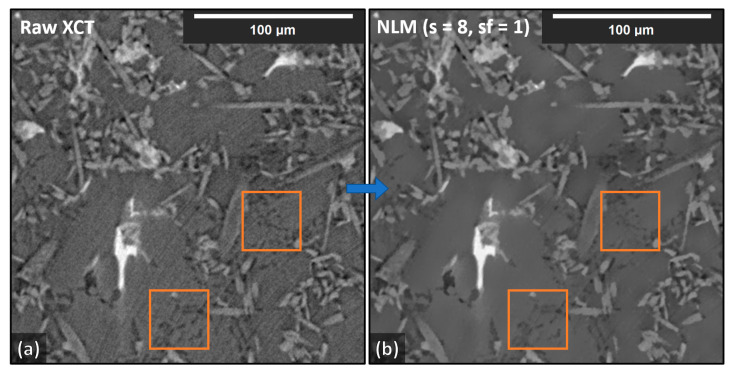
The greatest challenge when using deep convolutional neural networks (DCNNs) for automatic segmentation of microstructural X-ray computed tomography (XCT) data is the acquisition of sufficient and relevant data to train the working network. Traditionally, these have been attained by manually annotating a few slices for 2D DCNNs. However, complex multiphase microstructures would presumably be better segmented with 3D networks. However, manual segmentation labeling for 3D problems is prohibitive. In this work, we introduce a method for generating synthetic XCT data for a challenging six-phase Al-Si alloy composite reinforced with ceramic fibers and particles. Moreover, we propose certain data augmentations (brightness, contrast, noise, and blur), a special in-house designed deep convolutional neural network (Triple UNet), and a multi-view forwarding strategy to promote generalized learning from synthetic data and therefore achieve successful segmentations. We obtain an overall Dice score of 0.77. Lastly, we prove the detrimental effects of artifacts in the XCT data on achieving accurate segmentations when synthetic data are employed for training the DCNNs. The methods presented in this work are applicable to other materials and imaging techniques as well. Successful segmentation coupled with neural networks trained with synthetic data will accelerate scientific output.
使用深度卷积神经网络(DCNN)对微观结构X射线计算机断层扫描(XCT)数据进行自动分割时,最大的挑战是获取足够且相关的数据来训练工作网络。传统上,对于二维DCNN,是通过手动标注少量切片来实现的。然而,复杂的多相微观结构可能用三维网络进行分割会更好。但是,对三维问题进行手动分割标注是难以做到的。在这项工作中,我们介绍了一种为一种具有挑战性的、由陶瓷纤维和颗粒增强的六相铝硅合金复合材料生成合成XCT数据的方法。此外,我们提出了某些数据增强方法(亮度、对比度、噪声和模糊)、一种专门内部设计的深度卷积神经网络(三重U-Net)以及一种多视图转发策略,以促进从合成数据进行广义学习,从而实现成功分割。我们获得的总体Dice分数为0.77。最后,我们证明了在使用合成数据训练DCNN时,XCT数据中的伪影对实现准确分割的不利影响。这项工作中提出的方法也适用于其他材料和成像技术。结合使用合成数据训练的神经网络实现成功分割将加速科研产出。