The Netherlands Cancer Institute, Division of Molecular Pathology, Plesmanlaan 121, 1066 Amsterdam, the Netherlands.
University of Cambridge, Centre for Cancer Genetic Epidemiology, Department of Public Health and Primary Care, Cambridge, UK.
Am J Hum Genet. 2023 Mar 2;110(3):475-486. doi: 10.1016/j.ajhg.2023.02.003. Epub 2023 Feb 23.
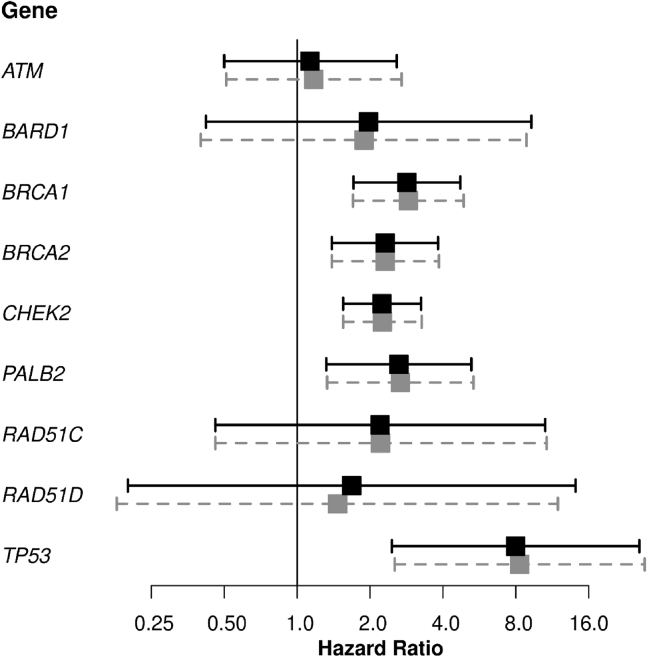
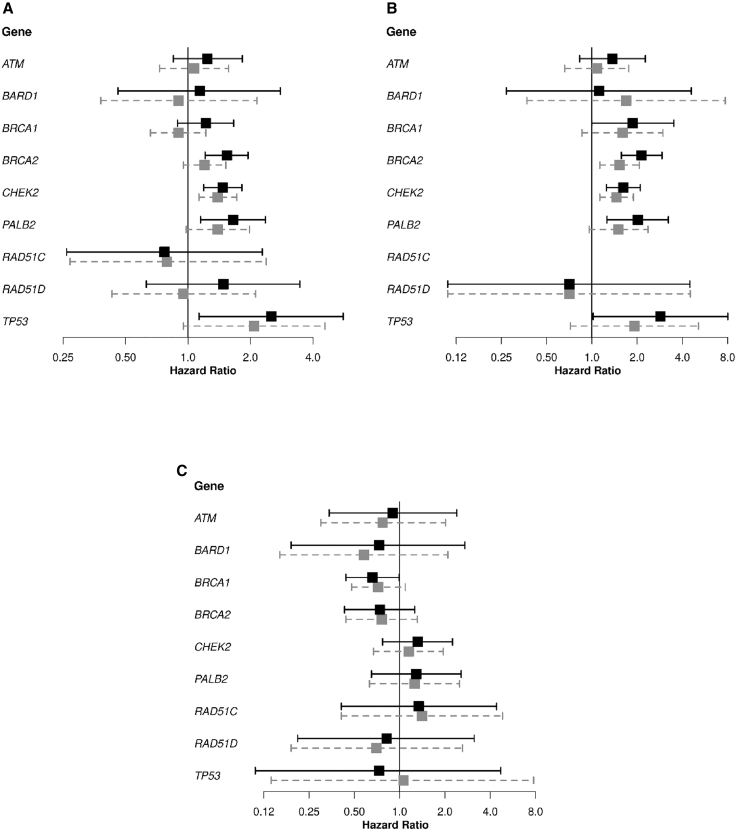
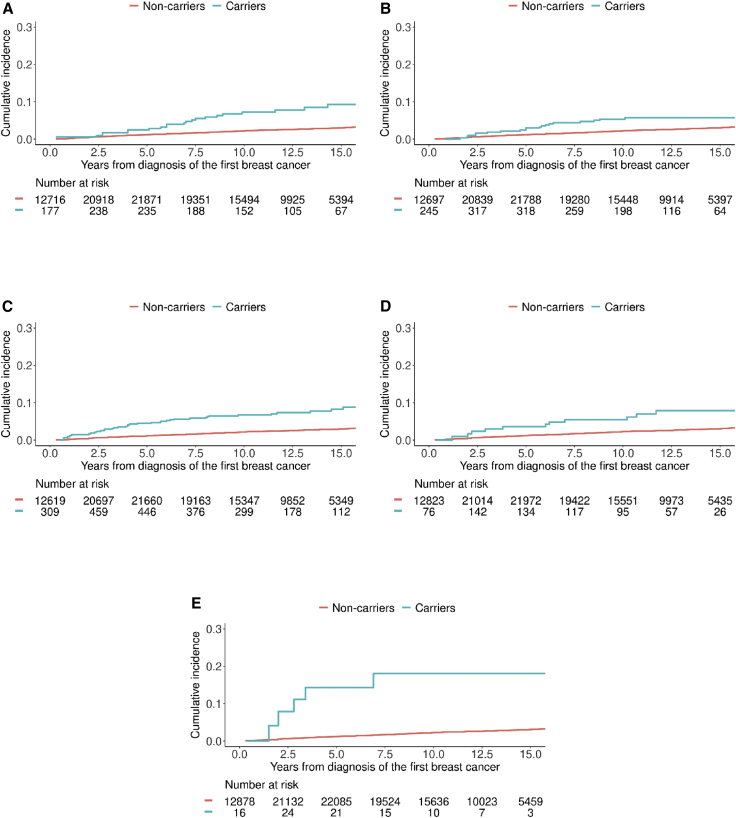
Evidence linking coding germline variants in breast cancer (BC)-susceptibility genes other than BRCA1, BRCA2, and CHEK2 with contralateral breast cancer (CBC) risk and breast cancer-specific survival (BCSS) is scarce. The aim of this study was to assess the association of protein-truncating variants (PTVs) and rare missense variants (MSVs) in nine known (ATM, BARD1, BRCA1, BRCA2, CHEK2, PALB2, RAD51C, RAD51D, and TP53) and 25 suspected BC-susceptibility genes with CBC risk and BCSS. Hazard ratios (HRs) and 95% confidence intervals (CIs) were estimated with Cox regression models. Analyses included 34,401 women of European ancestry diagnosed with BC, including 676 CBCs and 3,449 BC deaths; the median follow-up was 10.9 years. Subtype analyses were based on estrogen receptor (ER) status of the first BC. Combined PTVs and pathogenic/likely pathogenic MSVs in BRCA1, BRCA2, and TP53 and PTVs in CHEK2 and PALB2 were associated with increased CBC risk [HRs (95% CIs): 2.88 (1.70-4.87), 2.31 (1.39-3.85), 8.29 (2.53-27.21), 2.25 (1.55-3.27), and 2.67 (1.33-5.35), respectively]. The strongest evidence of association with BCSS was for PTVs and pathogenic/likely pathogenic MSVs in BRCA2 (ER-positive BC) and TP53 and PTVs in CHEK2 [HRs (95% CIs): 1.53 (1.13-2.07), 2.08 (0.95-4.57), and 1.39 (1.13-1.72), respectively, after adjusting for tumor characteristics and treatment]. HRs were essentially unchanged when censoring for CBC, suggesting that these associations are not completely explained by increased CBC risk, tumor characteristics, or treatment. There was limited evidence of associations of PTVs and/or rare MSVs with CBC risk or BCSS for the 25 suspected BC genes. The CBC findings are relevant to treatment decisions, follow-up, and screening after BC diagnosis.
将编码乳腺癌(BC)易感基因(除 BRCA1、BRCA2 和 CHEK2 以外)中的种系变异与对侧乳腺癌(CBC)风险和乳腺癌特异性生存(BCSS)联系起来的证据很少。本研究旨在评估 9 个已知(ATM、BARD1、BRCA1、BRCA2、CHEK2、PALB2、RAD51C、RAD51D 和 TP53)和 25 个可疑 BC 易感性基因中的蛋白质截断变异(PTV)和罕见错义变异(MSV)与 CBC 风险和 BCSS 的关联。使用 Cox 回归模型估计风险比(HR)和 95%置信区间(CI)。分析包括 34401 名被诊断患有 BC 的欧洲裔女性,其中 676 例 CBC 和 3449 例 BC 死亡;中位随访时间为 10.9 年。亚组分析基于首次 BC 的雌激素受体(ER)状态。BRCA1、BRCA2 和 TP53 中的复合 PTV 和致病性/可能致病性 MSV 以及 CHEK2 和 PALB2 中的 PTV 与增加的 CBC 风险相关[HR(95%CI):2.88(1.70-4.87),2.31(1.39-3.85),8.29(2.53-27.21),2.25(1.55-3.27)和 2.67(1.33-5.35)]。与 BCSS 关联最强的证据是 BRCA2(ER 阳性 BC)中的 PTV 和致病性/可能致病性 MSV 以及 CHEK2 中的 PTV[HR(95%CI):1.53(1.13-2.07),2.08(0.95-4.57)和 1.39(1.13-1.72),在调整肿瘤特征和治疗后]。当对 CBC 进行 censoring 时,HR 基本不变,表明这些关联不能完全用增加的 CBC 风险、肿瘤特征或治疗来解释。对于 25 个可疑的 BC 基因,与 CBC 风险或 BCSS 相关的 PTV 和/或罕见 MSV 的证据有限。CBC 结果与 BC 诊断后的治疗决策、随访和筛查有关。