Pongpan Surangrat, Thanatrakolsri Pantitcha, Vittaporn Supa, Khamnuan Patcharin, Daraswang Punnaphat
Faculty of Public Health, Thammasat University, Lampang 52190, Thailand.
Buriram Hospital, Muang, Buriram 31000, Thailand.
Trop Med Infect Dis. 2023 Feb 11;8(2):112. doi: 10.3390/tropicalmed8020112.
Leptospirosis is an important health problem in Thailand. People infected with leptospirosis may not have any mild symptoms, whereas some people have acute and severe illnesses. It is crucial to strengthen critical patients' diagnosis and treatment to prevent severe complications and reduce mortality. This study was performed to explore a set of parameters for the prediction of severe leptospirosis illness under routine clinical practice.
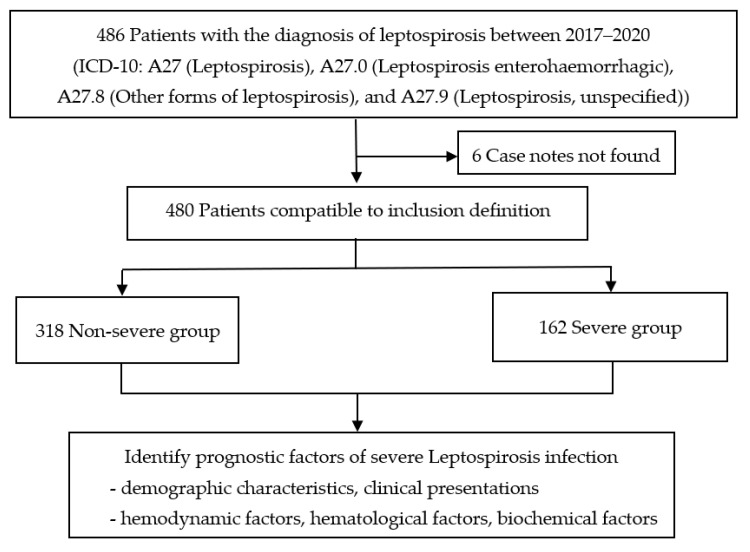
A case-control study was conducted in eight general hospitals in Thailand. Retrospective collection data were used, and key information was retrieved from inpatient medical files. Patients were grouped into two severity categories, severe and non-severe infection. Backward elimination was used to reach the final multivariate model.
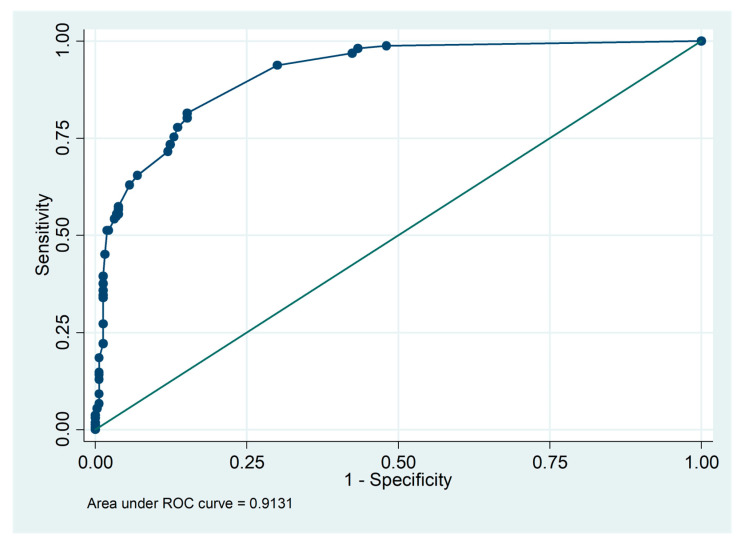
The six significant predictors identified in the study were hemoptysis (OR = 25.80, 95% CI 5.69, 116.92), hypotension (blood pressure < 90/60 mmHg) (OR = 17.33, 95% CI 6.89, 43.58), platelet count < 100,000/µL (OR = 8.37, 95% CI 4.65, 15.09), white blood cell count (WBC) > 14,000/µL (OR = 5.12, 95% CI 2.75, 9.51), hematocrit ≤ 30% (OR = 3.49, 95% CI 1.61, 7.57), and jaundice (OR = 3.11, 95% CI 1.71, 5.65). These predictors could correctly predict the severity of leptospirosis infection in 91.31% of the area under the receiver operation curve (AuROC).
The results of this study showed that severe leptospirosis infections have identifiable predictors. The predictors may be used to develop a scoring system for predicting the level of severity.
钩端螺旋体病在泰国是一个重要的健康问题。感染钩端螺旋体病的人可能没有任何轻微症状,而有些人则会出现急性和严重疾病。加强对重症患者的诊断和治疗以预防严重并发症并降低死亡率至关重要。本研究旨在探索一组在常规临床实践中预测重症钩端螺旋体病的参数。
在泰国的八家综合医院进行了一项病例对照研究。使用回顾性收集的数据,并从住院病历中检索关键信息。患者被分为两个严重程度类别,即严重感染和非严重感染。采用向后逐步回归法得出最终的多变量模型。
该研究确定的六个显著预测因素为咯血(比值比[OR]=25.80,95%置信区间[CI]为5.69,116.92)、低血压(血压<90/60 mmHg)(OR = 17.33,95% CI为6.89,43.58)、血小板计数<100,000/µL(OR = 8.37,95% CI为4.65,15.09)、白细胞计数(WBC)>14,000/µL(OR = 5.12,95% CI为2.75,9.51)、血细胞比容≤30%(OR = 3.49,95% CI为1.61,7.57)和黄疸(OR = 3.11,95% CI为1.71,5.65)。这些预测因素在受试者工作特征曲线下面积(AuROC)中能够正确预测钩端螺旋体病感染严重程度的比例为91.31%。
本研究结果表明,重症钩端螺旋体病感染有可识别的预测因素。这些预测因素可用于开发一个预测严重程度水平的评分系统。