Li Zewei, Wu Qi, Hong Pengfei, Tian Runzhi
Department of Psychology, School of Educational Science, Hunan Normal University, Changsha 410081, China.
Business Psychology, Business School, University of Leeds, Leeds LS2 9JT, UK.
Behav Sci (Basel). 2023 Jan 30;13(2):115. doi: 10.3390/bs13020115.
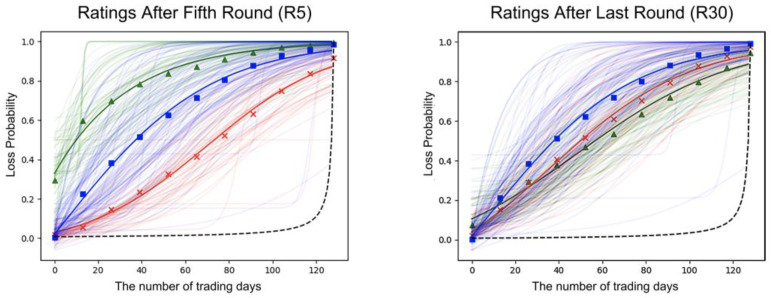
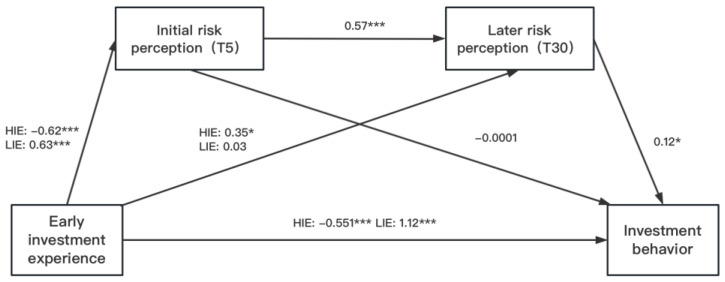
Due to the limitations of traditional financial analysis and the non-specificity of laboratory-based gambling tasks, it is difficult for researchers to isolate the independent contributions of risk perception and initial investment experience on novice investors' behaviors. Thus, it is still necessary for researchers to describe the process by which investment experience affects the investment behavior of novice investors by employing the methods of psychological experiments that can control and eliminate these confounding variables in the laboratory. The current study created a stock investment task based on the balloon analogy risk task to simulate the stock market in the laboratory. Two hundred and twenty Chinese college students were recruited as participants. Chain intermediary model analysis showed that initial investment experience influences a novice investor's behavior through risk perception. In addition, risk perception displayed the characteristics of continuity, in which the initial risk perception would affect later risk perception. These results indicate that investment experience does influence investment behavior. Different early investment experiences have correspondingly significant effects on the novice investors' investment behavior through their risk perception. The results also suggest that novice investors can partly correct the effects of their initial investment experience through continuous feedback from the stock market.
由于传统金融分析的局限性以及基于实验室的赌博任务的非特异性,研究人员很难分离风险感知和初始投资经验对新手投资者行为的独立影响。因此,研究人员仍然有必要通过采用能够在实验室中控制和消除这些混杂变量的心理实验方法,来描述投资经验影响新手投资者投资行为的过程。当前的研究基于气球模拟风险任务创建了一个股票投资任务,以在实验室中模拟股票市场。招募了220名中国大学生作为参与者。链式中介模型分析表明,初始投资经验通过风险感知影响新手投资者的行为。此外,风险感知表现出连续性的特征,其中初始风险感知会影响后来的风险感知。这些结果表明,投资经验确实会影响投资行为。不同的早期投资经验通过其风险感知对新手投资者的投资行为产生相应的显著影响。结果还表明,新手投资者可以通过股票市场的持续反馈部分纠正其初始投资经验的影响。