Li Yi-Fan, Byrne Suzanne, Yan Wei, Ewoldt Kathy B
Department of Interdisciplinary Learning and Teaching, The University of Texas at San Antonio, San Antonio, TX 78249, USA.
Behav Sci (Basel). 2023 Feb 7;13(2):138. doi: 10.3390/bs13020138.
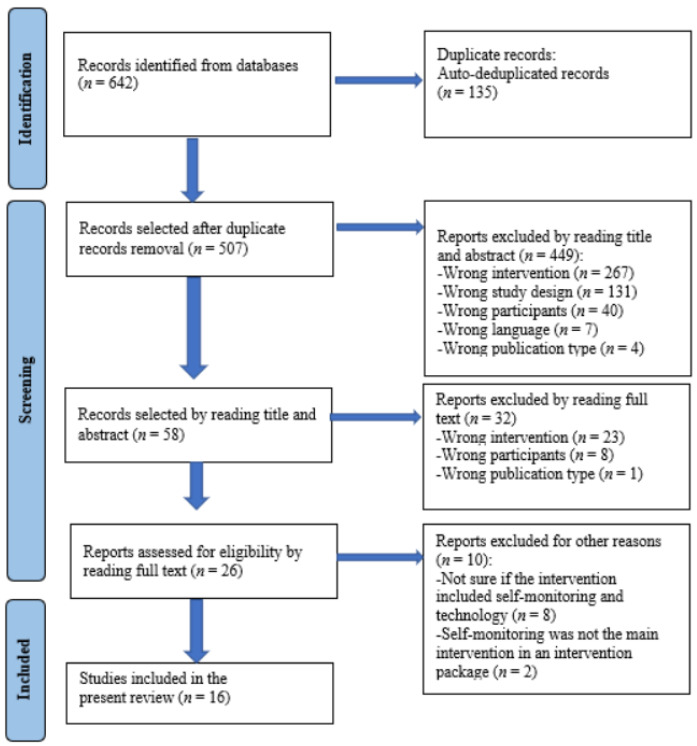
The ability to work and function independently is one of the most important skills for the achievement of ideal post-school outcomes. The use of self-monitoring to improve independence and/or reduce undesirable behaviors is an imperative need for individuals with autism. The purpose of this literature review was to examine technology-based self-monitoring interventions for individuals with autism. We used a four-step literature search process to identify studies for review. Online databases, such as ERIC, were used to search for studies. Using four inclusion criteria and PRISMA guidelines for the selection and screening process, we identified 16 studies that met the inclusion criteria. We used coding to summarize the following information from the included studies: participants who met the inclusion criteria, primary dependent variable, primary intervention, and study design. The results of the review revealed three primary functions of technology performed in self-monitoring. The included studies targeted on-task behaviors, skill acquisition, and socially relevant behaviors as primary dependent variables. The findings of the review suggested that future research could use self-monitoring interventions to support an adult with autism in employment settings and that a self-monitoring intervention could be tailored by considering individual differences.
独立工作和发挥功能的能力是实现理想的毕业后成果的最重要技能之一。对于自闭症患者而言,运用自我监控来提高独立性和/或减少不良行为是一项迫切需求。本文献综述的目的是考察针对自闭症患者的基于技术的自我监控干预措施。我们采用了四步文献检索流程来确定可供综述的研究。使用诸如教育资源信息中心(ERIC)等在线数据库来检索研究。通过四项纳入标准以及用于选择和筛选过程的系统评价和Meta分析的首选报告项目(PRISMA)指南,我们确定了16项符合纳入标准的研究。我们运用编码从纳入研究中总结以下信息:符合纳入标准的参与者、主要因变量、主要干预措施以及研究设计。综述结果揭示了技术在自我监控中发挥的三个主要功能。纳入研究将任务相关行为、技能习得以及社会相关行为作为主要因变量。综述结果表明,未来的研究可以运用自我监控干预措施来支持成年自闭症患者在就业环境中的发展,并且可以通过考虑个体差异来定制自我监控干预措施。