Masłowska Katarzyna, Redkiewicz Patrycja, Halik Paweł Krzysztof, Witkowska Ewa, Tymecka Dagmara, Walczak Rafał, Choiński Jarosław, Misicka Aleksandra, Gniazdowska Ewa
Centre of Radiochemistry and Nuclear Chemistry, Institute of Nuclear Chemistry and Technology, 03-195 Warsaw, Poland.
Department of Neuropeptides, Mossakowski Medical Research Institute Polish Academy of Sciences, 02-106 Warsaw, Poland.
Biomedicines. 2023 Feb 15;11(2):564. doi: 10.3390/biomedicines11020564.
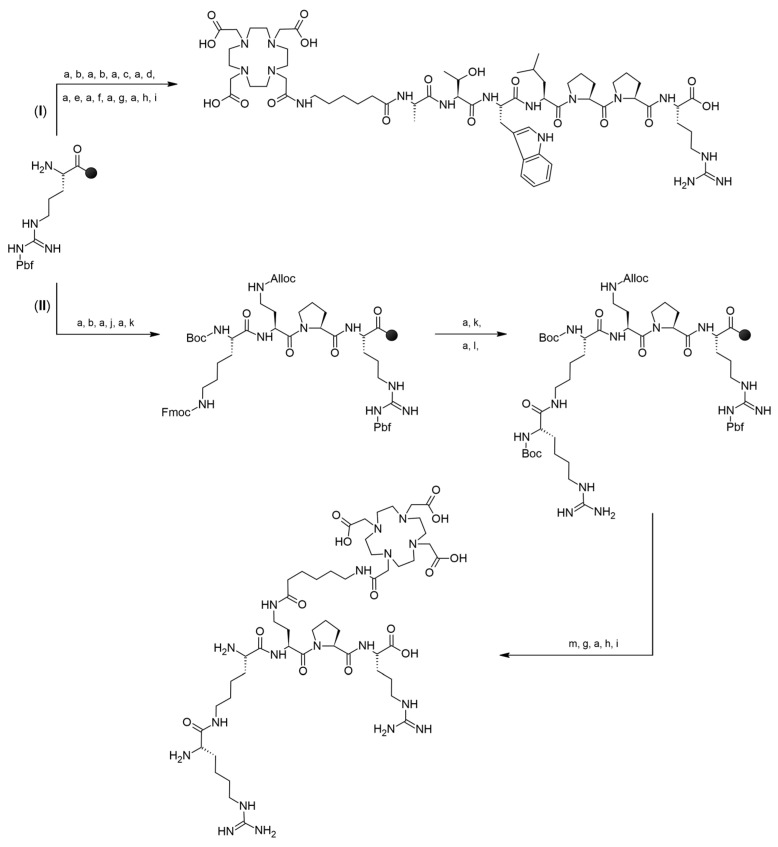
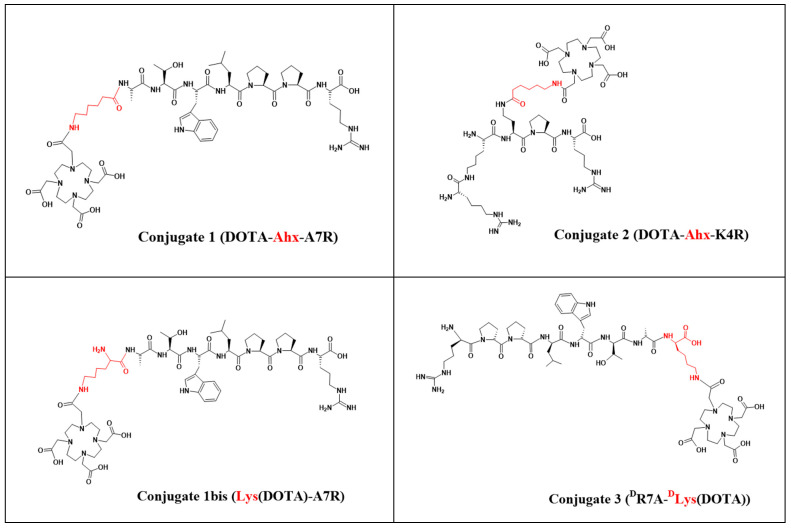
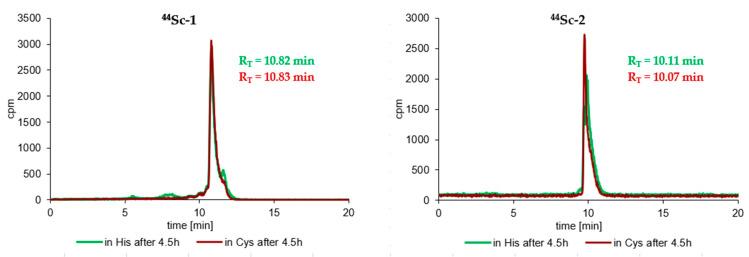
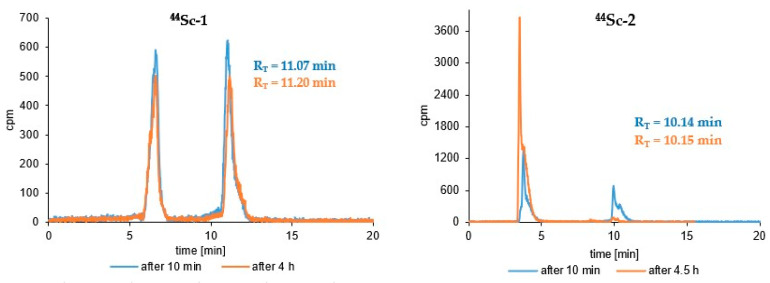
Pathological angiogenesis, resulting from an imbalance between anti- and pro-angiogenic factors, plays a pivotal role in tumor growth, development and metastasis. The inhibition of the angiogenesis process by the VEGF/VEGFR-2/NRP-1 pathway raises interest in the search for such interaction inhibitors for the purpose of the early diagnosis and treatment of angiogenesis-dependent diseases. In this work we designed and tested peptide-based radiocompounds that selectively bind to the neuropilin-1 co-receptor and prevent the formation of the pro-angiogenic VEGF-A/NRP-1 complex. Three biomolecules, A7R and retro-inverso R7A peptides, and the branched peptidomimetic Lys(hArg)-Dab-Pro-Arg (K4R), conjugated with macrocyclic chelator through two linkers' types, were labeled with theranostic scandium-44 radionuclide, and studied in vitro as potential targeted radiopharmaceuticals. ELISA (enzyme-linked immunosorbent assay) studies showed no negative effect of the introduced biomolecules' changes and high NRP-1 affinity in the case of A7R- and K4R-radiocompounds and a lack affinity for R7A-radiocompounds. All radiopeptides showed a hydrophilic nature as well as high stability against ligand exchange reactions in cysteine/histidine solutions. Unfortunately, all radiocompounds showed unsatisfactory nano-scale stability in human serum, especially for use as therapeutic radioagents. Further work is ongoing and focused on the search for angiogenesis inhibitors that are more human serum stable.
病理性血管生成是由抗血管生成因子和促血管生成因子之间的失衡引起的,在肿瘤生长、发展和转移中起关键作用。通过VEGF/VEGFR-2/NRP-1途径抑制血管生成过程,引发了人们对寻找此类相互作用抑制剂的兴趣,以用于血管生成依赖性疾病的早期诊断和治疗。在这项工作中,我们设计并测试了基于肽的放射性化合物,这些化合物选择性地与神经纤毛蛋白-1共受体结合,并阻止促血管生成的VEGF-A/NRP-1复合物的形成。三种生物分子,A7R和反向R7A肽,以及通过两种连接子类型与大环螯合剂共轭的支链拟肽Lys(hArg)-Dab-Pro-Arg (K4R),用治疗诊断用钪-44放射性核素进行标记,并作为潜在的靶向放射性药物进行体外研究。ELISA(酶联免疫吸附测定)研究表明,引入的生物分子变化没有负面影响,A7R-和K4R-放射性化合物对NRP-1具有高亲和力,而R7A-放射性化合物缺乏亲和力。所有放射性肽都表现出亲水性,并且在半胱氨酸/组氨酸溶液中对配体交换反应具有高稳定性。不幸的是,所有放射性化合物在人血清中都表现出不令人满意的纳米级稳定性,特别是用作治疗性放射性药物时。进一步的工作正在进行中,并专注于寻找在人血清中更稳定的血管生成抑制剂。