Chiusole Benedetta, Tortorelli Ilaria, Galiano Antonella, Murtas Fabio, Ahcene-Djaballah Selma, Tierno Giuseppina, Bergo Eleonora, Banzato Alberto, Gatti Maura, Di Maggio Antonio, Sergi Giuseppe, Rastrelli Marco, Sbaraglia Marta, Zagonel Vittorina, Brunello Antonella
Oncology 1, Department of Oncology, Istituto Oncologico Veneto IOV-IRCCS, 35128 Padova, Italy.
Department of Surgery, Oncology and Gastroenterology (DISCOG), University of Padua, 35128 Padua, Italy.
Cancers (Basel). 2023 Feb 7;15(4):1043. doi: 10.3390/cancers15041043.
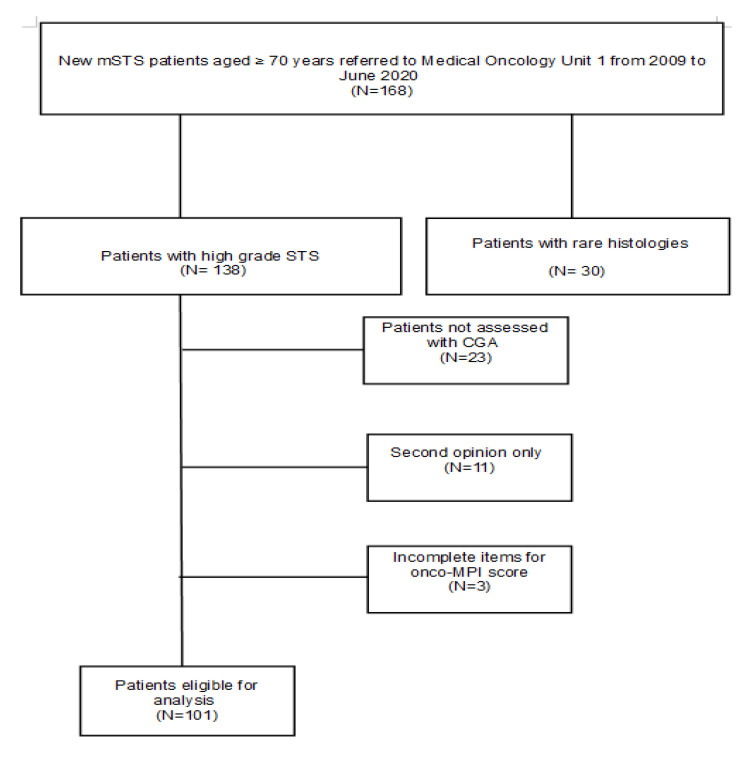
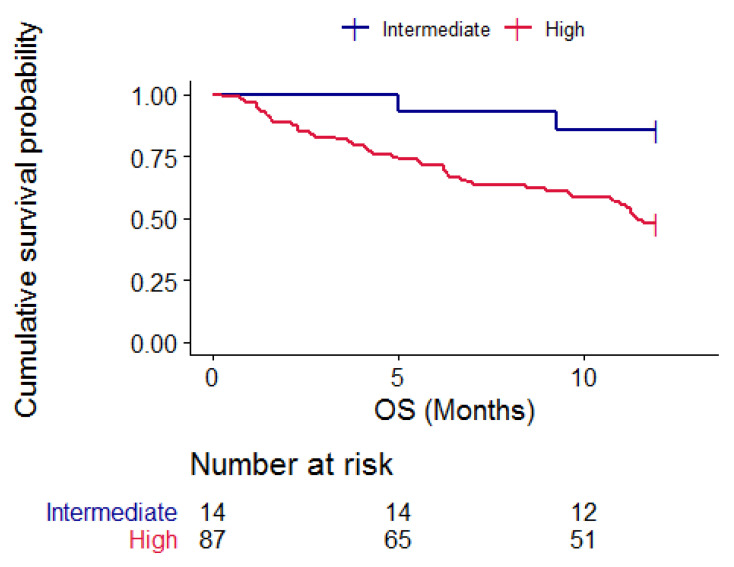
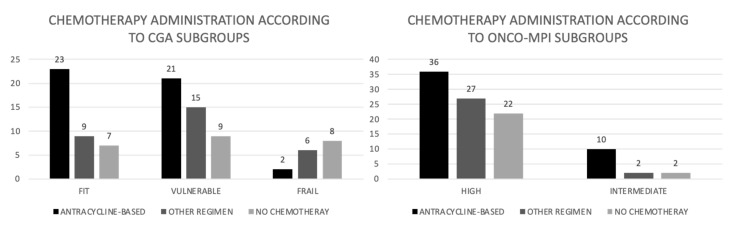
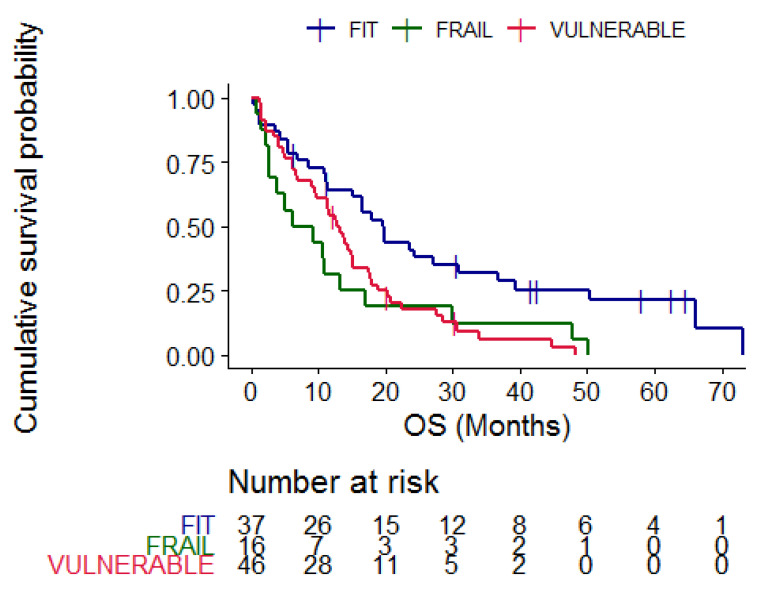
Incidences of soft tissue sarcomas (STS) steadily increase with age. Yet, despite the high prevalence in advanced age, older patients (pts) are underrepresented in sarcoma clinical trials and evidence-based guidelines for chemotherapy are lacking. International oncological societies suggest using geriatric tools to evaluate older patients with cancer to optimise treatment indication. Comprehensive geriatric assessment (CGA) is a multidimensional assessment of older subjects, based on which pts can be classified as fit, vulnerable or frail. Onco-MPI (multidimensional prognostic index) is a CGA-based score which also considers tumour characteristics, classifying pts into three risk groups of death at one year: high-risk, intermediate-risk and low-risk. This is a single-centre retrospective study which aims at describing real-word management and outcomes of older pts with advanced stage STS and at assessing the ability of CGA and onco-MPI to predict survival in these pts. Consecutive pts with advanced stage STS aged 70 years or older and treated at the Istituto Oncologico Veneto from January 2009 to June 2020 were retrieved from a prospectively maintained database. Pts' demographics, CGA assessments and tumour characteristics were analysed. Statistical analysis was performed with R version 3.4.3 Out of 101 pts, with a median age of 77 years, 76 received chemotherapy (75.3%), which was anthracycline-based for 46 pts (60.5%). Anthracyclines were used in a higher proportion in fit pts (58.9% fit vs. 45.1% vulnerable vs. 12.5% frail pts). Frail pts and pts in the onco-MPI high-risk group experienced a higher rate of chemotherapy-related toxicities. Median OS was 13.8 months (95% CI 11.3-17.7 months). According to CGA, the median OS was 19.53 months (95% CI 15.23-36.8) for fit pts, 12.83 months (95% CI 9.7-17.5) for vulnerable and 7.75 months (95% CI 2.73-30) for frail pts ( = 0.005). Onco-MPI confirmed a predictive value for 1-year survival with intermediate risk pts not reaching a median OS at 1 year, and high-risk pts having a median one-year OS of 11.5 months (95%CI 9.7-NA), = 0.02. In multivariate analysis, onco-MPI and CGA were associated with survival (high risk onco-MPI: HR 5.5, 95%CI 1.25-24.7 = 0.02; fitness at CGA HR 0.552 95% 0.314-0.973; = 0.040) as well as chemotherapy use (HR 0.24, 95% CI 0.11-0.51, < 0.005). Both CGA and onco-MPI retain prognostic value for survival in pts with metastatic STS. Pts frail/vulnerable at CGA and pts within the onco-MPI high risk category should be offered an oncogeriatric management approach in order to optimise treatment-related survival and reduce toxicity.
软组织肉瘤(STS)的发病率随年龄稳步上升。然而,尽管老年患者中STS的患病率很高,但老年患者在肉瘤临床试验中的代表性不足,且缺乏基于证据的化疗指南。国际肿瘤学会建议使用老年评估工具来评估老年癌症患者,以优化治疗指征。综合老年评估(CGA)是对老年受试者的多维度评估,据此可将患者分为健康、脆弱或衰弱三类。肿瘤多维度预后指数(Onco-MPI)是基于CGA的评分,它还考虑肿瘤特征,将患者分为一年死亡风险的三个组:高风险、中风险和低风险。这是一项单中心回顾性研究,旨在描述老年晚期STS患者的实际治疗管理和结局,并评估CGA和Onco-MPI预测这些患者生存的能力。从一个前瞻性维护的数据库中检索出2009年1月至2020年6月在威尼斯肿瘤研究所接受治疗的70岁及以上晚期STS连续患者。分析了患者的人口统计学、CGA评估和肿瘤特征。使用R 3.4.3版本进行统计分析。在101例患者中,中位年龄为77岁,76例接受了化疗(75.3%),其中46例(60.5%)接受了以蒽环类药物为基础的化疗。蒽环类药物在健康患者中的使用比例更高(健康患者中为58.9%,脆弱患者中为45.1%,衰弱患者中为12.5%)。衰弱患者和Onco-MPI高风险组的患者化疗相关毒性发生率更高。中位总生存期为13.8个月(95%CI 11.3 - 17.7个月)。根据CGA,健康患者的中位总生存期为19.53个月(95%CI 15.23 - 36.8),脆弱患者为12.83个月(95%CI 9.7 - 17.5),衰弱患者为7.75个月(95%CI 2.73 - 30)(P = 0.005)。Onco-MPI证实了对1年生存的预测价值,中风险患者1年未达到中位总生存期,高风险患者1年中位总生存期为11.5个月(95%CI 9.7 - NA),P = 0.02。在多变量分析中,Onco-MPI和CGA与生存相关(Onco-MPI高风险:HR 5.5,95%CI 1.25 - 24.7,P = 0.02;CGA健康HR 0.552,95% 0.314 - 0.973;P = 0.040)以及化疗使用情况(HR 0.24,95%CI 0.11 - 0.51,P < 0.005)。CGA和Onco-MPI对转移性STS患者的生存均保留预后价值。CGA评估为脆弱/衰弱的患者以及Onco-MPI高风险类别的患者应采用肿瘤老年管理方法,以优化与治疗相关的生存并降低毒性。