Theus-Steinmann Carlo, Schelling Georg, Heesen Philip, Breitenstein Stefan, Scaglioni Mario F, Fuchs Bruno
Swiss Sarcoma Network (SSN), Luzerner Kantonsspital (LUKS), Kantonsspital Winterthur (KSW), 6000 Luzern, Switzerland.
Faculty of Health Sciences and Medicine, University of Luzern, 6002 Luzern, Switzerland.
Cancers (Basel). 2023 Feb 18;15(4):1305. doi: 10.3390/cancers15041305.
To meet the challenges of the precision medicine era, quality assessment of shared sarcoma care becomes pivotal. The MDT approach is the most important parameter for a successful outcome. Of all MDT disciplines, surgery is the key step to rendering sarcoma patients disease free; therefore, defining its spectrum is critical. To the best of the authors' knowledge, a comprehensive interoperable digital platform to assess the scope of sarcoma surgery in its full complexity is lacking.
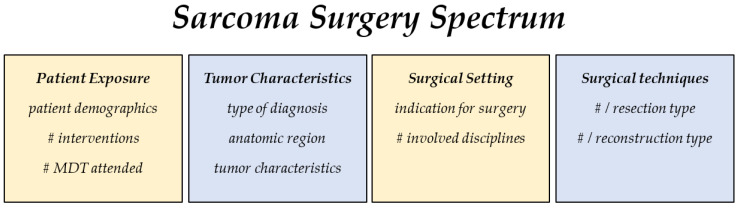
An interoperable digital platform on sarcoma surgery has been created to assess the clinical exposure, tumor characteristics, and surgical settings and techniques applied for both resections and reconstructions of sarcomas.
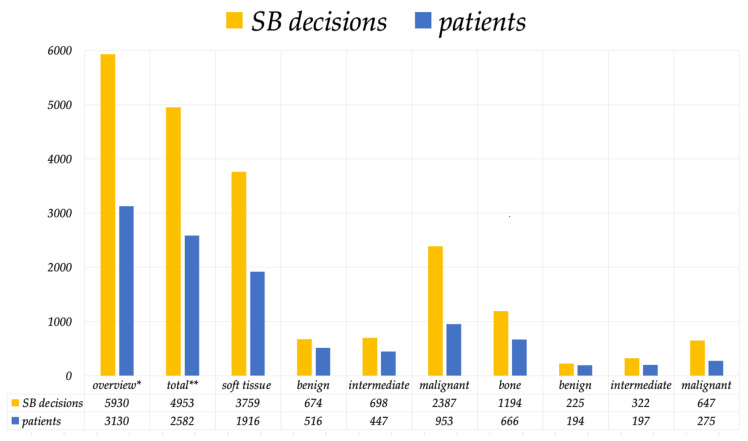
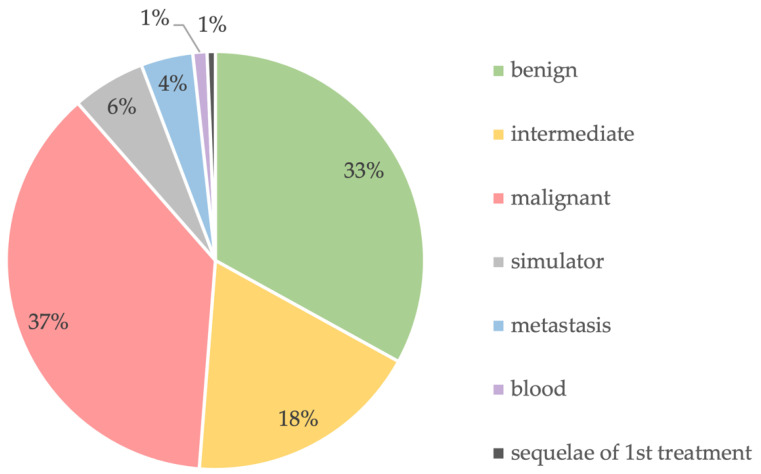
The surgical exposure of an individual surgeon over time served as a pilot. Over the study period of 10 years, there were 723 sarcoma board/MDT meetings discussing 3130 patients. A total of 1094 patients underwent 1250 surgical interventions on mesenchymal tumors by one single sarcoma surgeon. These included 615 deep soft tissue tumors (197 benign, 102 intermediate, 281 malignant, 27 simulator, 7 metastasis, 1 blood); 116 superficial soft tissue tumors (45 benign, 12 intermediate, 40 malignant, 18 simulator, 1 blood); and 519 bone tumors (129 benign, 112 intermediate, 182 malignant, 18 simulator, 46 metastasis, 14 blood, and 18 sequelae of first treatment). Detailed types of resections and reconstructions were analyzed.
An interoperable digital data platform on sarcoma surgery with transparent real-time descriptive analytics is feasible and enables large-scale definition of the spectrum of sarcoma surgery to meet the challenges of sarcoma precision care in the future.
为应对精准医学时代的挑战,肉瘤共享护理的质量评估变得至关重要。多学科团队(MDT)方法是取得成功结果的最重要参数。在所有MDT学科中,手术是使肉瘤患者无病的关键步骤;因此,界定其范围至关重要。据作者所知,缺乏一个全面的可互操作数字平台来全面评估肉瘤手术的范围。
创建了一个关于肉瘤手术的可互操作数字平台,以评估临床暴露情况、肿瘤特征以及用于肉瘤切除和重建的手术设置和技术。
一名外科医生随时间的手术暴露情况作为试点。在10年的研究期间,共召开了723次肉瘤委员会/MDT会议,讨论了3130例患者。一名肉瘤外科医生对1094例患者的间充质肿瘤进行了1250次手术干预。其中包括615例深部软组织肿瘤(197例良性、102例中间型、281例恶性、27例模拟病例、7例转移瘤、1例血液相关);116例浅表软组织肿瘤(45例良性、12例中间型、40例恶性、18例模拟病例、1例血液相关);以及519例骨肿瘤(129例良性、112例中间型、182例恶性、18例模拟病例、46例转移瘤、14例血液相关以及18例首次治疗后遗症)。对详细的切除和重建类型进行了分析。
一个具有透明实时描述性分析功能的肉瘤手术可互操作数字数据平台是可行的,能够大规模界定肉瘤手术范围,以应对未来肉瘤精准护理的挑战。