Environment Department, Institute of Science and High Technology and Environmental Sciences, Graduate University of Advanced Technology, Kerman 7631818356, Iran.
Research Center of Tropical and Infectious Diseases, Kerman University of Medical Sciences, Kerman 7616913555, Iran.
Biosensors (Basel). 2023 Feb 8;13(2):244. doi: 10.3390/bios13020244.
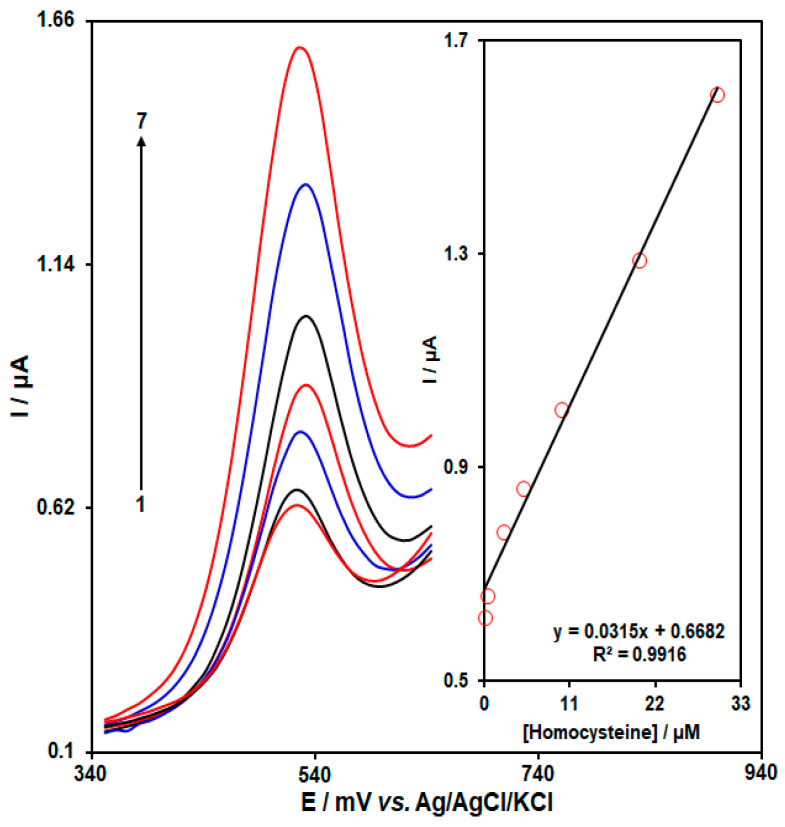
The current attempt was made to detect the amino acid homocysteine (HMC) using an electrochemical aptasensor. A high-specificity HMC aptamer was used to fabricate an Au nanostructured/carbon paste electrode (Au-NS/CPE). HMC at high blood concentration (hyperhomocysteinemia) can be associated with endothelial cell damage leading to blood vessel inflammation, thereby possibly resulting in atherogenesis leading to ischemic damage. Our proposed protocol was to selectively immobilize the aptamer on the gate electrode with a high affinity to the HMC. The absence of a clear alteration in the current due to common interferants (methionine (Met) and cysteine (Cys)) indicated the high specificity of the sensor. The aptasensor was successful in sensing HMC ranging between 0.1 and 30 μM, with a narrow limit of detection (LOD) as low as 0.03 μM.
本研究旨在利用电化学生物传感器检测氨基酸同型半胱氨酸(HMC)。采用高特异性 HMC 适体制备金纳米结构/碳糊电极(Au-NS/CPE)。高血液浓度(高同型半胱氨酸血症)的 HMC 可导致内皮细胞损伤,引发血管炎症,从而可能导致动脉粥样硬化导致缺血损伤。我们的方案是通过与 HMC 高亲和力将适体选择性地固定在栅极电极上。由于常见干扰物(蛋氨酸(Met)和半胱氨酸(Cys))电流没有明显变化,表明传感器具有高特异性。该适体传感器能够在 0.1 至 30 μM 范围内成功检测 HMC,检测限(LOD)低至 0.03 μM。