Department of Immunology, Genetics and Pathology, Uppsala University, SE-751 85 Uppsala, Sweden.
Int J Mol Sci. 2023 Feb 13;24(4):3762. doi: 10.3390/ijms24043762.
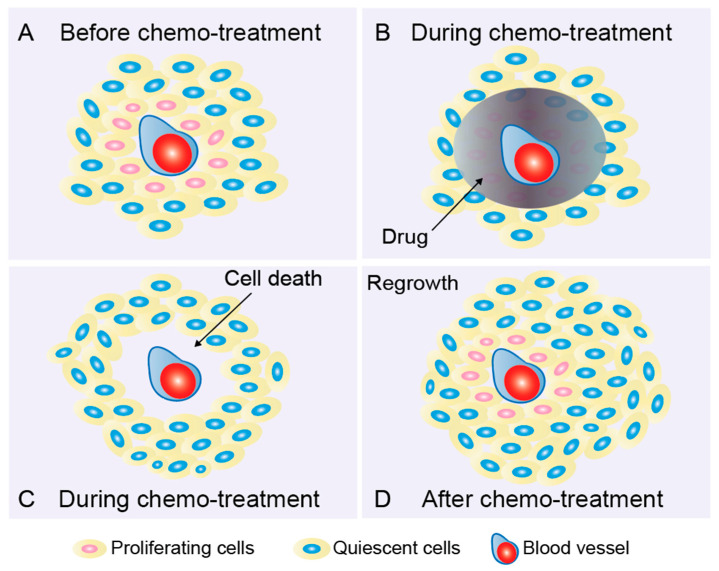
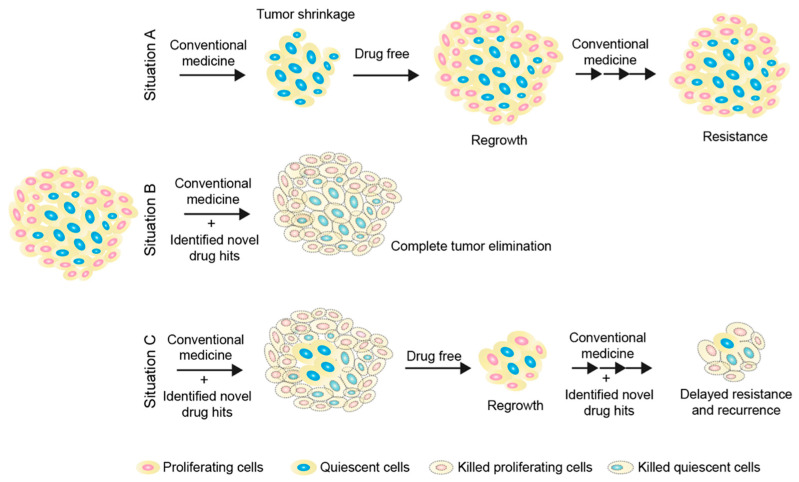
Quiescent cancer cells (QCCs) are nonproliferating cells arrested in the G0 phase, characterized by ki67 and p27. QCCs avoid most chemotherapies, and some treatments could further lead to a higher proportion of QCCs in tumors. QCCs are also associated with cancer recurrence since they can re-enter a proliferative state when conditions are favorable. As QCCs lead to drug resistance and tumor recurrence, there is a great need to understand the characteristics of QCCs, decipher the mechanisms that regulate the proliferative-quiescent transition in cancer cells, and develop new strategies to eliminate QCCs residing in solid tumors. In this review, we discussed the mechanisms of QCC-induced drug resistance and tumor recurrence. We also discussed therapeutic strategies to overcome resistance and relapse by targeting QCCs, including (i) identifying reactive quiescent cancer cells and removing them via cell-cycle-dependent anticancer reagents; (ii) modulating the quiescence-to-proliferation switch; and (iii) eliminating QCCs by targeting their unique features. It is believed that the simultaneous co-targeting of proliferating and quiescent cancer cells may ultimately lead to the development of more effective therapeutic strategies for the treatment of solid tumors.
静止期癌细胞(QCCs)是处于 G0 期的非增殖细胞,其特征是 ki67 和 p27 阳性。QCCs 逃避大多数化疗药物,一些治疗方法可能会导致肿瘤中 QCCs 的比例进一步升高。QCCs 还与癌症复发有关,因为当条件有利时,它们可以重新进入增殖状态。由于 QCCs 导致耐药性和肿瘤复发,因此非常有必要了解 QCCs 的特征,解析调节癌细胞增殖-静止状态转换的机制,并开发新的策略来消除实体瘤中的 QCCs。在这篇综述中,我们讨论了 QCC 诱导的耐药性和肿瘤复发的机制。我们还讨论了通过针对 QCCs 来克服耐药性和复发的治疗策略,包括:(i)通过细胞周期依赖性抗癌试剂识别反应性静止期癌细胞并将其去除;(ii)调节静止-增殖转换;(iii)通过靶向 QCCs 的独特特征来消除 QCCs。人们相信,同时针对增殖期和静止期癌细胞进行共同靶向治疗,可能最终会为治疗实体瘤开发出更有效的治疗策略。