Division of Metabolism, Department of Internal Medicine, Faculty of Medicine, University of Debrecen, H-4032 Debrecen, Hungary.
Department of Emergency Medicine, Faculty of Medicine, University of Debrecen, H-4032 Debrecen, Hungary.
Int J Mol Sci. 2023 Feb 18;24(4):4115. doi: 10.3390/ijms24044115.
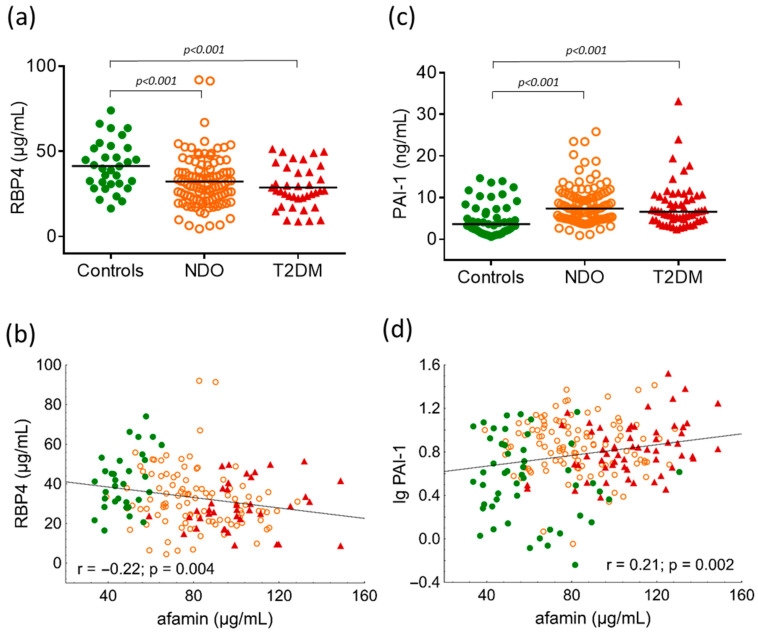
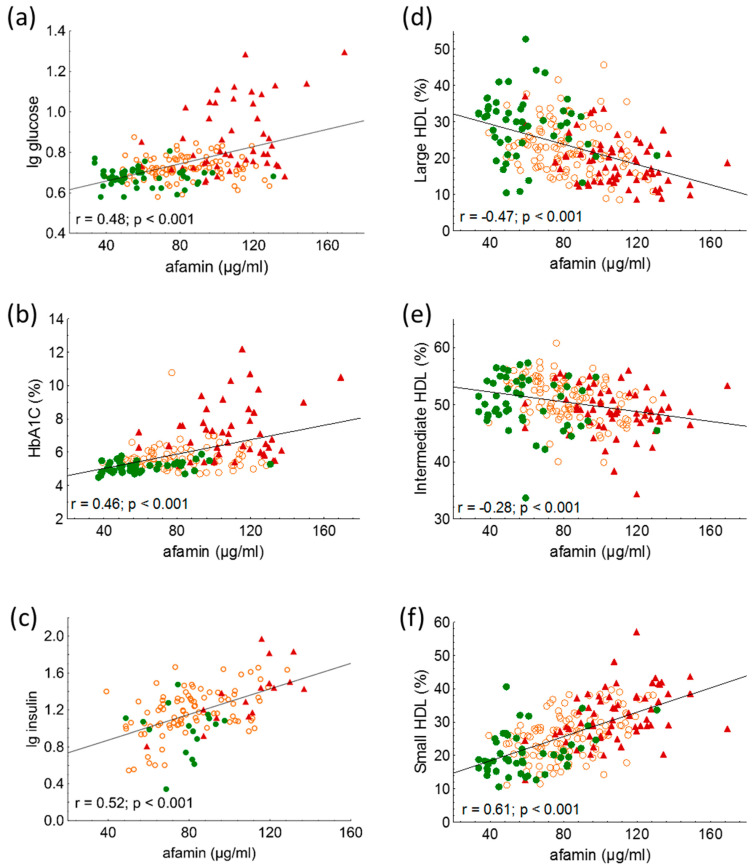
Altered organokine expression contributes to increased cardiometabolic risk in obesity. Our aim was to evaluate the associations of serum afamin with glucose homeostasis, atherogenic dyslipidemia, and other adipokines in severe obesity to clarify the early metabolic alterations. 106 non-diabetic obese (NDO) subjects and 62 obese patients with type 2 diabetes matched for age, gender, and body mass index (BMI) were enrolled in this study. We compared their data with 49 healthy, lean controls. Serum afamin and retinol-binding protein 4 (RBP4), as well as plasma plasminogen activator inhibitor-1 (PAI-1), were measured with ELISA, and lipoprotein subfractions were analyzed using Lipoprint gel electrophoresis. Afamin and PAI-1 found to be significantly higher in the NDO and T2M group ( < 0.001 and < 0.001, respectively) than in the controls. In contrast, RBP4 was unexpectedly lower in the NDO and T2DM group compared to controls ( < 0.001). Afamin showed negative correlations with mean LDL size and RBP4, but positive correlations with anthropometric, glucose/lipid parameters, and PAI-1 in both the overall patients and the in NDO + T2DM groups. BMI, glucose, intermediate HDL, and small HDL were predictors of afamin. Afamin may serve as a biomarker for the severity of cardiometabolic disturbances in obesity. The complexity of organokine patterns in NDO subjects draws attention to the diverse spectrum of obesity-related comorbidities.
器官因子表达改变导致肥胖患者心血管代谢风险增加。我们的目的是评估血清 afamin 与葡萄糖稳态、动脉粥样硬化性血脂异常和其他肥胖相关脂肪因子的关系,以阐明早期代谢改变。本研究纳入了 106 例非糖尿病肥胖(NDO)患者和 62 例年龄、性别和体重指数(BMI)相匹配的 2 型糖尿病肥胖患者,并与 49 例健康瘦对照者进行比较。我们使用 ELISA 检测血清 afamin 和视黄醇结合蛋白 4(RBP4),并使用 Lipoprint 凝胶电泳分析脂蛋白亚组分。结果显示,NDO 和 T2M 组的 afamin 和 PAI-1 明显高于对照组( < 0.001 和 < 0.001),而 RBP4 则低于对照组( < 0.001)。此外,afamin 与平均 LDL 大小和 RBP4 呈负相关,与体重指数、血糖/脂质参数和 PAI-1 呈正相关,这在所有患者和 NDO + T2DM 组中均有体现。BMI、血糖、中间 HDL 和小 HDL 是 afamin 的预测因子。Afamin 可能是肥胖患者心血管代谢紊乱严重程度的生物标志物。NDO 患者器官因子模式的复杂性引起了对肥胖相关合并症多样性的关注。