Kaale Bertel Rune, McArthur Tony J, Barbosa Maria H, Freeman Michael D
Firda Medical Center AS, 6823 Sandane, Norway.
CAPHRI School for Public Health and Primary Care, Faculty of Health, Medicine, and Life Sciences, Maastricht University, 6211 LM Maastricht, The Netherlands.
J Clin Med. 2023 Feb 12;12(4):1469. doi: 10.3390/jcm12041469.
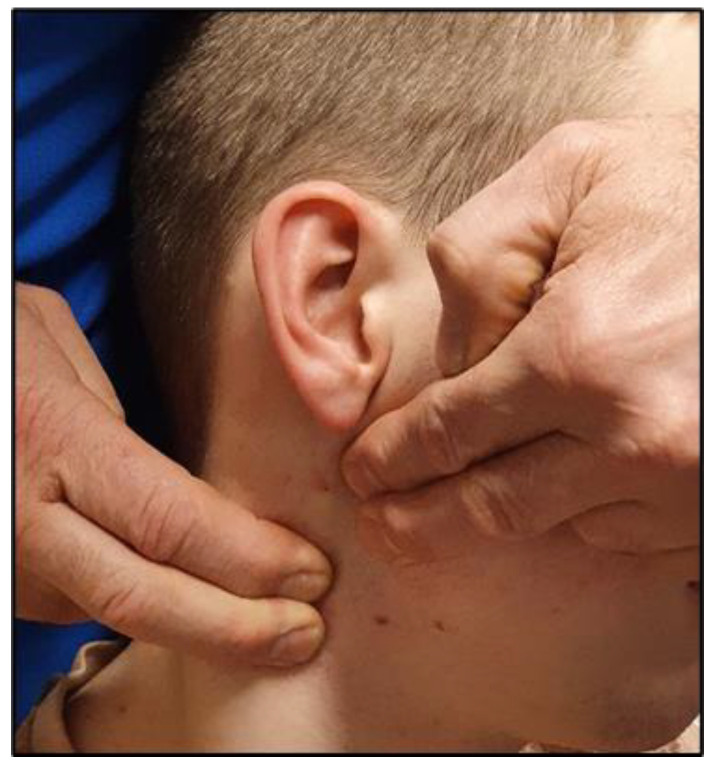
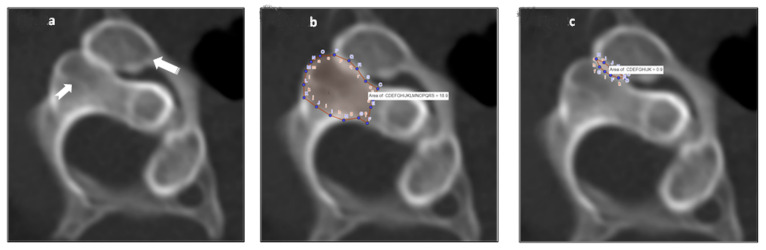
Post-traumatic rotational instability at the atlanto-axial (C1-2) joint is difficult to assess, much less quantify, due to the orientation and motion plane of the joint. Prior investigations have demonstrated that a dynamic axial CT scan, during which the patient maximally rotates the head right and left, can be used to evaluate and quantify the amount of residual overlap between the inferior articulating facet of C1 and the superior facet of C2, as an index of ligamentous laxity at the joint. We have previously demonstrated that a novel orthopedic test of rotational instability, the atlas-axis rotational test (A-ART), may have utility in identifying patients with imaging evidence of upper cervical ligament injury. In the present investigation, we assessed the correlation between a positive A-ART and a CT scan assessment of the relative quantity of residual C1-2 overlap, as a percent of the superior articulating facet surface area of C2. A retrospective review was conducted of the records of consecutive patients presenting to a physical therapy and rehabilitation clinic, over a 5-year period (2015-20) for chronic head and neck pain after whiplash trauma. The primary inclusion criteria were that the patient had undergone both a clinical evaluation with A-ART and a dynamic axial CT to evaluate for C1-2 residual facet overlap at maximum rotation. The records for a total of 57 patients (44 female/13 male) were identified who fit the selection criteria, and among these, there were 43 with a positive A-ART (i.e., "cases") and 14 with a negative A-ART (i.e., "controls). The analysis demonstrated that a positive A-ART was highly predictive of decreased residual C1-2 facet overlap: the average overlap area among the cases was approximately one-third that of the control group (on the left, 10.7% versus 29.1%, and 13.6% versus 31.0% on the right). These results suggest that a positive A-ART is a reliable indicator of underlying rotational instability at C1-2 in patients with chronic head and neck symptoms following whiplash trauma.
由于寰枢(C1-2)关节的方向和运动平面,创伤后该关节的旋转不稳定难以评估,更难以量化。先前的研究表明,动态轴向CT扫描可用于评估和量化C1下关节面与C2上关节面之间残余重叠的量,在扫描过程中患者最大程度地左右转动头部,以此作为关节韧带松弛的指标。我们之前已经证明,一种用于检测旋转不稳定的新型骨科检查方法——寰枢旋转试验(A-ART),可能有助于识别有上颈椎韧带损伤影像学证据的患者。在本研究中,我们评估了A-ART阳性与CT扫描评估的C1-2残余重叠相对量(占C2上关节面表面积的百分比)之间的相关性。我们对一家物理治疗与康复诊所5年期间(2015 - 2020年)因挥鞭样损伤后出现慢性头颈疼痛的连续患者记录进行了回顾性分析。主要纳入标准是患者既接受了A-ART临床评估,又接受了动态轴向CT检查以评估最大旋转时C1-2关节面的残余重叠情况。共识别出57例符合选择标准的患者记录(44例女性/13例男性),其中43例A-ART阳性(即“病例组”),14例A-ART阴性(即“对照组”)。分析表明,A-ART阳性高度预示着C1-2关节面残余重叠减少:病例组的平均重叠面积约为对照组的三分之一(左侧为10.7%对29.1%,右侧为13.6%对31.0%)。这些结果表明,A-ART阳性是挥鞭样损伤后出现慢性头颈症状患者C1-2潜在旋转不稳定的可靠指标。