Tenbergen Carlijn J A, Ruhm Loreen, Ypma Sjoerd, Heerschap Arend, Henning Anke, Scheenen Tom W J
Department of Medical Imaging, Radboud University Medical Center, 6525 GA Nijmegen, The Netherlands.
High-Field MR Center, Max Planck Institute for Biological Cybernetics, 72076 Tübingen, Germany.
Life (Basel). 2023 Jan 19;13(2):282. doi: 10.3390/life13020282.
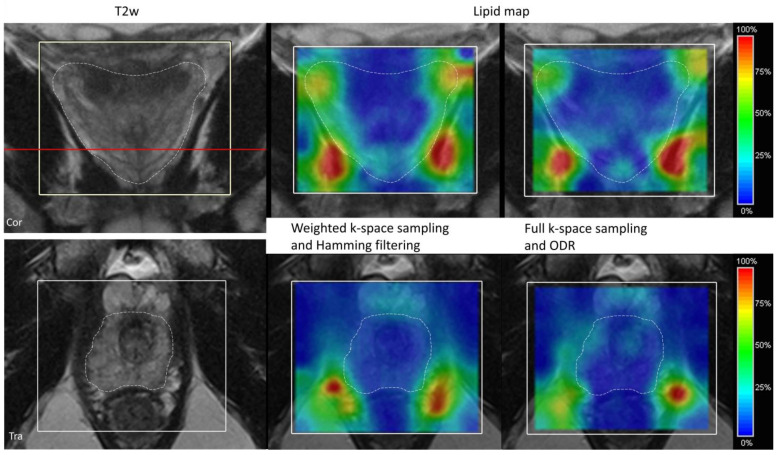
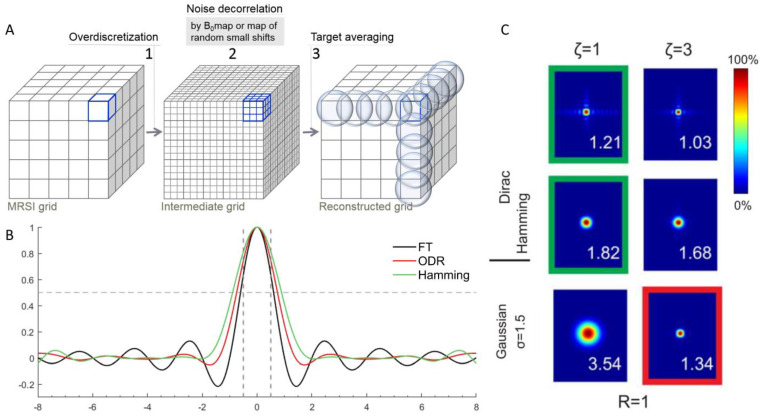
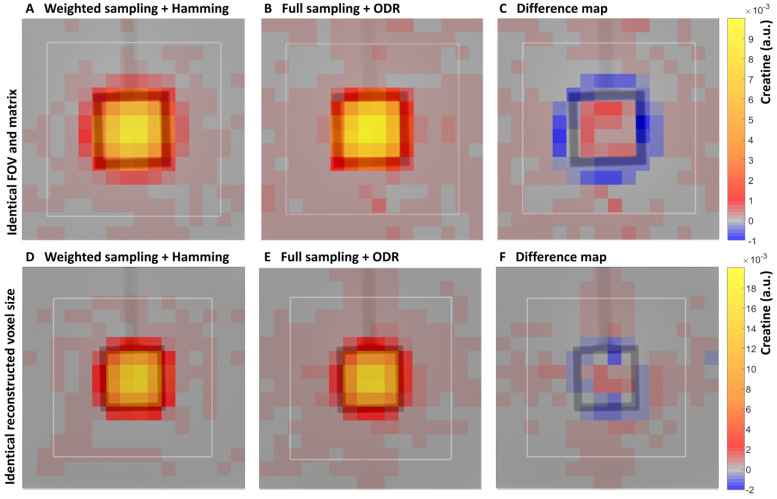
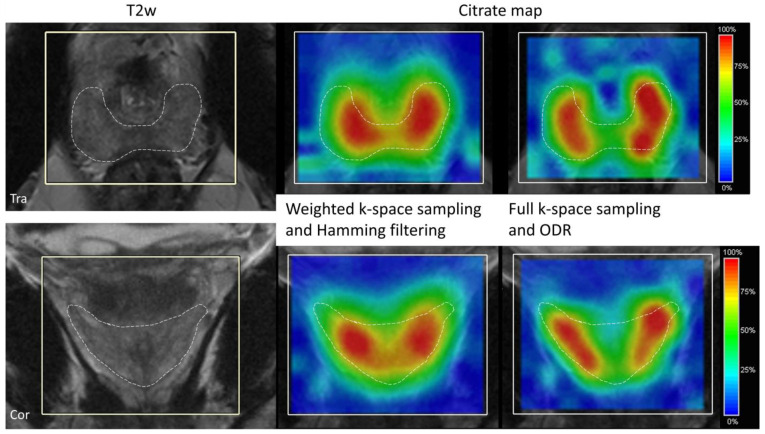
In in vivo H-MRSI of the prostate, small matrix sizes can cause voxel bleeding extending to regions far from a voxel, dispersing a signal of interest outside that voxel and mixing extra-prostatic residual lipid signals into the prostate. To resolve this problem, we developed a three-dimensional overdiscretized reconstruction method. Without increasing the acquisition time from current 3D MRSI acquisition methods, this method is aimed to improve the localization of metabolite signals in the prostate without compromising on SNR. The proposed method consists of a 3D spatial overdiscretization of the MRSI grid, followed by noise decorrelation with small random spectral shifts and weighted spatial averaging to reach a final target spatial resolution. We successfully applied the three-dimensional overdiscretized reconstruction method to 3D prostate H-MRSI data at 3T. Both in phantom and in vivo, the method proved to be superior to conventional weighted sampling with Hamming filtering of k-space. Compared with the latter, the overdiscretized reconstructed data with smaller voxel size showed up to 10% less voxel bleed while maintaining higher SNR by a factor of 1.87 and 1.45 in phantom measurements. For in vivo measurements, within the same acquisition time and without loss of SNR compared with weighted k-space sampling and Hamming filtering, we achieved increased spatial resolution and improved localization in metabolite maps.
在前列腺的体内氢磁共振波谱成像(H-MRSI)中,小的矩阵尺寸会导致体素内的出血扩展到远离该体素的区域,使感兴趣的信号分散到该体素之外,并将前列腺外的残余脂质信号混入前列腺中。为了解决这个问题,我们开发了一种三维超离散重建方法。在不增加当前三维磁共振波谱成像采集方法采集时间的情况下,该方法旨在提高前列腺中代谢物信号的定位,同时不降低信噪比(SNR)。所提出的方法包括对磁共振波谱成像网格进行三维空间超离散化,然后通过小的随机频谱偏移进行噪声去相关以及加权空间平均,以达到最终的目标空间分辨率。我们成功地将三维超离散重建方法应用于3T下的三维前列腺氢磁共振波谱成像数据。在体模和体内实验中,该方法都被证明优于传统的对k空间进行汉明滤波的加权采样方法。与后者相比,具有较小体素尺寸的超离散重建数据在体模测量中显示体素内出血减少了多达10%,同时信噪比分别提高了1.87倍和1.45倍。对于体内测量,在相同的采集时间内,与加权k空间采样和汉明滤波相比,在不损失信噪比的情况下,我们在代谢物图谱中实现了更高的空间分辨率和更好的定位。