Asiedu Bernice, Lembede Busisani Wiseman, Gomes Monica, Kasonga Abe, Nkomozepi Pilani, Nyakudya Trevor Tapiwa, Chivandi Eliton
School of Physiology, Faculty of Health Sciences, University of the Witwaterstrand, 7 York Street, Parktown, Johannesburg 2193, South Africa.
Department of Physiology, School of Medicine, Faculty of Health Sciences, University of Pretoria, Private Bag X323, Gezina, Pretoria 0031, South Africa.
Metabolites. 2023 Jan 23;13(2):167. doi: 10.3390/metabo13020167.
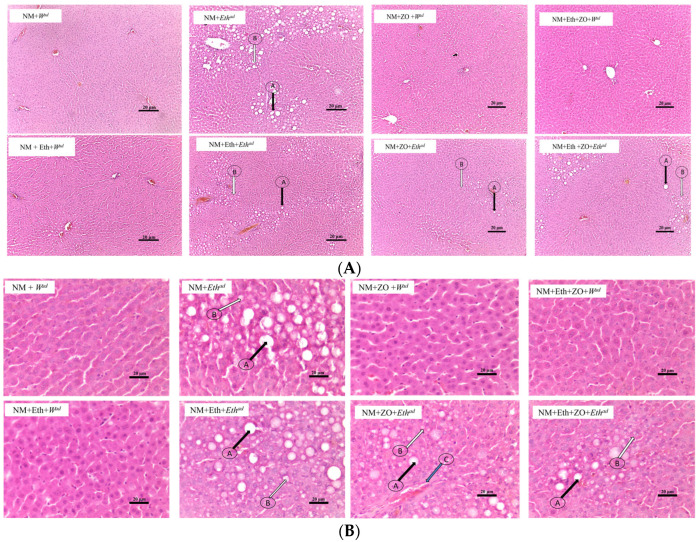
Alcohol intake at different developmental stages can lead to the development of alcohol-induced fatty liver disease (AFLD). Zingerone (ZO) possess hepato-protective properties; thus, when administered neonatally, it could render protection against AFLD. This study aimed to evaluate the potential long-term protective effect of ZO against the development of AFLD. One hundred and twenty-three 10-day-old Sprague-Dawley rat pups (60 males; 63 females) were randomly assigned to four groups and orally administered the following treatment regimens daily during the pre-weaning period from postnatal day (PND) 12-21: group 1-nutritive milk (NM), group 2-NM +1 g/kg ethanol (Eth), group 3-NM + 40 mg/kg ZO, group 4-NM + Eth +ZO. From PND 46-100, each group from the neonatal stage was divided into two; subgroup I had tap water and subgroup II had ethanol solution as drinking fluid, respectively, for eight weeks. Mean daily ethanol intake, which ranged from 10 to 14.5 g/kg body mass/day, resulted in significant CYP2E1 elevation ( < 0.05). Both late single hit and double hit with alcohol increased liver fat content, caused hepatic macrosteatosis, dysregulated mRNA expression of and in male and female rats ( < 0.05). However, neonatal orally administered ZO protected against liver lipid accretion and upregulation in male rats only and attenuated the alcohol-induced hepatic downregulation and macrosteatosis in both sexes. This data suggests that neonatal orally administered zingerone can be a potential prophylactic agent against the development of AFLD.
不同发育阶段摄入酒精可导致酒精性脂肪肝(AFLD)的发生。姜辣素(ZO)具有肝脏保护特性;因此,在新生期给予时,它可以预防AFLD。本研究旨在评估ZO对AFLD发生的潜在长期保护作用。将123只10日龄的Sprague-Dawley幼鼠(60只雄性;63只雌性)随机分为四组,并在出生后第12 - 21天的断奶前期每天口服以下治疗方案:第1组 - 营养牛奶(NM),第2组 - NM + 1 g/kg乙醇(Eth),第3组 - NM + 40 mg/kg ZO,第4组 - NM + Eth + ZO。从出生后第46 - 100天,每个新生期的组再分为两组;亚组I饮用自来水,亚组II饮用乙醇溶液,持续八周。平均每日乙醇摄入量为10至14.5 g/kg体重/天,导致CYP2E1显著升高(< 0.05)。酒精晚期单次打击和双重打击均增加了肝脏脂肪含量,导致肝脏大脂肪变性,使雄性和雌性大鼠中 和 的mRNA表达失调(< 0.05)。然而,新生期口服ZO仅对雄性大鼠的肝脏脂质积聚和 上调具有保护作用,并减轻了两性中酒精诱导的肝脏 下调和大脂肪变性。该数据表明,新生期口服姜辣素可能是预防AFLD发生的潜在药物。