Kleinert Corinna, Zoch Gundula
Leibniz-Institut für Bildungsverläufe, Otto-Friedrich-Universität Bamberg, Wilhelmsplatz 3, 96047 Bamberg, Deutschland.
Leibniz-Institut für Bildungsverläufe, Carl von Ossietzky Universität Oldenburg, Ammerländer Heerstraße 114-118, 26129 Oldenburg, Deutschland.
Z Erziehwiss. 2023 Feb 21:1-30. doi: 10.1007/s11618-023-01142-2.
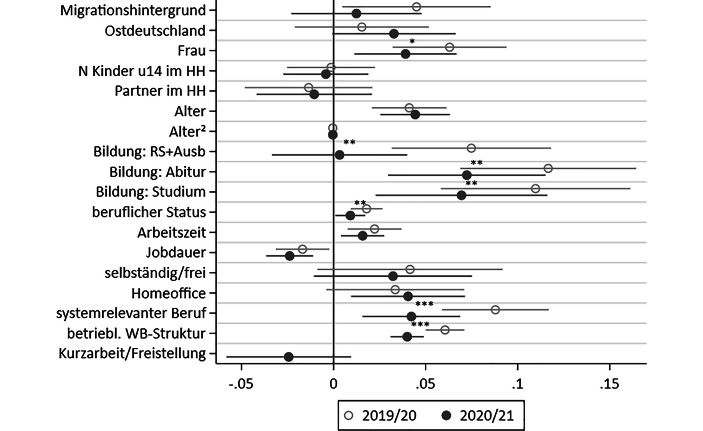
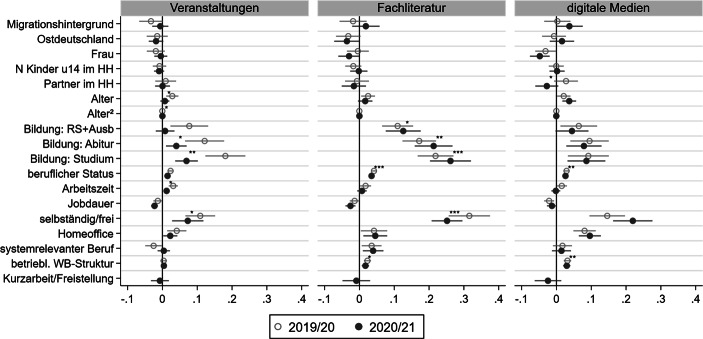
Political and scientific discourses repeatedly emphasize the importance of lifelong learning in today's knowledge societies. At the same time, participation in vocational further education (VFE) is still socially stratified: mainly those adults profit who already bring with them better qualifications and more resources. The Corona pandemic has profoundly changed the supply with and the demand for further education in a short period of time, and it is not yet clear-and empirically not sufficiently investigated-how the pandemic has affected participation in VFE and what barriers and opportunities the crisis has brought for different groups of employees. We answer these questions empirically using data from NEPS Start Cohort 6 for a sample of adults, who participated in the NEPS surveys before and during the Corona crisis and were employed shortly before the outbreak of the pandemic. Our results show that the Covid-19 pandemic in Germany was associated with a moderate decline in participation in job-related courses and face-to-face events. The social, occupational, and workplace differences in these forms of participation, which were pronounced before the pandemic, also declined slightly in the wake of the crisis. We conclude that the pandemic has led to a decrease of social inequality of adult education, at least in its first and second wave.
政治和科学论述反复强调终身学习在当今知识社会中的重要性。与此同时,参与职业继续教育(VFE)在社会层面上仍然存在分层现象:主要受益的是那些本身已经具备更好资质和更多资源的成年人。新冠疫情在短时间内深刻改变了继续教育的供给和需求,目前尚不清楚——从实证角度来看也未得到充分研究——疫情如何影响了职业继续教育的参与情况,以及这场危机给不同员工群体带来了哪些障碍和机遇。我们利用NEPS起始队列6的数据,对一组成年人进行实证研究来回答这些问题,这些成年人在新冠危机之前和期间参与了NEPS调查,并且在疫情爆发前不久仍在工作。我们的研究结果表明,德国的新冠疫情与参加与工作相关课程和面对面活动的参与率适度下降有关。在疫情之前就很明显的这些参与形式上的社会、职业和工作场所差异,在危机之后也略有下降。我们得出结论,至少在第一波和第二波疫情期间,疫情导致了成人教育社会不平等的减少。