Department of Blood Transfusion, The First Affiliated Hospital, Zhejiang University School of Medicine, Hangzhou 310003, China.
Department of Ultrasound, Wenzhou City People's Hospital, Wenzhou 325100, China.
Dis Markers. 2023 Feb 16;2023:7787803. doi: 10.1155/2023/7787803. eCollection 2023.
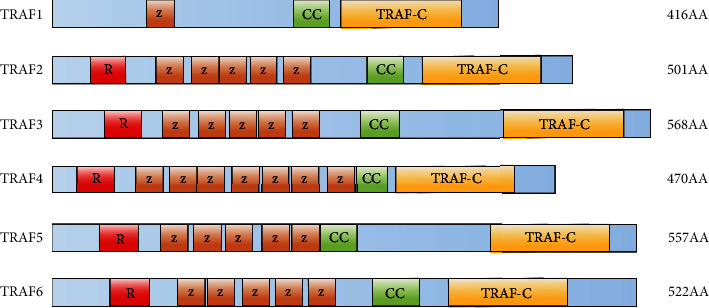
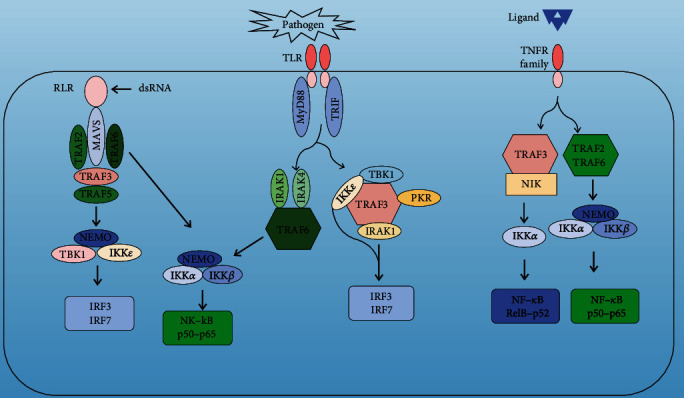
Seven tumor necrosis factor receptor- (TNFR-) associated factors (TRAFs) have been found in mammals, which are primarily involved in the signal translation of the TNFR superfamily, the Toll-like receptor (TLR) family, and the retinoic acid-inducible gene I- (RIG-I-) like receptor (RLR) family. TRAF3 is one of the most diverse members of the TRAF family. It can positively regulate type I interferon production while negatively regulating signaling pathways of classical nuclear factor-B, nonclassical nuclear factor-B, and mitogen-activated protein kinase (MAPK). This review summarizes the roles of TRAF3 signaling and the related immune receptors (e.g., TLRs) in several preclinical and clinical diseases and focuses on the roles of TRAF3 in immune responses, the regulatory mechanisms, and its role in disease.
七种肿瘤坏死因子受体-(TNFR-)相关因子(TRAFs)在哺乳动物中被发现,它们主要参与 TNFR 超家族、Toll 样受体(TLR)家族和视黄酸诱导基因 I-(RIG-I-)样受体(RLR)家族的信号转导。TRAF3 是 TRAF 家族中最多样化的成员之一。它可以正向调节 I 型干扰素的产生,同时负向调节经典核因子-B、非经典核因子-B 和丝裂原激活蛋白激酶(MAPK)的信号通路。本综述总结了 TRAF3 信号及其相关免疫受体(如 TLRs)在几种临床前和临床疾病中的作用,并重点介绍了 TRAF3 在免疫反应、调节机制中的作用及其在疾病中的作用。