Talantseva Oksana I, Romanova Raisa S, Shurdova Ekaterina M, Dolgorukova Tatiana A, Sologub Polina S, Titova Olga S, Kleeva Daria F, Grigorenko Elena L
Center for Cognitive Sciences, Sirius University of Science and Technology, Sirius, Russia.
Laboratory of Translational Developmental Sciences, Department of Psychology, Saint Petersburg State University, Saint Petersburg, Russia.
Front Psychiatry. 2023 Feb 9;14:1071181. doi: 10.3389/fpsyt.2023.1071181. eCollection 2023.
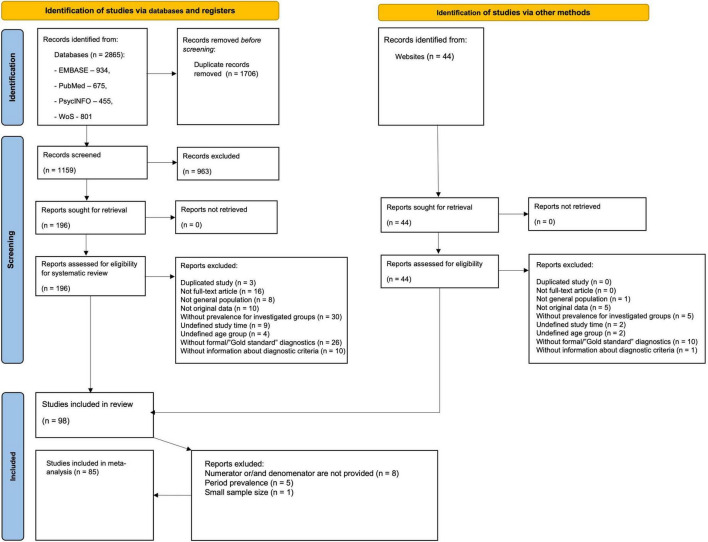
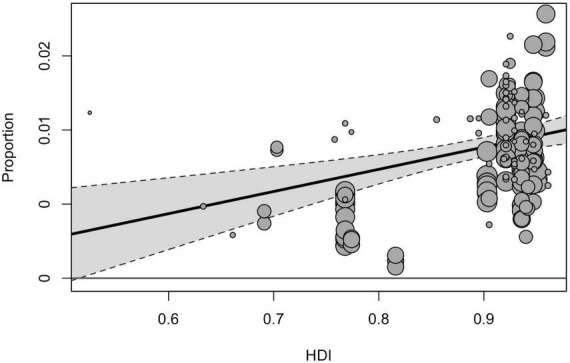
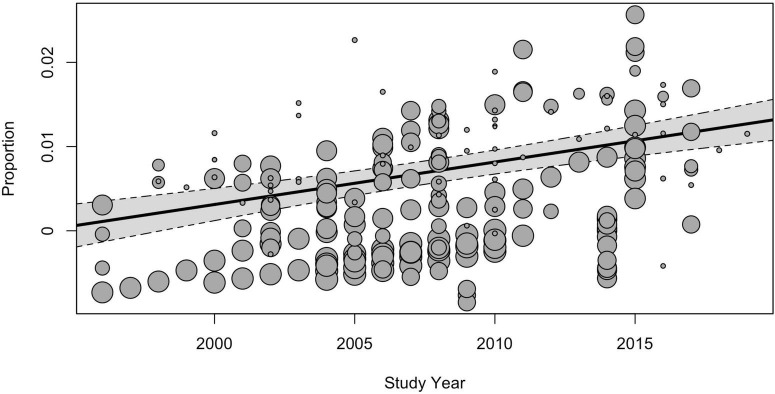
Autism spectrum disorder (ASD) is one the most disabling developmental disorders, imposing an extremely high economic burden. Obtaining as accurate prevalence estimates as possible is crucial to guide governments in planning policies for identification and intervention for individuals with ASD and their relatives. The precision of prevalence estimates can be heightened by summative analyses of the data collected around the world. To that end, we conducted a three-level mixed-effects meta-analysis. A systematic search of the Web of Science, PubMed, EMBASE, and PsycINFO databases from 2000 up to 13 July 2020 was performed, and reference lists of previous reviews and existing databases of prevalence studies were screened. Overall, 79 studies were included in the analysis of ASD and 59-in the analysis of previously existing relevant diagnoses: 30 for Autistic Disorder (AD), 15 for Asperger Syndrome (AS), and 14 for Atypical Autism (AA) and Pervasive Developmental Disorder - Not Otherwise Specified (PDD-NOS); these research reports covered the period from 1994 to 2019. Pooled prevalence estimates were 0.72% (95% CI = 0.61-0.85) for ASD, 0.25% (95% CI = 0.18-0.33) for AD, 0.13% (95% CI = 0.07-0.20) for AS, and 0.18% (95% CI = 0.10-0.28) for the combined group of AA and PDD-NOS. Estimates were higher (1) for the studies that used records-review surveillance rather than other designs; (2) in North America compared with other geographical regions; and (3) in high-income compared with lower-income countries. The highest prevalence estimates were registered in the USA. There was an increase in autism prevalence estimates over time. The prevalence was also significantly higher for children aged between 6 and 12 years compared to children under the age of 5 and over the age of 13 years.
https://www.crd.york.ac.uk/prospero/display_record.php?ID=CRD42019131525, identifier CRD42019131525.
自闭症谱系障碍(ASD)是最具致残性的发育障碍之一,带来极高的经济负担。尽可能获得准确的患病率估计对于指导政府制定针对ASD患者及其亲属的识别和干预政策至关重要。通过对全球收集的数据进行汇总分析,可以提高患病率估计的精度。为此,我们进行了三级混合效应荟萃分析。对2000年至2020年7月13日期间的科学网、PubMed、EMBASE和PsycINFO数据库进行了系统检索,并筛选了先前综述的参考文献列表和现有的患病率研究数据库。总体而言,79项研究纳入了ASD分析,59项纳入了先前存在的相关诊断分析:30项针对孤独症(AD),15项针对阿斯伯格综合征(AS),14项针对非典型孤独症(AA)和广泛性发育障碍未特定型(PDD-NOS);这些研究报告涵盖了1994年至2019年期间。ASD的合并患病率估计为0.72%(95%CI = 0.61 - 0.85),AD为0.25%(95%CI = 0.18 - 0.33),AS为0.13%(95%CI = 0.07 - 0.20),AA和PDD-NOS合并组为0.18%(95%CI = 0.10 - 0.28)。估计值在以下情况更高:(1)使用记录审查监测而非其他设计的研究;(2)与其他地理区域相比,在北美;(3)与低收入国家相比,在高收入国家。美国的患病率估计最高。随着时间推移,自闭症患病率估计有所增加。与5岁以下和13岁以上儿童相比,6至12岁儿童的患病率也显著更高。
https://www.crd.york.ac.uk/prospero/display_record.php?ID=CRD42019131525,标识符CRD42019131525。