Wang Shang, Wang Shan, Tang Ying, Peng Guoyu, Hao Tongyu, Wu Xincheng, Wei Jiehong, Qiu Xinying, Zhou Dewang, Zhu Shimao, Li Yuqing, Wu Song
Institute of Urology, The Third Affiliated Hospital of Shenzhen University, Shenzhen, China.
Shenzhen Institute of Synthetic Biology, Shenzhen Institutes of Advanced Technology, Chinese Academy of Sciences, Shenzhen, China.
Front Microbiol. 2023 Feb 9;14:1128261. doi: 10.3389/fmicb.2023.1128261. eCollection 2023.
() is a Gram-negative bacterium that opportunistically causes nosocomial infections in the lung, bloodstream, and urinary tract. Extended-spectrum β-Lactamases (ESBLs)-expressed strains are widely reported to cause antibiotic resistance and therapy failure. Therefore, early identification of K. pneumonia, especially ESBL-positive strains, is essential in preventing severe infections. However, clinical detection of requires a time-consuming process in agar disk diffusion. Nucleic acid detection, like qPCR, is precise but requires expensive equipment. Recent research reveals that collateral cleavage activity of CRISPR-LbCas12a has been applied in nucleic acid detection, and the unique testing model can accommodate various testing models.
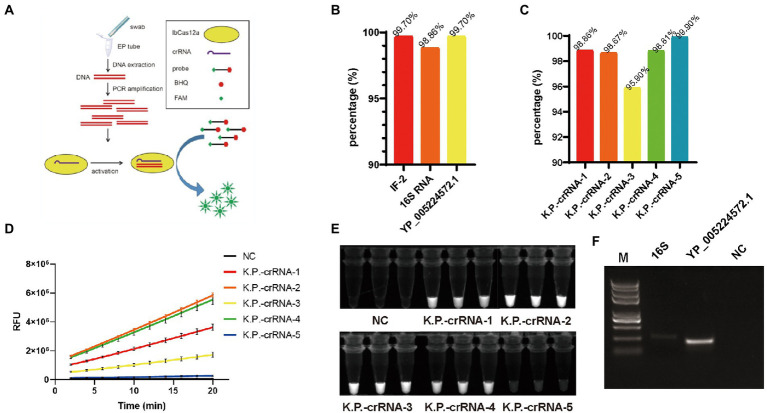
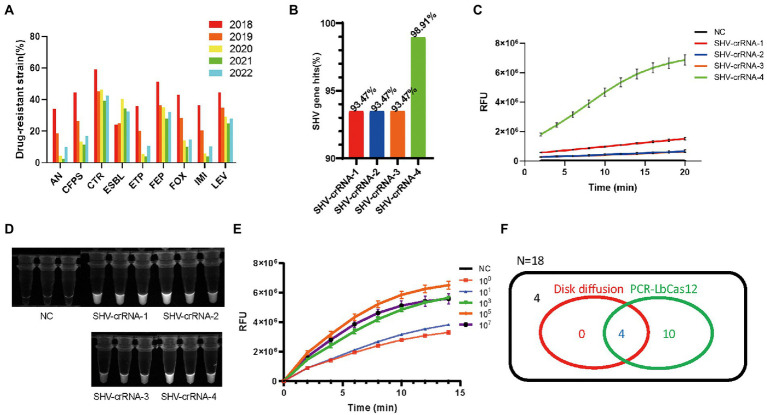
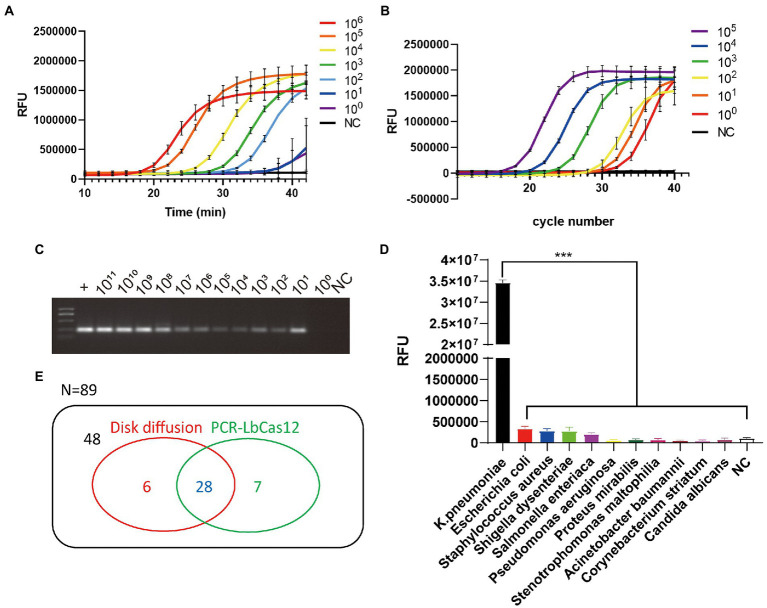
This study established a system that combined PCR with CRISPR-LbCas12a targeting the system. Additionally, this study summarized the antibiotic-resistant information of the past five years' clinic cases in Luohu Hospital and found that the ESBL-positive strains were growing. This study then designs a crRNA that targets to detect ESBL-resistant . This work is to detect and ESBL-positive strains' nucleic acid using CRISPR-Cas12 technology. We compared PCR-LbCas12 workflow with PCR and qPCR techniques.
This system showed excellent detection specificity and sensitivity in both bench work and clinical samples. Due to its advantages, its application can meet different detection requirements in health centers where qPCR is not accessible. The antibiotic-resistant information is valuable for further research.
()是一种革兰氏阴性菌,可在肺部、血液和泌尿道引发医院感染。广泛报道称,产超广谱β-内酰胺酶(ESBLs)的菌株会导致抗生素耐药性和治疗失败。因此,早期识别肺炎克雷伯菌,尤其是ESBL阳性菌株,对于预防严重感染至关重要。然而,在琼脂平板扩散法中,对()的临床检测过程耗时。核酸检测,如qPCR,虽精确但需要昂贵的设备。最近的研究表明,CRISPR-LbCas12a的旁切活性已应用于核酸检测,且其独特的检测模式可适应各种检测模型。
本研究建立了一种将PCR与靶向()系统的CRISPR-LbCas12a相结合的体系。此外,本研究总结了罗湖区医院过去五年()临床病例的耐药信息,发现ESBL阳性菌株在增加。然后,本研究设计了一种靶向()以检测ESBL耐药()的crRNA。这项工作旨在利用CRISPR-Cas12技术检测()和ESBL阳性菌株的核酸。我们将PCR-LbCas12工作流程与PCR和qPCR技术进行了比较。
该系统在实验室研究和临床样本中均显示出优异的检测特异性和灵敏度。由于其优势,其应用可满足在无法使用qPCR的医疗中心的不同检测需求。耐药信息对进一步研究具有重要价值。