Bertoletti Alice, Biagi Federico, Di Pietro Giorgio, Karpiński Zbigniew
European Commission - Joint Research Centre (JRC), Edificio EXPO, calle Inca Garcilaso, 3, 41092 Seville, Spain.
European Commission - Joint Research Centre (JRC), Building 26A CCR, via Enrico Fermi 2749, 21027 Ispra, Italy.
Large Scale Assess Educ. 2023;11(1):6. doi: 10.1186/s40536-023-00154-y. Epub 2023 Feb 23.
This paper investigates how the COVID-19 school closure has affected the gender gap in grade-8 students' performance and what are the drivers behind this. By analysing four different countries (i.e., the Russian Federation, Slovenia, Uzbekistan and the United Arab Emirates), the paper represents the first study addressing the issue from a comparative perspective.
The study uses data from the Responses to Educational Disruption Survey (REDS) survey, which comprises international comparable data on how students approached remote learning during the COVID-19 disruption. The extent of the gender gap is estimated by employing an ordered logit model, while the Karlson-Holm-Breen (KHB) decomposition method is used to analyse the different potential channels that could account for the gender gap during COVID-19.
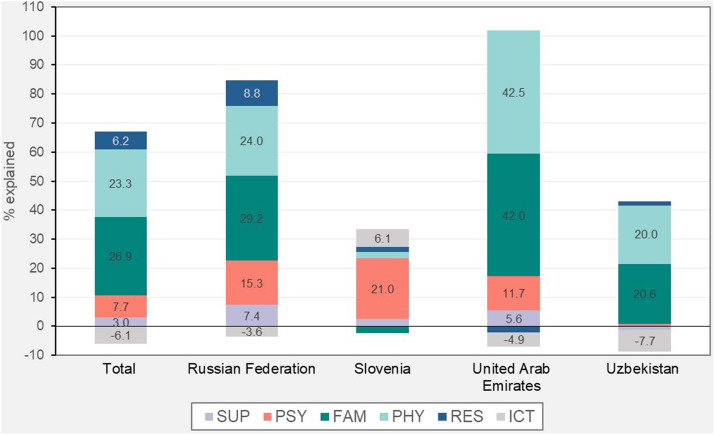
The empirical results reveal that, during the COVID-19 school closure, girls tended to perceive changes in their learnings less favourably than boys, both in terms of improvement in self-perceived learning and self-reported improvement in grades-with odds of a more affirmative response between 20 and 25% lower for girls relative to boys. The main drivers explaining this gender gap are physical activity and psychological distress of students during the COVID-19 disruption, as well as the perceived family climate.
The paper shows systematic gender differences in how students perceived their educational outcomes changed due to the COVID-19 disruption, providing evidence on the factors driving these differences. The findings could be employed to design policy actions aimed at increasing gender equality in education.
本文研究了新冠疫情期间学校关闭对八年级学生成绩性别差距的影响及其背后的驱动因素。通过分析四个不同国家(即俄罗斯联邦、斯洛文尼亚、乌兹别克斯坦和阿拉伯联合酋长国)的数据,本文首次从比较视角探讨了这一问题。
本研究使用了来自教育中断应对调查(REDS)的数据,该调查包含了关于学生在新冠疫情期间如何进行远程学习的国际可比数据。通过有序logit模型估计性别差距的程度,同时使用卡尔森-霍尔姆-布林(KHB)分解方法分析在新冠疫情期间可能导致性别差距的不同潜在渠道。
实证结果表明,在新冠疫情学校关闭期间,无论是在自我感知学习的改善方面,还是在自我报告的成绩提高方面,女孩对学习变化的感知往往不如男孩有利——女孩给出更肯定回答的几率比男孩低20%至25%。解释这种性别差距的主要驱动因素是新冠疫情期间学生的体育活动和心理困扰,以及感知到的家庭氛围。
本文显示了学生如何因新冠疫情而感知其教育成果变化方面存在系统性的性别差异,并提供了驱动这些差异的因素的证据。这些发现可用于设计旨在提高教育中性别平等的政策行动。