Xu Xueer, Xu Yifei, Zhang Jingtong, Zhong Yu, Li Zhongxu, Qiu Huayu, Wu Hao Bin, Wang Jie, Wang Xiuli, Gu Changdong, Tu Jiangping
State Key Laboratory of Silicon Materials, Key Laboratory of Advanced Materials and Applications for Batteries of Zhejiang Province, and School of Materials Science and Engineering, Zhejiang University, Hangzhou, 310027, People's Republic of China.
Institute for Composites Science Innovation (InCSI) and State Key Laboratory of Silicon Materials, School of Materials Science and Engineering, Zhejiang University, Hangzhou, 310027, People's Republic of China.
Nanomicro Lett. 2023 Feb 28;15(1):56. doi: 10.1007/s40820-023-01031-7.
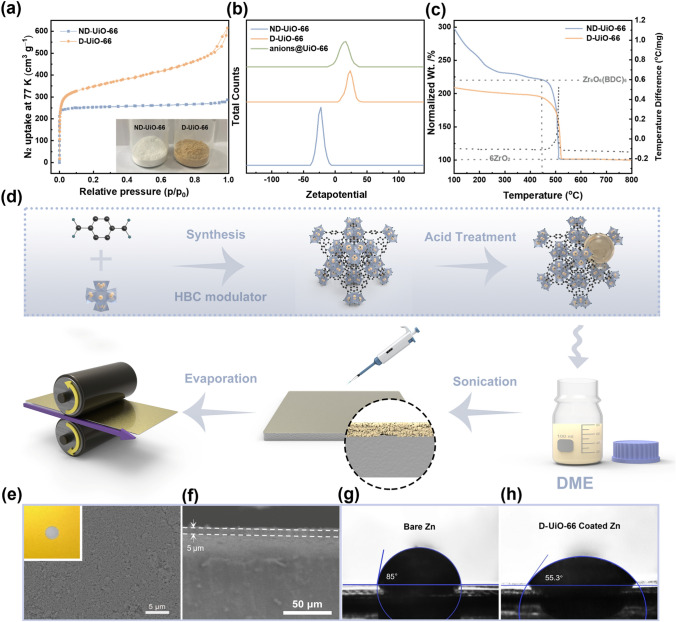
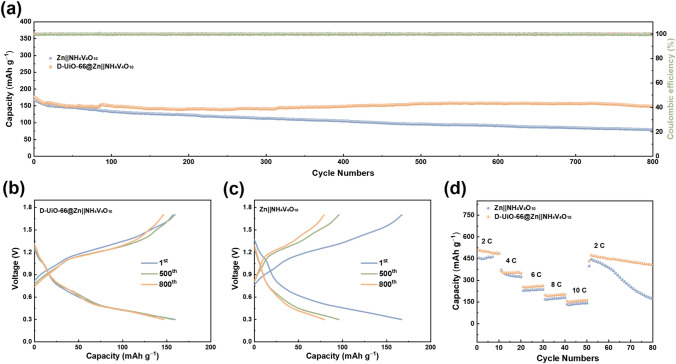
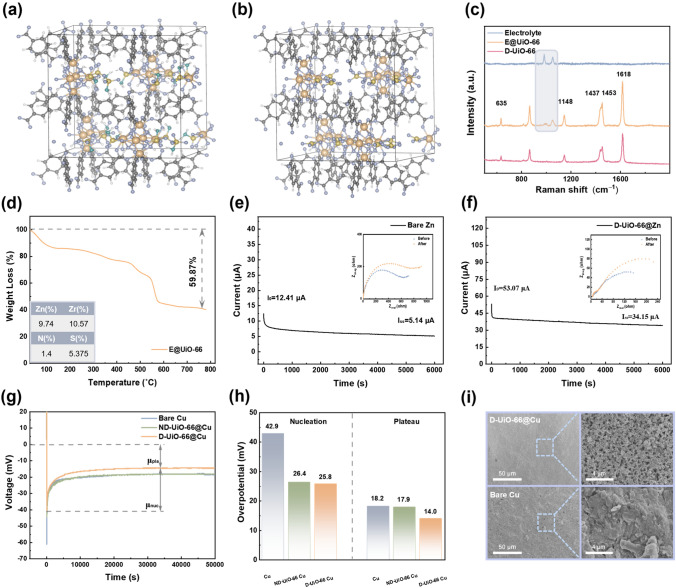
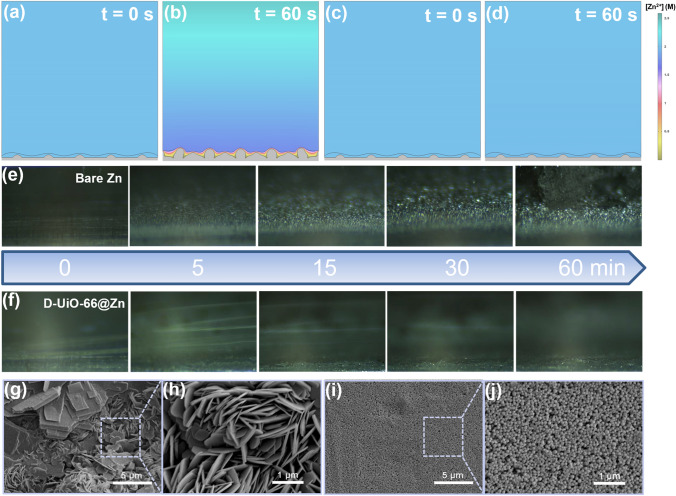
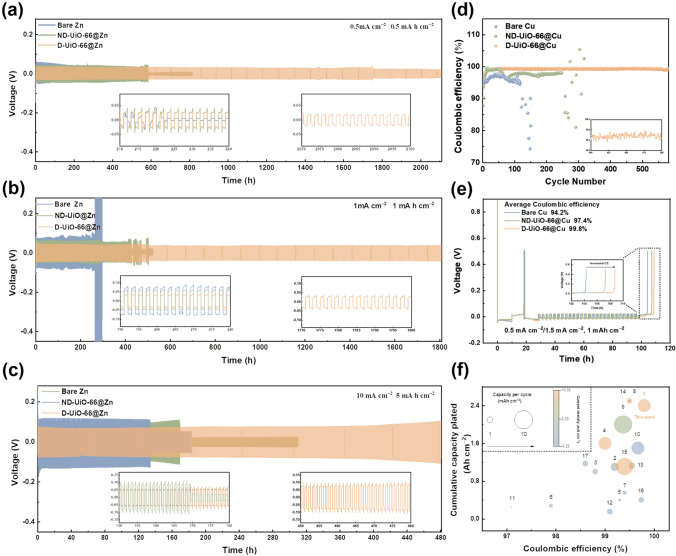
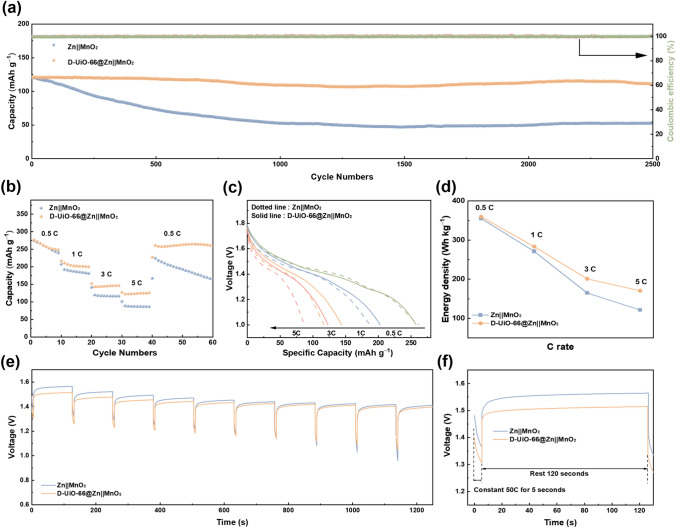
The practical applications of zinc metal batteries are plagued by the dendritic propagation of its metal anodes due to the limited transfer rate of charge and mass at the electrode/electrolyte interphase. To enhance the reversibility of Zn metal, a quasi-solid interphase composed by defective metal-organic framework (MOF) nanoparticles (D-UiO-66) and two kinds of zinc salts electrolytes is fabricated on the Zn surface served as a zinc ions reservoir. Particularly, anions in the aqueous electrolytes could be spontaneously anchored onto the Lewis acidic sites in defective MOF channels. With the synergistic effect between the MOF channels and the anchored anions, Zn transport is prompted significantly. Simultaneously, such quasi-solid interphase boost charge and mass transfer of Zn, leading to a high zinc transference number, good ionic conductivity, and high Zn concentration near the anode, which mitigates Zn dendrite growth obviously. Encouragingly, unprecedented average coulombic efficiency of 99.8% is achieved in the Zn||Cu cell with the proposed quasi-solid interphase. The cycling performance of D-UiO-66@Zn||MnO (~ 92.9% capacity retention after 2000 cycles) and D-UiO-66@Zn||NHVO (~ 84.0% capacity retention after 800 cycles) prove the feasibility of the quasi-solid interphase.
由于电极/电解质界面处电荷和质量的转移速率有限,锌金属电池的实际应用受到其金属阳极枝晶生长的困扰。为了提高锌金属的可逆性,在锌表面制备了一种由缺陷金属有机框架(MOF)纳米颗粒(D-UiO-66)和两种锌盐电解质组成的准固态界面,作为锌离子储存库。特别地,水性电解质中的阴离子可以自发地锚定在缺陷MOF通道中的路易斯酸性位点上。在MOF通道和锚定阴离子的协同作用下,锌的传输显著加快。同时,这种准固态界面促进了锌的电荷和质量转移,导致高锌迁移数、良好的离子导电性以及阳极附近的高锌浓度,明显减轻了锌枝晶的生长。令人鼓舞的是,在所提出的具有准固态界面的Zn||Cu电池中实现了前所未有的99.8%的平均库仑效率。D-UiO-66@Zn||MnO(2000次循环后容量保持率约为92.9%)和D-UiO-66@Zn||NHVO(800次循环后容量保持率约为84.0%)的循环性能证明了准固态界面的可行性。