FHI 360, New York, NY, USA.
FHI 360, Abuja, Nigeria.
Glob Health Sci Pract. 2023 Feb 28;11(1). doi: 10.9745/GHSP-D-22-00370.
While oral preexposure prophylaxis (PrEP) is recommended for all individuals with substantial risk of acquiring HIV, people who inject drugs (PWID) have not been prioritized for oral PrEP services in most settings. The Meeting Targets and Maintaining Epidemic Control (EpiC) project implemented a comprehensive community-based program to increase access to and uptake of oral PrEP services among PWID in Bayelsa and Niger States, Nigeria.
EpiC established partnerships with community-based organizations working with the PWID community, identified hotspots (common locations for socialization and drug use), and engaged PWID in tailoring oral PrEP services. The HIV prevention package provided in hotspots and drop-in centers included HIV testing, oral PrEP, postexposure prophylaxis, sexually transmitted infection screening and management, condoms and lubricants, PWID-specific risk reduction counseling, and referrals to other support programs. At drop-in centers, paralegal and psychological services were also provided. Peer outreach workers led outreach efforts. All PWID who tested HIV negative were eligible for oral PrEP screening. National oral PrEP eligibility criteria included: no suspicion of acute HIV infection, absence of proteinuria, and willingness to use oral PrEP as prescribed. We used descriptive analysis of routine programmatic data to illustrate program outcomes.
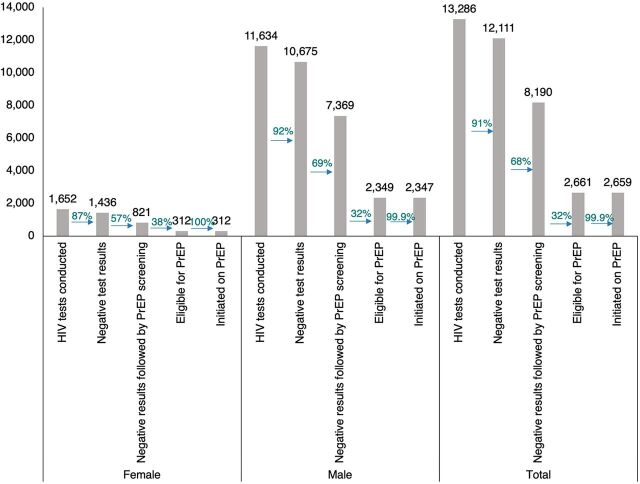
From January 2020 to September 2021, 13,286 HIV tests were completed for PWID. Of these, 12,111 (91.16%) had negative results. Among those testing negative, 8,190 (67.62%) were screened for oral PrEP eligibility, and 2,661 (32.49%) were eligible. A total of 2,659 PWID (100% [312/312] among eligible females; 99.91% [2,347/2,349] among eligible males) initiated oral PrEP.
Provision of oral PrEP services to PWID in Nigeria is feasible through a peer-led, differentiated, and holistic approach that addresses structural barriers among the PWID community. Greater efforts are needed to understand the needs and barriers to better tailor HIV services to reach females and other subpopulations in this community that are harder to reach.
虽然口服暴露前预防(PrEP)被推荐用于所有存在大量感染 HIV 风险的人群,但在大多数情况下,注射毒品者(PWID)并未被优先考虑接受口服 PrEP 服务。 Meeting Targets and Maintaining Epidemic Control(EpiC)项目在尼日利亚巴耶尔萨州和尼日尔州实施了一项综合性的社区为基础的项目,旨在增加 PWID 获得和接受口服 PrEP 服务的机会。
EpiC 与与 PWID 社区合作的社区组织建立了伙伴关系,确定了热点地区(社交和吸毒的常见地点),并让 PWID 参与定制口服 PrEP 服务。热点地区和临时中心提供的艾滋病毒预防一揽子计划包括艾滋病毒检测、口服 PrEP、暴露后预防、性传播感染筛查和管理、避孕套和润滑剂、针对 PWID 的特定风险降低咨询以及转介到其他支持计划。在临时中心,还提供了律师助理和心理服务。同伴外展工作者领导外展工作。所有 HIV 检测阴性的 PWID 都有资格接受口服 PrEP 筛查。国家口服 PrEP 资格标准包括:没有急性 HIV 感染的怀疑、没有蛋白尿和愿意按照规定使用口服 PrEP。我们使用常规项目数据的描述性分析来说明项目结果。
从 2020 年 1 月到 2021 年 9 月,为 PWID 完成了 13286 次艾滋病毒检测。其中,12111 次(91.16%)结果为阴性。在检测结果为阴性的人群中,8190 人(67.62%)接受了口服 PrEP 资格筛查,2661 人(32.49%)有资格。共有 2659 名 PWID(100%[312/312]符合条件的女性;99.91%[2347/2349]符合条件的男性)开始服用口服 PrEP。
通过同伴领导、差异化和整体方法向尼日利亚的 PWID 提供口服 PrEP 服务是可行的,这种方法解决了 PWID 社区中的结构性障碍。需要进一步努力了解需求和障碍,以便更好地为该社区中的女性和其他更难接触到的亚人群量身定制艾滋病毒服务。