Health Systems Program, Department of International Health, Johns Hopkins School of Public Health, Baltimore, Maryland, USA.
Curamericas/Guatemala, Calhuitz, San Sebastián Coatán, Huehuetenango, Guatemala.
Int J Equity Health. 2023 Feb 28;21(Suppl 2):195. doi: 10.1186/s12939-022-01754-w.
The Curamericas/Guatemala Maternal and Child Health Project, 2011-2015, included implementation research designed to assess the effectiveness of an approach referred to as CBIO+ , composed of: (1) the Census-Based, Impact-Oriented (CBIO) Approach, (2) the Care Group Approach, and (3) the Community Birthing Center Approach. This is the second paper in a supplement of 10 articles describing the implementation research and its findings. Paper 1 describes CBIO+ , the Project Area, and how the Project was implemented.
This paper describes the implementation research design and details of how it was carried out.
We reviewed the original implementation research protocol and the methods used for all data collection related to this Project. The protocol and methods used for the implementation research related to this Project were all standard approaches to the monitoring and evaluation of child survival projects as developed by the United States Agency for International Development Child Survival and Health Grants Program (CSHGP) and the CORE Group. They underwent independent peer review supervised by the CSHGP before the implementation research began.
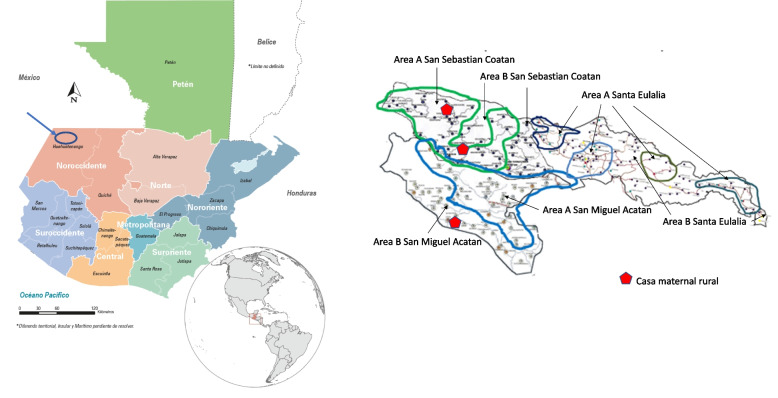
The study area was divided into two sets of communities with a total population of 98,000 people. Project interventions were implemented in Area A from 2011 until the end of the project in 2015 (44 months) and in Area B from late 2013 until 2015 (20 months). Thus, Area B served as a quasi-comparison area during the first two years of Project implementation. The overarching study question was whether the CBIO+ Approach improved the health and well-being of children and mothers. The outcome indicators included (1) changes in population coverage of evidence-based interventions, (2) changes in childhood nutritional status, (3) changes in the mortality of children and mothers, (4) quality of care provided at Community Birthing Centers, (5) the impact of the Project on women's empowerment and social capital, (6) stakeholder assessment of the effectiveness of the CBIO+ Approach, and (7) the potential of wider adoption of the CBIO+ Approach.
The implementation research protocol guided the assessment of the effectiveness of the CBIO+ Approach in improving the health and well-being of children, mothers, and their communities.
2011-2015 年期间,“危地马拉母婴健康库米拉梅卡项目”实施了研究,旨在评估一种名为 CBIO+ 的方法的有效性,该方法包括:(1)基于普查、以影响为导向的方法(CBIO)、(2)护理小组方法、(3)社区分娩中心方法。本文是补充的 10 篇文章中的第二篇,描述了实施研究及其发现。第 1 篇文章介绍了 CBIO+、项目区以及项目的实施情况。
本文介绍了实施研究设计,并详细介绍了其实施情况。
我们回顾了原始实施研究方案以及与本项目相关的所有数据收集所使用的方法。本项目实施研究相关的方案和方法均为美国国际开发署儿童生存与健康赠款项目(CSHGP)和核心小组制定的儿童生存项目监测和评估的标准方法。在实施研究开始之前,这些方法经过了 CSHGP 的独立同行审查。
研究区分为两组社区,总人口为 98000 人。项目干预措施在 A 区实施,从 2011 年持续到 2015 年项目结束(44 个月),在 B 区从 2013 年底持续到 2015 年(20 个月)。因此,B 区在项目实施的头两年充当了一个准比较区。总体研究问题是 CBIO+方法是否改善了儿童和母亲的健康和福祉。结果指标包括:(1)基于证据的干预措施的人口覆盖范围变化;(2)儿童营养状况变化;(3)儿童和母亲死亡率变化;(4)社区分娩中心提供的护理质量;(5)项目对妇女赋权和社会资本的影响;(6)利益相关者对 CBIO+方法有效性的评估;(7)更广泛采用 CBIO+方法的潜力。
实施研究方案指导了 CBIO+方法在改善儿童、母亲及其社区健康和福祉方面的有效性评估。