Burte Victor, Cointe Melina, Perez Guy, Mailleret Ludovic, Calcagno Vincent
Université Côte d'Azur, INRAE, CNRS, Institut Sophia Agrobiotech, Sophia Antipolis, France.
Université Côte d'Azur, Inria, INRAE, CNRS, Sorbonne Université, Biocore, Sophia Antipolis, France.
Mov Ecol. 2023 Mar 1;11(1):13. doi: 10.1186/s40462-023-00371-8.
Understanding how behavioural dynamics, inter-individual variability and individual interactions scale-up to shape the spatial spread and dispersal of animal populations is a major challenge in ecology. For biocontrol agents, such as the microscopic Trichogramma parasitic wasps, an understanding of movement strategies is also critical to predict pest-suppression performance in the field.
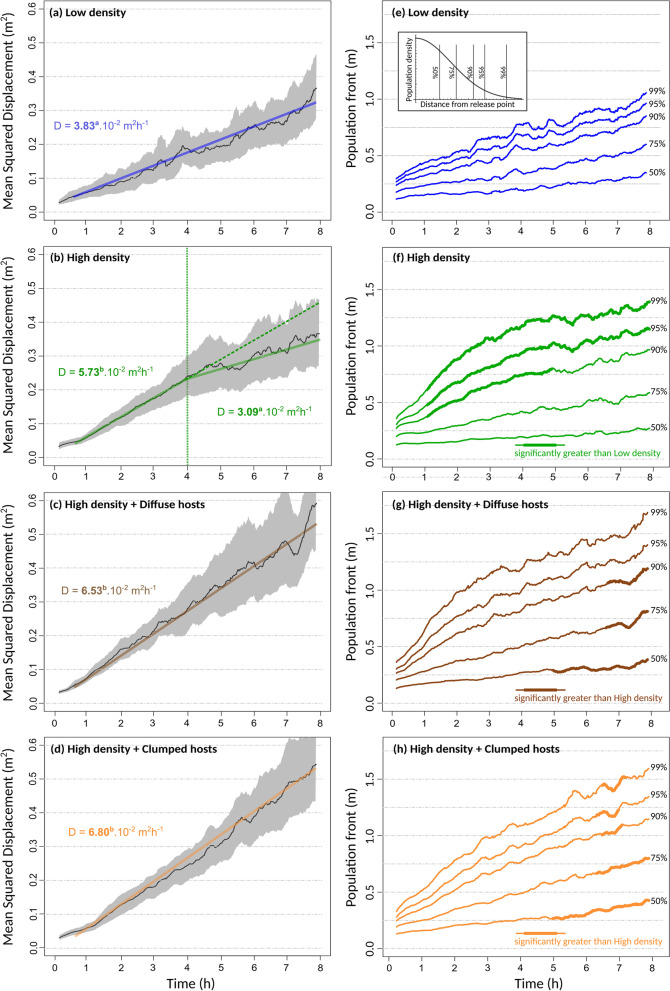
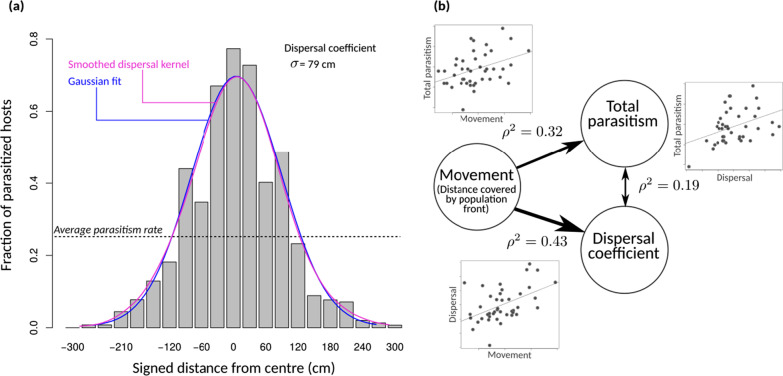
We experimentally studied the spatial propagation of groups of parasitoids and their patterns of parasitism. We investigated whether population spread is density-dependent, how it is affected by the presence of hosts, and whether the spatial distribution of parasitism (dispersal kernel) can be predicted from the observed spread of individuals. Using a novel experimental device and high-throughput imaging techniques, we continuously tracked the spatial spread of groups of parasitoids over large temporal and spatial scales (8 h; and 6 m, ca. 12,000 body lengths). We could thus study how population density, the presence of hosts and their spatial distribution impacted the rate of population spread, the spatial distribution of individuals during population expansion, the overall rate of parasitism and the dispersal kernel (position of parasitism events).
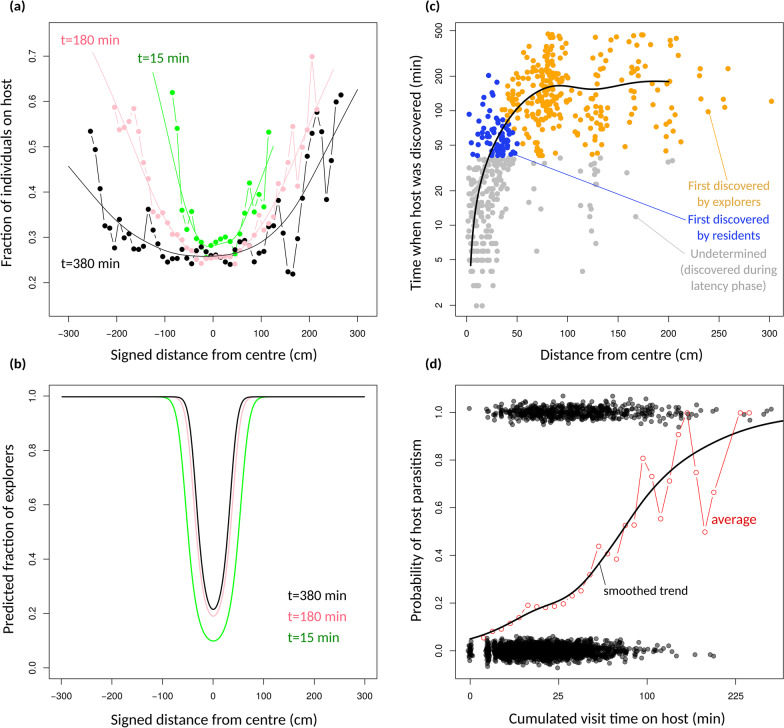
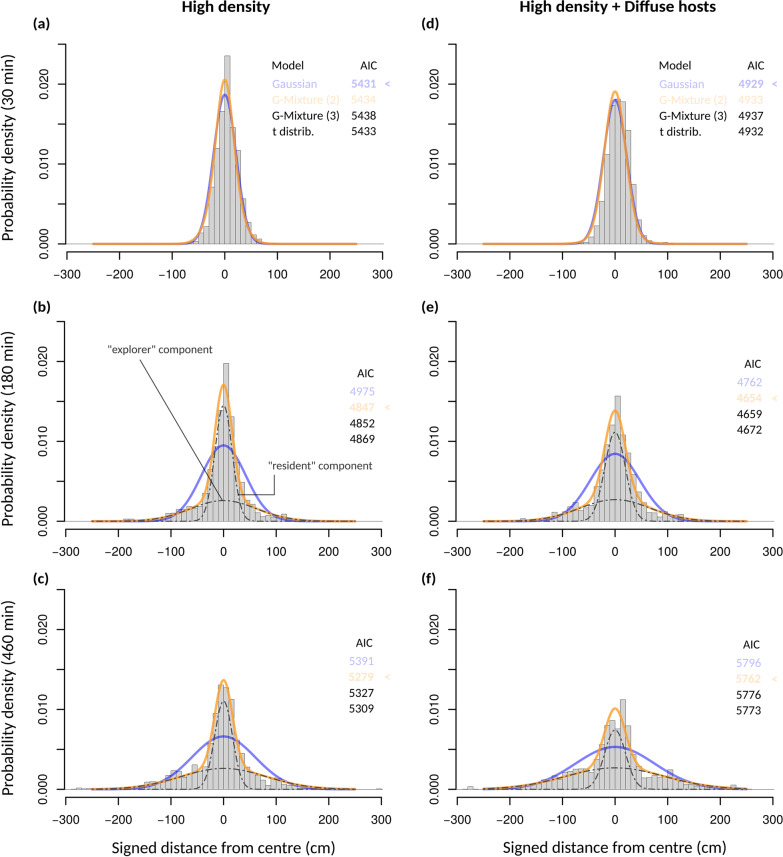
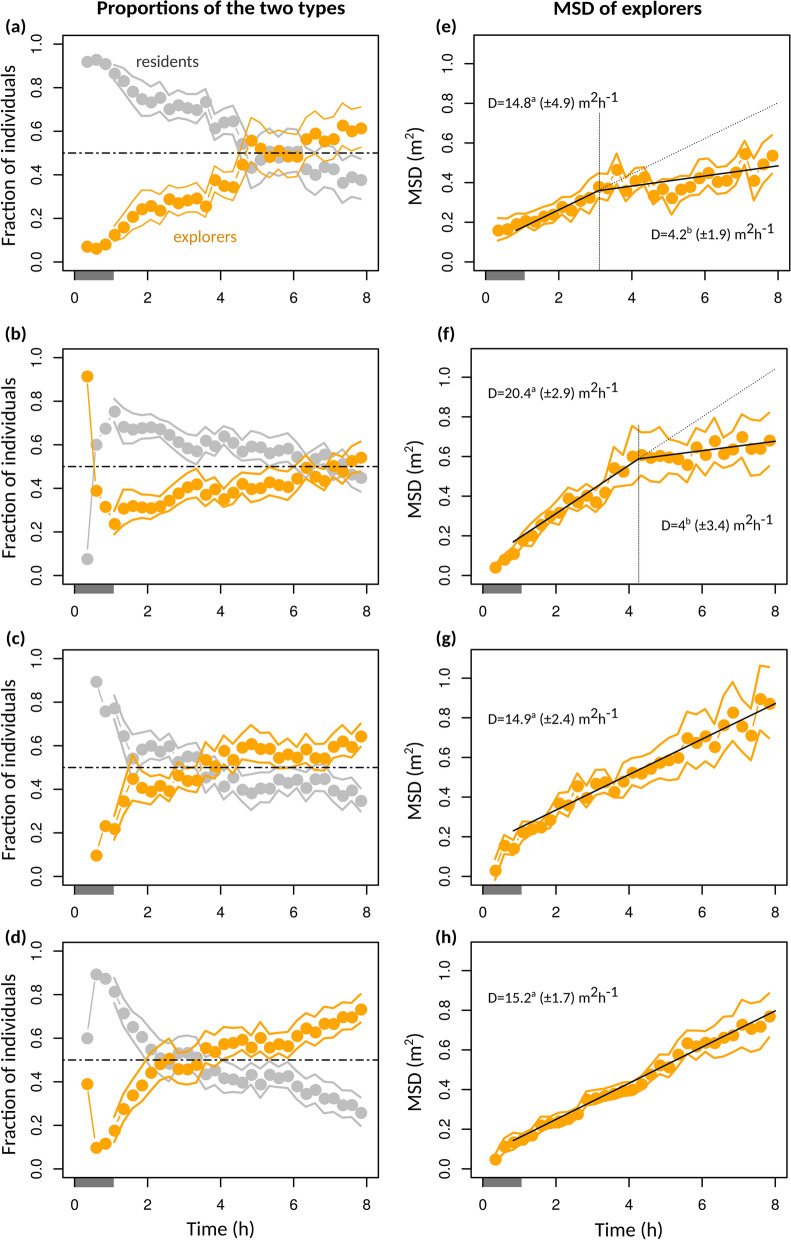
Higher population density accelerated population spread, but only transiently: the rate of spread reverted to low values after 4 h, in a "tortoise-hare" effect. Interestingly, the presence of hosts suppressed this transiency and permitted a sustained high rate of population spread. Importantly, we found that population spread did not obey classical diffusion, but involved dynamical switches between resident and explorer movement modes. Population distribution was therefore not Gaussian, though surprisingly the distribution of parasitism (dispersal kernel) was.
Even homogenous asexual groups of insects develop behavioural heterogeneities over a few hours, and the latter control patterns of population spread. Behavioural switching between resident and explorer states determined population distribution, density-dependence and dispersal. A simple Gaussian dispersal kernel did not reflect classical diffusion, but rather the interplay of several non-linearities at individual level. These results highlight the need to take into account behaviour and inter-individual heterogeneity to understand population spread in animals.
理解行为动态、个体间变异性和个体相互作用如何扩大规模以塑造动物种群的空间扩散和分布,是生态学中的一项重大挑战。对于诸如微小赤眼蜂这类生物防治剂而言,了解其移动策略对于预测田间害虫抑制效果也至关重要。
我们通过实验研究了寄生蜂群体的空间传播及其寄生模式。我们调查了种群扩散是否依赖密度,宿主的存在如何影响种群扩散,以及能否根据观察到的个体扩散来预测寄生的空间分布(扩散核)。利用一种新型实验装置和高通量成像技术,我们在较大的时间和空间尺度上(8小时;6米,约12000个体长)持续追踪寄生蜂群体的空间扩散。由此我们能够研究种群密度、宿主的存在及其空间分布如何影响种群扩散速率、种群扩张过程中个体的空间分布、总体寄生率以及扩散核(寄生事件的位置)。
较高的种群密度加速了种群扩散,但只是短暂的:扩散速率在4小时后恢复到低值,呈现出“龟兔效应”。有趣的是,宿主的存在抑制了这种短暂性,并使得种群能够持续以高扩散速率传播。重要的是,我们发现种群扩散并不遵循经典扩散规律,而是涉及定居和探索移动模式之间的动态转换。因此,种群分布并非高斯分布,尽管令人惊讶的是寄生的分布(扩散核)却是高斯分布。
即使是同质的无性昆虫群体,在数小时内也会出现行为异质性,而这种异质性控制着种群扩散模式。定居和探索状态之间的行为转换决定了种群分布、密度依赖性和扩散。简单的高斯扩散核并未反映经典扩散,而是反映了个体层面上几种非线性因素的相互作用。这些结果凸显了考虑行为和个体间异质性对于理解动物种群扩散的必要性。