Division of Molecular Oncology & Immunology, The Netherlands Cancer Institute, Amsterdam, the Netherlands.
Division of Molecular Carcinogenesis, The Netherlands Cancer Institute, Amsterdam, the Netherlands.
Nat Med. 2023 Mar;29(3):605-614. doi: 10.1038/s41591-023-02240-8. Epub 2023 Mar 2.
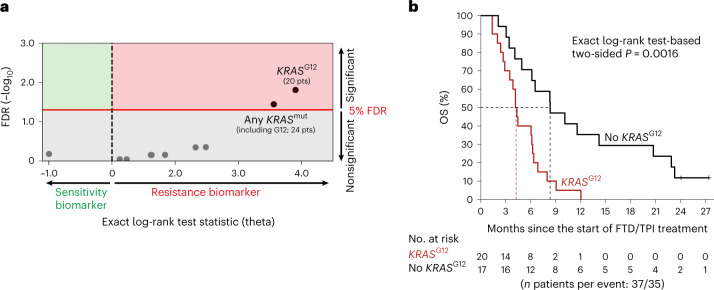
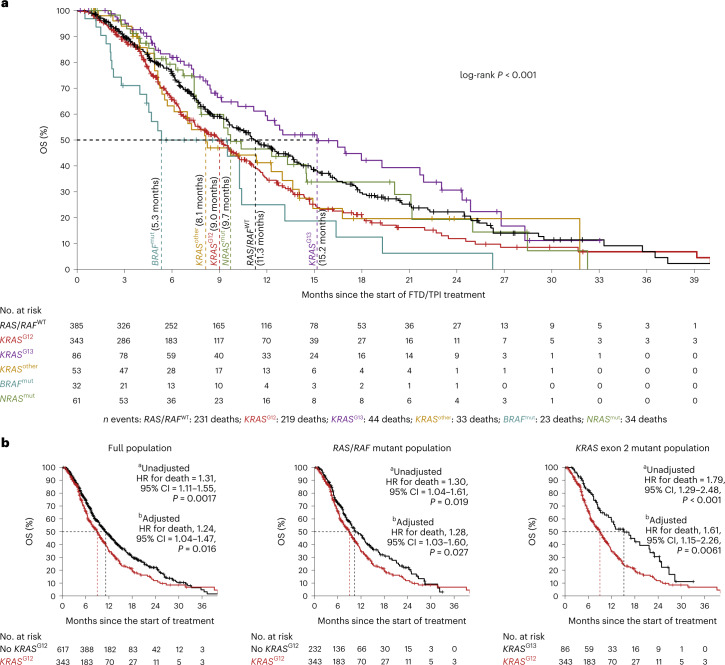
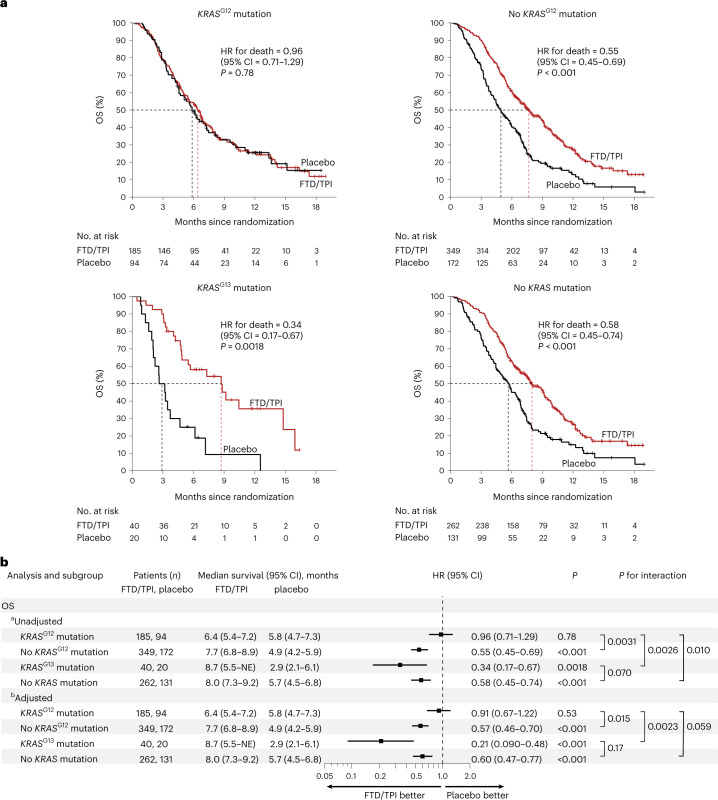
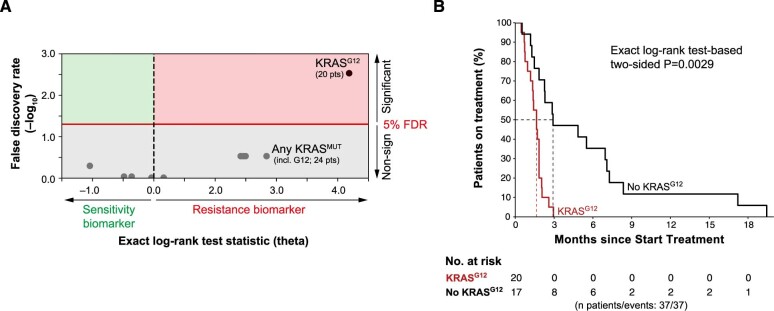
Genomics has greatly improved how patients with cancer are being treated; however, clinical-grade genomic biomarkers for chemotherapies are currently lacking. Using whole-genome analysis of 37 patients with metastatic colorectal cancer (mCRC) treated with the chemotherapy trifluridine/tipiracil (FTD/TPI), we identified KRAS codon G12 (KRAS) mutations as a potential biomarker of resistance. Next, we collected real-world data of 960 patients with mCRC receiving FTD/TPI and validated that KRAS mutations were significantly associated with poor survival, also in analyses restricted to the RAS/RAF mutant subgroup. We next analyzed the data of the global, double-blind, placebo-controlled, phase 3 RECOURSE trial (n = 800 patients) and found that KRAS mutations (n = 279) were predictive biomarkers for reduced overall survival (OS) benefit of FTD/TPI versus placebo (unadjusted interaction P = 0.0031, adjusted interaction P = 0.015). For patients with KRAS mutations in the RECOURSE trial, OS was not prolonged with FTD/TPI versus placebo (n = 279; hazard ratio (HR) = 0.97; 95% confidence interval (CI) = 0.73-1.20; P = 0.85). In contrast, patients with KRAS mutant tumors showed significantly improved OS with FTD/TPI versus placebo (n = 60; HR = 0.29; 95% CI = 0.15-0.55; P < 0.001). In isogenic cell lines and patient-derived organoids, KRAS mutations were associated with increased resistance to FTD-based genotoxicity. In conclusion, these data show that KRAS mutations are biomarkers for reduced OS benefit of FTD/TPI treatment, with potential implications for approximately 28% of patients with mCRC under consideration for treatment with FTD/TPI. Furthermore, our data suggest that genomics-based precision medicine may be possible for a subset of chemotherapies.
基因组学极大地改善了癌症患者的治疗方式;然而,目前缺乏用于化疗的临床级基因组生物标志物。我们对 37 名接受化疗氟嘧啶替匹嘧啶(FTD/TPI)治疗的转移性结直肠癌(mCRC)患者进行全基因组分析,发现 KRAS 密码子 G12(KRAS)突变是一种潜在的耐药生物标志物。接下来,我们收集了 960 名接受 FTD/TPI 治疗的 mCRC 患者的真实世界数据,并验证了 KRAS 突变与不良生存显著相关,在对 RAS/RAF 突变亚组的分析中也是如此。我们随后分析了全球、双盲、安慰剂对照、III 期 RECOURSE 试验(n=800 名患者)的数据,发现 KRAS 突变(n=279)是预测 FTD/TPI 相对于安慰剂总体生存(OS)获益降低的生物标志物(未调整的交互 P=0.0031,调整后的交互 P=0.015)。在 RECOURSE 试验中,KRAS 突变患者接受 FTD/TPI 治疗与安慰剂相比,OS 并未延长(n=279;风险比(HR)=0.97;95%置信区间(CI)=0.73-1.20;P=0.85)。相比之下,KRAS 突变肿瘤患者接受 FTD/TPI 治疗与安慰剂相比,OS 显著改善(n=60;HR=0.29;95%CI=0.15-0.55;P<0.001)。在同基因细胞系和患者来源的类器官中,KRAS 突变与 FTD 相关的遗传毒性增加的耐药性相关。总之,这些数据表明 KRAS 突变是 FTD/TPI 治疗 OS 获益降低的生物标志物,这可能对考虑接受 FTD/TPI 治疗的 mCRC 患者中的约 28%产生影响。此外,我们的数据表明,基于基因组学的精准医学可能适用于某些化疗药物。