• 文献检索
  • 文档翻译
  • 深度研究
  • 学术资讯
  • Suppr Zotero 插件Zotero 插件
  • 邀请有礼
  • 套餐&价格
  • 历史记录
应用&插件
Suppr Zotero 插件Zotero 插件浏览器插件Mac 客户端Windows 客户端微信小程序
定价
高级版会员购买积分包购买API积分包
服务
文献检索文档翻译深度研究API 文档MCP 服务
关于我们
关于 Suppr公司介绍联系我们用户协议隐私条款
关注我们

Suppr 超能文献

核心技术专利:CN118964589B侵权必究
粤ICP备2023148730 号-1Suppr @ 2026

文献检索

告别复杂PubMed语法,用中文像聊天一样搜索,搜遍4000万医学文献。AI智能推荐,让科研检索更轻松。

立即免费搜索

文件翻译

保留排版,准确专业,支持PDF/Word/PPT等文件格式,支持 12+语言互译。

免费翻译文档

深度研究

AI帮你快速写综述,25分钟生成高质量综述,智能提取关键信息,辅助科研写作。

立即免费体验

年龄大于40岁的患者中,约一半在关节镜下半月板部分切除术后6个月达到患者可接受的症状状态。

Approximately One Half of Patients Greater Than 40 Years Old Achieve Patient Acceptable Symptomatic State 6 Months After Arthroscopic Partial Meniscectomy.

作者信息

Bisson Leslie J, Goldstein Brett S, Levy Benjamin J

机构信息

Department of Orthopaedics, Jacobs School of Medicine and Biomedical Science, The State University of New York at Buffalo, Buffalo, New York, U.S.A.

Global Asset Allocation at Putnam Investments, Boston Massachusetts, U.S.A.

出版信息

Arthrosc Sports Med Rehabil. 2022 Dec 5;5(1):e51-e57. doi: 10.1016/j.asmr.2022.10.007. eCollection 2023 Feb.

DOI:10.1016/j.asmr.2022.10.007
PMID:36866296
原文链接:https://pmc.ncbi.nlm.nih.gov/articles/PMC9971894/
Abstract

PURPOSE

The purposes of this study were to 1) calculate the minimal clinically important difference (MCID) in a population of patients undergoing arthroscopic partial meniscectomy (APM) based on Knee Injury and Osteoarthritis Outcomes Scores (KOOS), 2) quantify the difference between the proportion of patients reaching MCID based on KOOS versus the proportion who considered surgery to be successful based on a "yes" answer to a patient acceptable symptom state (PASS) question, and 3) calculate the percentage of patients experiencing treatment failure (TF).

METHODS

A large, single-institution clinical database was queried for patients undergoing isolated APM (>40 years of age). Data were collected at regular time intervals, including KOOS and PASS outcome measures. Calculation of MCID using a distribution-based model was performed using preoperative KOOS scores as baseline. Comparison of the proportion of patients surpassing MCID was made to the proportion of patients answering "yes" to a tiered PASS question at 6 months after APM. Proportion of patients experiencing TF was calculated using patients who responded "no" to a PASS question and "yes" to a TF question.

RESULTS

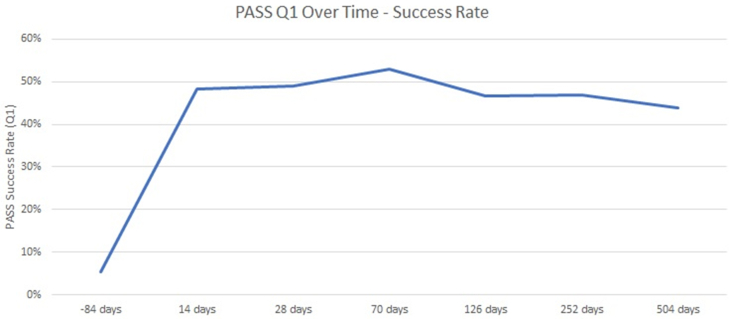
Three-hundred and fourteen of 969 patients met inclusion criteria. At 6 months following APM, the percentage of patients meeting or exceeding the MCID for each respective KOOS subscore ranged from 64 to 72% compared to 48% who achieved a PASS ( < .0001 for each subscore). Fourteen percent of patients experienced TF.

CONCLUSIONS

Six months after APM, approximately one half of the patients achieved a PASS and 15% experienced TF. The difference between achieving MCID based on each of the KOOS subscores and achieving success via PASS ranged from 16% to 24%. Thirty-eight percent of patients undergoing APM did not fit neatly into overt success or failure categorization.

LEVEL OF EVIDENCE

Level III, retrospective cohort study.

摘要

目的

本研究的目的是:1)基于膝关节损伤和骨关节炎疗效评分(KOOS),计算接受关节镜下部分半月板切除术(APM)患者群体的最小临床重要差异(MCID);2)量化基于KOOS达到MCID的患者比例与基于患者可接受症状状态(PASS)问题的“是”答案认为手术成功的患者比例之间的差异;3)计算经历治疗失败(TF)的患者百分比。

方法

查询一个大型单机构临床数据库中接受单纯APM(年龄>40岁)的患者。定期收集数据,包括KOOS和PASS结局指标。使用基于分布的模型,以术前KOOS评分作为基线计算MCID。将超过MCID的患者比例与APM后6个月对分层PASS问题回答“是”的患者比例进行比较。使用对PASS问题回答“否”且对TF问题回答“是”的患者计算经历TF的患者比例。

结果

969例患者中有314例符合纳入标准。APM后6个月,各KOOS子评分达到或超过MCID的患者百分比在64%至72%之间,而达到PASS的患者为48%(各子评分均P<0.0001)。14%的患者经历了TF。

结论

APM后6个月,约一半患者达到PASS,15%经历TF。基于各KOOS子评分达到MCID与通过PASS取得成功之间的差异在16%至24%之间。38%接受APM的患者不属于明显的成功或失败类别。

证据水平

III级,回顾性队列研究。

https://cdn.ncbi.nlm.nih.gov/pmc/blobs/2967/9971894/d1bfe20fb4f4/gr4.jpg
https://cdn.ncbi.nlm.nih.gov/pmc/blobs/2967/9971894/8222fff60f2a/gr1.jpg
https://cdn.ncbi.nlm.nih.gov/pmc/blobs/2967/9971894/301e760e8ff6/gr2.jpg
https://cdn.ncbi.nlm.nih.gov/pmc/blobs/2967/9971894/09a2ec4a874c/gr3.jpg
https://cdn.ncbi.nlm.nih.gov/pmc/blobs/2967/9971894/d1bfe20fb4f4/gr4.jpg
https://cdn.ncbi.nlm.nih.gov/pmc/blobs/2967/9971894/8222fff60f2a/gr1.jpg
https://cdn.ncbi.nlm.nih.gov/pmc/blobs/2967/9971894/301e760e8ff6/gr2.jpg
https://cdn.ncbi.nlm.nih.gov/pmc/blobs/2967/9971894/09a2ec4a874c/gr3.jpg
https://cdn.ncbi.nlm.nih.gov/pmc/blobs/2967/9971894/d1bfe20fb4f4/gr4.jpg

相似文献

1
Approximately One Half of Patients Greater Than 40 Years Old Achieve Patient Acceptable Symptomatic State 6 Months After Arthroscopic Partial Meniscectomy.年龄大于40岁的患者中,约一半在关节镜下半月板部分切除术后6个月达到患者可接受的症状状态。
Arthrosc Sports Med Rehabil. 2022 Dec 5;5(1):e51-e57. doi: 10.1016/j.asmr.2022.10.007. eCollection 2023 Feb.
2
Factors Associated With Clinically Significant Patient-Reported Outcomes After Primary Arthroscopic Partial Meniscectomy.与初次关节镜下部分半月板切除术治疗后具有临床意义的患者报告结局相关的因素。
Arthroscopy. 2019 May;35(5):1567-1575.e3. doi: 10.1016/j.arthro.2018.12.014. Epub 2019 Apr 15.
3
Defining the Minimal Clinically Important Difference and Patient Acceptable Symptom State for Microfracture of the Knee: A Psychometric Analysis at Short-term Follow-up.定义膝关节微骨折的最小临床重要差异和患者可接受的症状状态:短期随访的心理测量分析。
Am J Sports Med. 2020 Mar;48(4):876-883. doi: 10.1177/0363546520903279. Epub 2020 Feb 14.
4
Establishing the Minimal Clinically Important Difference and Patient-Acceptable Symptomatic State After Arthroscopic Meniscal Repair and Associated Variables for Achievement.关节镜半月板修复术后的最小临床重要差异和患者可接受的症状状态的建立及其实现的相关变量。
Arthroscopy. 2021 Dec;37(12):3479-3486. doi: 10.1016/j.arthro.2021.04.058. Epub 2021 May 6.
5
Preoperative Predictors of Arthroscopic Partial Meniscectomy Outcomes: The APM Index Score.关节镜下部分半月板切除术的术前预测因素:APM 指数评分。
Am J Sports Med. 2024 Jan;52(1):116-123. doi: 10.1177/03635465231210303.
6
Establishing Clinically Significant Outcomes After Meniscal Allograft Transplantation.半月板同种异体移植术后建立具有临床意义的结果。
Orthop J Sports Med. 2019 Jan 4;7(1):2325967118818462. doi: 10.1177/2325967118818462. eCollection 2019 Jan.
7
Determining the Patient Acceptable Symptomatic State for Patients Undergoing Arthroscopic Partial Meniscectomy in the Knee.确定膝关节关节镜下部分半月板切除术患者的可接受症状状态。
Am J Sports Med. 2020 Mar;48(4):847-852. doi: 10.1177/0363546520904017.
8
The Minimal Clinically Important Difference, Substantial Clinical Benefit, and Patient-Acceptable Symptomatic State after Medial Patellofemoral Ligament Reconstruction.髌股内侧韧带重建术后的最小临床重要差异、显著临床获益及患者可接受的症状状态
Arthrosc Sports Med Rehabil. 2022 Feb 5;4(2):e661-e678. doi: 10.1016/j.asmr.2021.12.009. eCollection 2022 Apr.
9
Magnetic Resonance Observation of Cartilage Repair Tissue (MOCART) Scores > 55 at 6 Months Postoperative Predict Ability to Achieve Patient Acceptable Symptomatic State at Minimum 1 Year Postoperative Following Autologous Chondrocyte Implantation for Grade IV Chondral Defects About the Patellofemoral Joint.在自体软骨细胞植入治疗髌股关节IV级软骨损伤术后6个月时,磁共振成像观察软骨修复组织(MOCART)评分>55可预测术后至少1年达到患者可接受症状状态的能力。
Cartilage. 2025 Mar;16(1):17-23. doi: 10.1177/19476035241244491. Epub 2024 Apr 13.
10
Identifying Aseptic Revision Total Knee Arthroplasty Diagnoses That Achieve Minimal Clinically Important Difference and Patient Acceptable Symptom State.确定达到最小临床重要差异和患者可接受症状状态的无菌性翻修全膝关节置换术诊断。
J Arthroplasty. 2023 Jul;38(7):1309-1312. doi: 10.1016/j.arth.2023.01.020. Epub 2023 Jan 23.

引用本文的文献

1
Anxiety and depression prior to total knee arthroplasty are associated with worse pain and subjective function: A prospective comparative study.全膝关节置换术前的焦虑和抑郁与更严重的疼痛及主观功能相关:一项前瞻性对照研究。
Knee Surg Sports Traumatol Arthrosc. 2025 Jan;33(1):308-318. doi: 10.1002/ksa.12336. Epub 2024 Jun 29.

本文引用的文献

1
Editorial: The New AAOS Guidelines on Knee Arthroscopy for Degenerative Meniscus Tears are a Step in the Wrong Direction.社论:美国矫形外科医师学会(AAOS)关于退行性半月板撕裂的膝关节镜检查新指南是朝着错误方向迈出的一步。
Clin Orthop Relat Res. 2022 Jan 1;480(1):1-3. doi: 10.1097/CORR.0000000000002068.
2
Better Outcomes but No Difference in Joint Space Narrowing at Five Years Among Patients Without Unstable Chondral Lesions Versus Those With Unstable Chondral Lesions (Left In Situ) at the Time of Arthroscopic Partial Meniscectomy.对于接受关节镜部分半月板切除术的患者,如果在手术时没有不稳定的软骨损伤(原位保留),那么在五年时,具有和不具有不稳定软骨损伤的患者在关节间隙狭窄方面没有差异,但结果更好。
Arthroscopy. 2022 Mar;38(3):936-944. doi: 10.1016/j.arthro.2021.06.030. Epub 2021 Jul 13.
3
Establishing the Minimal Clinically Important Difference and Patient-Acceptable Symptomatic State After Arthroscopic Meniscal Repair and Associated Variables for Achievement.关节镜半月板修复术后的最小临床重要差异和患者可接受的症状状态的建立及其实现的相关变量。
Arthroscopy. 2021 Dec;37(12):3479-3486. doi: 10.1016/j.arthro.2021.04.058. Epub 2021 May 6.
4
Preoperative Patient-Centric Predictors of Postoperative Outcomes in Patients Undergoing Arthroscopic Meniscectomy.接受关节镜半月板切除术患者的术后结局的术前以患者为中心的预测因素。
Arthroscopy. 2021 Mar;37(3):964-971. doi: 10.1016/j.arthro.2020.10.042. Epub 2020 Nov 2.
5
Surgeon and Patient Upper Extremity Dominance Does Not Influence Clinical Outcomes After Total Shoulder Arthroplasty.手术医生和患者的上肢优势并不影响全肩关节置换术后的临床结果。
Orthop J Sports Med. 2020 Jul 8;8(7):2325967120932106. doi: 10.1177/2325967120932106. eCollection 2020 Jul.
6
Determining the Patient Acceptable Symptomatic State for Patients Undergoing Arthroscopic Partial Meniscectomy in the Knee.确定膝关节关节镜下部分半月板切除术患者的可接受症状状态。
Am J Sports Med. 2020 Mar;48(4):847-852. doi: 10.1177/0363546520904017.
7
"Doctor, What Happens After My Meniscectomy?".“医生,我的半月板切除术后会怎样?”
J Bone Joint Surg Am. 2019 Nov 6;101(21):1965-1973. doi: 10.2106/JBJS.19.00082.
8
Outcomes and Patient Satisfaction With Arthroscopic Partial Meniscectomy for Degenerative and Traumatic Tears in Middle-Aged Patients With No or Mild Osteoarthritis.关节镜下部分半月板切除术治疗中青年无或轻度骨关节炎患者退行性和创伤性半月板撕裂的疗效和患者满意度。
Am J Sports Med. 2019 Aug;47(10):2412-2419. doi: 10.1177/0363546519857589. Epub 2019 Jun 28.
9
In Patients with Nonobstructive Meniscal Tears, Physiotherapy Was Noninferior to Arthroscopic Partial Meniscectomy for Knee Function Over a 24-Month Period.在非阻塞性半月板撕裂患者中,在24个月期间,物理治疗在膝关节功能方面不劣于关节镜下部分半月板切除术。
J Bone Joint Surg Am. 2019 May 15;101(10):941. doi: 10.2106/JBJS.19.00177.
10
Minimal clinically important difference of commonly used hip-, knee-, foot-, and ankle-specific questionnaires: a systematic review.常用髋关节、膝关节、足部和踝关节特定问卷的最小临床重要差异:系统评价。
J Clin Epidemiol. 2019 Sep;113:44-57. doi: 10.1016/j.jclinepi.2019.04.017. Epub 2019 May 9.