Department of Radiological, Oncological and Pathological Science, Sapienza University of Rome, 00185, Rome, Italy.
Department of Molecular Medicine, Sapienza University of Rome, Viale Regina Elena 291, 00161, Rome, Italy.
Cancer Immunol Immunother. 2023 Jul;72(7):2217-2231. doi: 10.1007/s00262-023-03384-9. Epub 2023 Mar 3.
Immune checkpoint inhibitors (ICIs) have particular, immune-related adverse events (irAEs), as a consequence of interfering with self-tolerance mechanisms. The incidence of irAEs varies depending on ICI class, administered dose and treatment schedule. The aim of this study was to define a baseline (T0) immune profile (IP) predictive of irAE development.
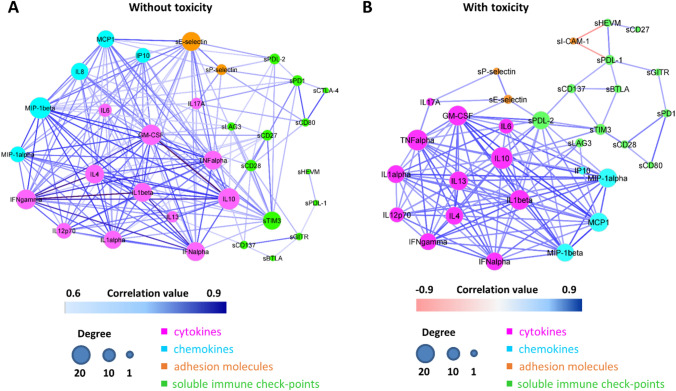
A prospective, multicenter study evaluating the immune profile (IP) of 79 patients with advanced cancer and treated with anti-programmed cell death protein 1 (anti-PD-1) drugs as a first- or second-line setting was performed. The results were then correlated with irAEs onset. The IP was studied by means of multiplex assay, evaluating circulating concentration of 12 cytokines, 5 chemokines, 13 soluble immune checkpoints and 3 adhesion molecules. Indoleamine 2, 3-dioxygenase (IDO) activity was measured through a modified liquid chromatography-tandem mass spectrometry using the high-performance liquid chromatography-mass spectrometry (HPLC-MS/MS) method. A connectivity heatmap was obtained by calculating Spearman correlation coefficients. Two different networks of connectivity were constructed, based on the toxicity profile.
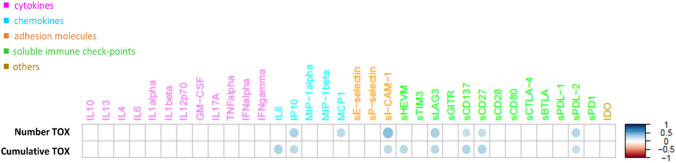
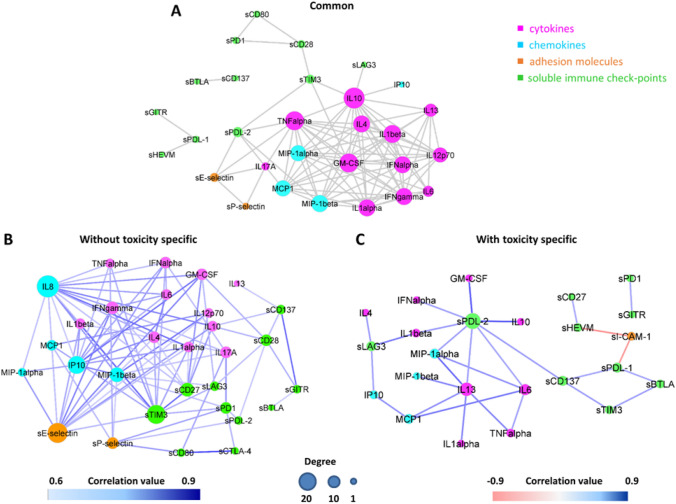
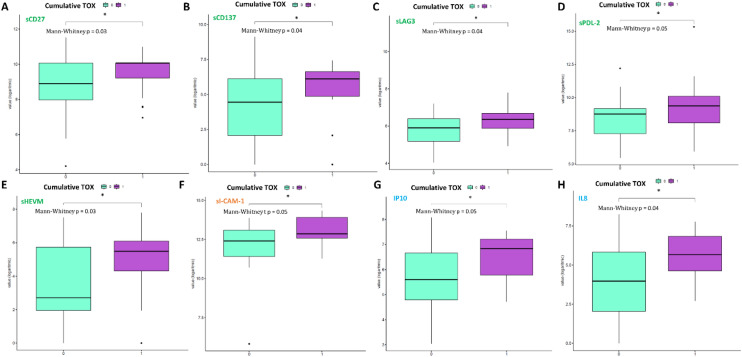
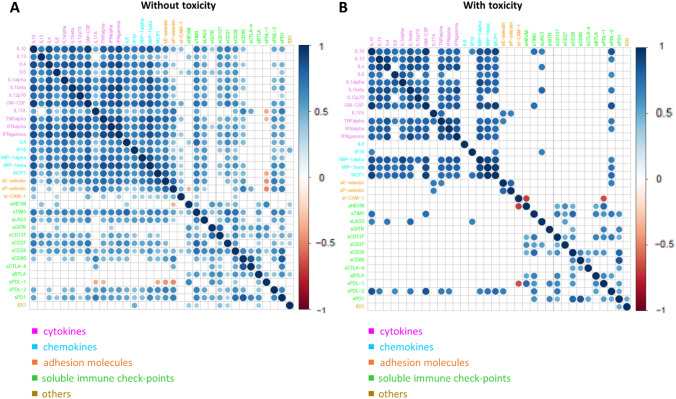
Toxicity was predominantly of low/moderate grade. High-grade irAEs were relatively rare, while cumulative toxicity was high (35%). Positive and statistically significant correlations between the cumulative toxicity and IP10 and IL8, sLAG3, sPD-L2, sHVEM, sCD137, sCD27 and sICAM-1 serum concentration were found. Moreover, patients who experienced irAEs had a markedly different connectivity pattern, characterized by disruption of most of the paired connections between cytokines, chemokines and connections of sCD137, sCD27 and sCD28, while sPDL-2 pair-wise connectivity values seemed to be intensified. Network connectivity analysis identified a total of 187 statistically significant interactions in patients without toxicity and a total of 126 statistically significant interactions in patients with toxicity. Ninety-eight interactions were common to both networks, while 29 were specifically observed in patients who experienced toxicity.
A particular, common pattern of immune dysregulation was defined in patients developing irAEs. This immune serological profile, if confirmed in a larger patient population, could lead to the design of a personalized therapeutic strategy in order to prevent, monitor and treat irAEs at an early stage.
免疫检查点抑制剂(ICIs)由于干扰自身耐受机制,会产生特殊的免疫相关不良反应(irAEs)。irAEs 的发生率取决于 ICI 类别、给予的剂量和治疗方案。本研究旨在确定预测 irAE 发展的基线(T0)免疫谱(IP)。
进行了一项前瞻性、多中心研究,评估了 79 例晚期癌症患者的免疫谱(IP),这些患者以抗程序性细胞死亡蛋白 1(抗 PD-1)药物作为一线或二线治疗。然后将结果与 irAE 发病相关联。通过多指标检测评估循环中 12 种细胞因子、5 种趋化因子、13 种可溶性免疫检查点和 3 种黏附分子的浓度,来研究 IP。使用高效液相色谱-串联质谱法(HPLC-MS/MS)方法通过改良的液相色谱-串联质谱法(LC-MS/MS)测量吲哚胺 2,3-双加氧酶(IDO)活性。通过计算 Spearman 相关系数获得连接热图。根据毒性谱构建了两个不同的连接网络。
毒性主要为低/中度。高等级 irAE 相对较少,但累积毒性较高(35%)。发现累积毒性与 IP10 和 IL8、sLAG3、sPD-L2、sHVEM、sCD137、sCD27 和 sICAM-1 血清浓度之间存在阳性且具有统计学意义的相关性。此外,发生 irAE 的患者具有明显不同的连接模式,其特征是细胞因子、趋化因子之间的大多数配对连接以及 sCD137、sCD27 和 sCD28 之间的连接中断,而 sPDL-2 对连接值似乎得到加强。网络连接分析确定了无毒性患者中 187 个具有统计学意义的相互作用,以及毒性患者中 126 个具有统计学意义的相互作用。两个网络共有的相互作用有 98 个,而在发生毒性的患者中则观察到 29 个特定的相互作用。
在发生 irAE 的患者中定义了一种特殊的、常见的免疫失调模式。如果在更大的患者人群中得到证实,这种免疫血清学特征可能会导致设计个性化的治疗策略,以便在早期预防、监测和治疗 irAE。