Xu Xiaohan, Zhang Yuelun, Tang Bo, Yu Xuerong, Huang Yuguang
Department of Anesthesiology, Chinese Academy of Medical Sciences & Peking Union Medical College Hospital, Beijing, China.
Medical Research Center, Chinese Academy of Medical Sciences & Peking Union Medical College Hospital, Beijing, China.
Front Med (Lausanne). 2023 Feb 15;10:1130359. doi: 10.3389/fmed.2023.1130359. eCollection 2023.
An aggressive plasma transfusion is associated with a decreased mortality in traumatic patients requiring massive transfusion (MT). However, it is controversial whether non-traumatic or non-massively transfused patients can benefit from high doses of plasma.
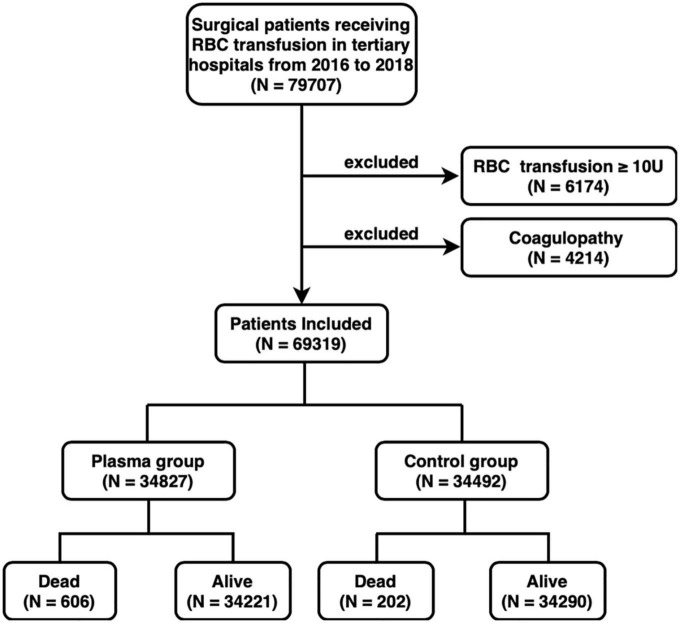
We performed a nationwide retrospective cohort study using data from Hospital Quality Monitoring System, which collected anonymized inpatient medical records from 31 provinces in mainland China. We included the patients who had at least one record of surgical procedure and received red blood cell transfusion on the day of surgery from 2016 to 2018. We excluded those receiving MT or diagnosed with coagulopathy at admission. The exposure variable was the total volume of fresh frozen plasma (FFP) transfused, and the primary outcome was in-hospital mortality. The relationship between them was assessed using multivariable logistic regression model adjusting 15 potential confounders.
A total of 69319 patients were included, and 808 died among them. A 100-ml increase in FFP transfusion volume was associated with a higher in-hospital mortality (odds ratio 1.05, 95% confidence interval 1.04-1.06, < 0.001) after controlling for the confounders. FFP transfusion volume was also associated with superficial surgical site infection, nosocomial infection, prolonged length of hospital stay, ventilation time, and acute respiratory distress syndrome. The significant association between FFP transfusion volume and in-hospital mortality was extended to the subgroups of cardiac surgery, vascular surgery, and thoracic or abdominal surgery.
A higher volume of perioperative FFP transfusion was associated with an increased in-hospital mortality and inferior postoperative outcomes in surgical patients without MT.
积极的血浆输注与需要大量输血(MT)的创伤患者死亡率降低相关。然而,非创伤性或非大量输血的患者是否能从高剂量血浆中获益仍存在争议。
我们利用医院质量监测系统的数据进行了一项全国性回顾性队列研究,该系统收集了中国大陆31个省份匿名的住院病历。我们纳入了2016年至2018年期间至少有一次手术记录且在手术当天接受红细胞输血的患者。我们排除了那些接受大量输血或入院时被诊断为凝血病的患者。暴露变量是输注的新鲜冰冻血浆(FFP)总量,主要结局是住院死亡率。使用多变量逻辑回归模型评估它们之间的关系,并对15个潜在混杂因素进行了调整。
共纳入69319例患者,其中808例死亡。在控制混杂因素后,FFP输血量每增加100 ml与更高的住院死亡率相关(比值比1.05,95%置信区间1.04 - 1.06,P < 0.001)。FFP输血量还与表浅手术部位感染、医院感染、住院时间延长、通气时间和急性呼吸窘迫综合征相关。FFP输血量与住院死亡率之间的显著关联在心脏手术、血管手术以及胸腹部手术亚组中均存在。
在未接受大量输血的手术患者中,围手术期较高的FFP输血量与住院死亡率增加及术后不良结局相关。