• 文献检索
  • 文档翻译
  • 深度研究
  • 学术资讯
  • Suppr Zotero 插件Zotero 插件
  • 邀请有礼
  • 套餐&价格
  • 历史记录
应用&插件
Suppr Zotero 插件Zotero 插件浏览器插件Mac 客户端Windows 客户端微信小程序
定价
高级版会员购买积分包购买API积分包
服务
文献检索文档翻译深度研究API 文档MCP 服务
关于我们
关于 Suppr公司介绍联系我们用户协议隐私条款
关注我们

Suppr 超能文献

核心技术专利:CN118964589B侵权必究
粤ICP备2023148730 号-1Suppr @ 2026

文献检索

告别复杂PubMed语法,用中文像聊天一样搜索,搜遍4000万医学文献。AI智能推荐,让科研检索更轻松。

立即免费搜索

文件翻译

保留排版,准确专业,支持PDF/Word/PPT等文件格式,支持 12+语言互译。

免费翻译文档

深度研究

AI帮你快速写综述,25分钟生成高质量综述,智能提取关键信息,辅助科研写作。

立即免费体验

在2019冠状病毒病出现之前北美医疗服务提供者对慢性非癌性疼痛使用阿片类药物的知识、信念和态度:一项定性研究的系统综述

Healthcare provider knowledge, beliefs, and attitudes regarding opioids for chronic non-cancer pain in North America prior to the emergence of COVID-19: A systematic review of qualitative research.

作者信息

Bell Louise V, Fitzgerald Sarah F, Flusk David, Poulin Patricia A, Rash Joshua A

机构信息

Department of Psychology, University of New Brunswick, Fredericton, New Brunswick, Canada.

Department of Psychology, Memorial University of Newfoundland, St. John's, Newfoundland and Labrador, Canada.

出版信息

Can J Pain. 2023 Feb 17;7(1):2156331. doi: 10.1080/24740527.2022.2156331. eCollection 2023.

DOI:10.1080/24740527.2022.2156331
PMID:36874229
原文链接:https://pmc.ncbi.nlm.nih.gov/articles/PMC9980668/
Abstract

BACKGROUND

Balance between benefits and harms of using opioids for the management of chronic noncancer pain (CNCP) must be carefully considered on a case-by-case basis. There is no one-size-fits-all approach that can be executed by prescribers and clinicians when considering this therapy.

AIM

The aim of this study was to identify barriers and facilitators for prescribing opioids for CNCP through a systematic review of qualitative literature.

METHODS

Six databases were searched from inception to June 2019 for qualitative studies reporting on provider knowledge, attitudes, beliefs, or practices pertaining to prescribing opioids for CNCP in North America. Data were extracted, risk of bias was rated, and confidence in evidence was graded.

RESULTS

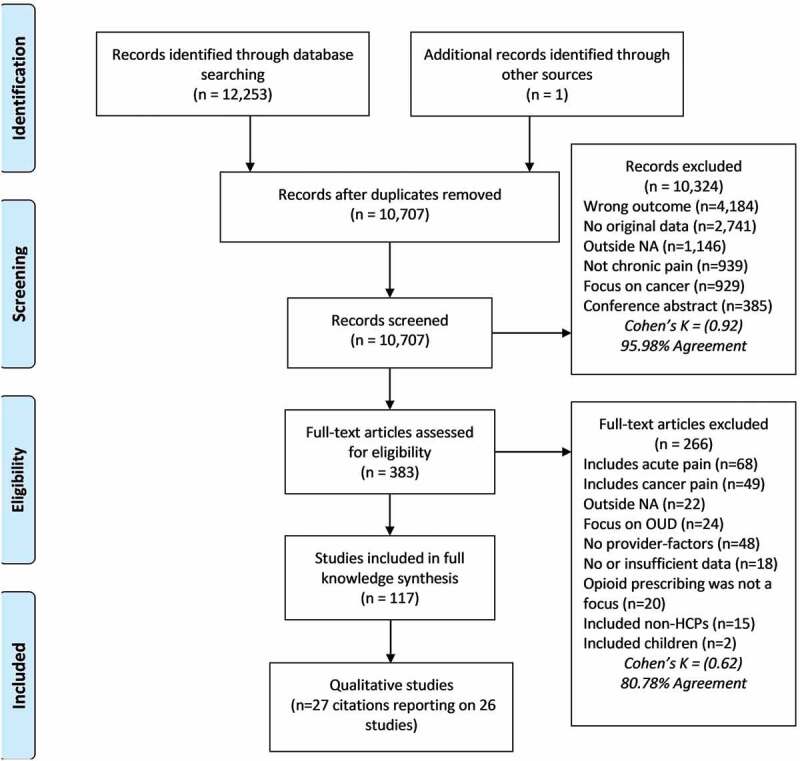
Twenty-seven studies reporting data from 599 health care providers were included. Ten themes emerged that influenced clinical decision making when prescribing opioids. Providers were more comfortable to prescribe opioids when (1) patients were actively engaged in pain self-management, (2) clear institutional prescribing policies were present and prescription drug monitoring programs were used, (3) long-standing relationships and strong therapeutic alliance were present, and (4) interprofessional supports were available. Factors that reduced likelihood of prescribing opioids included (1) uncertainty toward subjectivity of pain and efficacy of opioids, (2) concern for the patient (e.g., adverse effects) and community (i.e., diversion), (3) previous negative experiences (e.g., receiving threats), (4) difficulty enacting guidelines, and (5) organizational barriers (e.g., insufficient appointment duration and lengthy documentation).

CONCLUSIONS

Understanding barriers and facilitators that influence opioid-prescribing practices offers insight into modifiable targets for interventions that can support providers in delivering care consistent with practice guidelines.

摘要

背景

在使用阿片类药物治疗慢性非癌性疼痛(CNCP)时,必须逐案仔细权衡其利弊。在考虑这种治疗方法时,没有一种适用于所有情况的方法可供开处方者和临床医生采用。

目的

本研究的目的是通过对定性文献的系统评价,确定为CNCP开阿片类药物的障碍和促进因素。

方法

检索了6个数据库,从建库至2019年6月,查找有关北美地区为CNCP开阿片类药物的提供者知识、态度、信念或实践的定性研究。提取数据,评估偏倚风险,并对证据的可信度进行分级。

结果

纳入了27项报告来自599名医疗保健提供者数据的研究。出现了10个影响阿片类药物处方临床决策的主题。当(1)患者积极参与疼痛自我管理,(2)存在明确的机构处方政策并使用了处方药监测计划,(3)存在长期关系和强大的治疗联盟,以及(4)有跨专业支持时,提供者更愿意开阿片类药物。降低开阿片类药物可能性的因素包括:(1)对疼痛主观性和阿片类药物疗效的不确定性,(2)对患者(如不良反应)和社区(即药物转移)的担忧,(3)以前的负面经历(如受到威胁),(4)难以执行指南,以及(5)组织障碍(如预约时间不足和文件记录冗长)。

结论

了解影响阿片类药物处方实践的障碍和促进因素,有助于深入了解可改变的干预目标,从而支持提供者提供符合实践指南的护理。
https://cdn.ncbi.nlm.nih.gov/pmc/blobs/749d/9980668/30bac05aa181/UCJP_A_2156331_F0001_OC.jpg

相似文献

1
Healthcare provider knowledge, beliefs, and attitudes regarding opioids for chronic non-cancer pain in North America prior to the emergence of COVID-19: A systematic review of qualitative research.在2019冠状病毒病出现之前北美医疗服务提供者对慢性非癌性疼痛使用阿片类药物的知识、信念和态度:一项定性研究的系统综述
Can J Pain. 2023 Feb 17;7(1):2156331. doi: 10.1080/24740527.2022.2156331. eCollection 2023.
2
Healthcare provider knowledge, attitudes, beliefs, and practices surrounding the prescription of opioids for chronic non-cancer pain in North America: protocol for a mixed-method systematic review.北美医疗服务提供者在开具阿片类药物治疗慢性非癌性疼痛方面的知识、态度、信念和实践:一项混合方法系统评价的方案。
Syst Rev. 2018 Nov 13;7(1):189. doi: 10.1186/s13643-018-0858-7.
3
Beyond the black stump: rapid reviews of health research issues affecting regional, rural and remote Australia.超越黑木树:影响澳大利亚地区、农村和偏远地区的健康研究问题的快速综述。
Med J Aust. 2020 Dec;213 Suppl 11:S3-S32.e1. doi: 10.5694/mja2.50881.
4
Responsible, Safe, and Effective Prescription of Opioids for Chronic Non-Cancer Pain: American Society of Interventional Pain Physicians (ASIPP) Guidelines.慢性非癌性疼痛阿片类药物的合理、安全与有效处方:美国介入性疼痛医师协会(ASIPP)指南
Pain Physician. 2017 Feb;20(2S):S3-S92.
5
Primary care providers' perspective on prescribing opioids to older adults with chronic non-cancer pain: a qualitative study.初级保健提供者对老年慢性非癌痛患者开具阿片类药物的看法:一项定性研究。
BMC Geriatr. 2011 Jul 14;11:35. doi: 10.1186/1471-2318-11-35.
6
Presence of opioid safety initiatives, prescribing patterns for opioid and naloxone, and perceived barriers to prescribing naloxone: Cross-sectional survey results based on practice type, scope, and location.阿片类药物安全措施的存在、阿片类药物和纳洛酮的处方模式,以及开具纳洛酮的感知障碍:基于实践类型、范围和地点的横断面调查结果。
J Opioid Manag. 2021 Jan-Feb;17(1):19-38. doi: 10.5055/jom.2021.0611.
7
Barriers and enablers to monitoring and deprescribing opioid analgesics for chronic non-cancer pain: a systematic review with qualitative evidence synthesis using the Theoretical Domains Framework.监测和减少慢性非癌症疼痛阿片类镇痛药的障碍和促进因素:使用理论领域框架进行系统评价和定性证据综合。
BMJ Qual Saf. 2022 May;31(5):387-400. doi: 10.1136/bmjqs-2021-014186. Epub 2022 Jan 21.
8
Knowledge, Attitude and Practice Survey of Prescribing Opioids for Chronic Noncancer Pain in Taiwan-Comparison of Pain and Non-Pain Physicians.台湾慢性非癌性疼痛处方阿片类药物的知识、态度与实践调查——疼痛科与非疼痛科医生的比较
Pain Med. 2019 Dec 1;20(12):2397-2410. doi: 10.1093/pm/pnw189.
9
Interventions to Influence Opioid Prescribing Practices for Chronic Noncancer Pain: A Systematic Review and Meta-Analysis.干预措施对影响阿片类药物处方治疗慢性非癌痛的实践:系统评价和荟萃分析。
Am J Prev Med. 2021 Jan;60(1):e15-e26. doi: 10.1016/j.amepre.2020.07.012. Epub 2020 Nov 20.
10
Attributes, Attitudes, and Practices of Clinicians Concerned with Opioid Prescribing.关注阿片类药物处方的临床医生的特征、态度和实践。
Pain Med. 2019 Oct 1;20(10):1934-1941. doi: 10.1093/pm/pny204.

引用本文的文献

1
Navigating the patient-provider relationship during severe illness with lessons from a qualitative perspective of calciphylaxis.从钙过敏的定性角度汲取经验,在重症期间处理医患关系。
Sci Rep. 2025 Jul 2;15(1):23515. doi: 10.1038/s41598-025-09116-6.
2
Unraveling the Tapestry of Pain: A Comprehensive Review of Ethnic Variations, Cultural Influences, and Physiological Mechanisms in Pain Management and Perception.解读疼痛的全貌:对疼痛管理与感知中的种族差异、文化影响及生理机制的全面综述
Cureus. 2024 May 20;16(5):e60692. doi: 10.7759/cureus.60692. eCollection 2024 May.
3
Older Canadians' Perceptions of the Safety, Effectiveness and Accessibility of Cannabis for Medicinal Purposes: A Cross-Sectional Analysis.

本文引用的文献

1
General practitioners' attitudes towards opioids for non-cancer pain: a qualitative systematic review.全科医生对非癌性疼痛使用阿片类药物的态度:一项定性系统评价。
BMJ Open. 2022 Feb 1;12(2):e054945. doi: 10.1136/bmjopen-2021-054945.
2
A systematic review of strategies to improve appropriate use of opioids and to reduce opioid use disorder and deaths from prescription opioids.关于改善阿片类药物合理使用、减少阿片类药物使用障碍及处方阿片类药物所致死亡的策略的系统评价。
Can J Pain. 2018 Jul 31;2(1):218-235. doi: 10.1080/24740527.2018.1479842. eCollection 2018.
3
"One Size Fits All" Doesn't Fit When It Comes to Long-Term Opioid Use for People with Chronic Pain.
加拿大老年人对医用大麻的安全性、有效性和可及性的认知:一项横断面分析。
Drugs Aging. 2024 Apr;41(4):329-337. doi: 10.1007/s40266-024-01109-w. Epub 2024 Mar 19.
4
Physician perspectives on chronic pain management: barriers and the use of eHealth in the COVID-19 era.医生对慢性疼痛管理的看法:COVID-19 时代的障碍和电子健康的使用。
BMC Health Serv Res. 2023 Oct 20;23(1):1131. doi: 10.1186/s12913-023-10157-8.
对于慢性疼痛患者长期使用阿片类药物而言,“一刀切”并不适用。
Can J Pain. 2017 May 4;1(1):2-7. doi: 10.1080/24740527.2017.1319733. eCollection 2017.
4
Accessing care in multidisciplinary pain treatment facilities continues to be a challenge in Canada.在加拿大,多学科疼痛治疗机构的医疗服务获取仍然存在挑战。
Reg Anesth Pain Med. 2020 Dec;45(12):943-948. doi: 10.1136/rapm-2020-101935. Epub 2020 Oct 6.
5
Impact of COVID-19 pandemic on chronic pain management: Looking for the best way to deliver care.COVID-19 大流行对慢性疼痛管理的影响:寻找提供护理的最佳方式。
Best Pract Res Clin Anaesthesiol. 2020 Sep;34(3):529-537. doi: 10.1016/j.bpa.2020.07.001. Epub 2020 Jul 17.
6
Caring for patients with pain during the COVID-19 pandemic: consensus recommendations from an international expert panel.在 COVID-19 大流行期间关爱疼痛患者:国际专家小组的共识建议。
Anaesthesia. 2020 Jul;75(7):935-944. doi: 10.1111/anae.15076. Epub 2020 Apr 26.
7
Managing patients with chronic pain during the COVID-19 outbreak: considerations for the rapid introduction of remotely supported (eHealth) pain management services.在2019冠状病毒病疫情期间管理慢性疼痛患者:快速引入远程支持(电子健康)疼痛管理服务的注意事项
Pain. 2020 May;161(5):889-893. doi: 10.1097/j.pain.0000000000001885.
8
Improving Residency Education on Chronic Pain and Opioid Use Disorder: Evaluation of CDC Guideline-Based Education.改善慢性疼痛和阿片类药物使用障碍的住院医师教育:基于 CDC 指南的教育评估。
Subst Use Misuse. 2020;55(4):684-690. doi: 10.1080/10826084.2019.1691600. Epub 2019 Nov 22.
9
Opioid Tapering and the Patient-Provider Relationship.阿片类药物减量与医患关系
J Gen Intern Med. 2020 Jan;35(1):8-9. doi: 10.1007/s11606-019-05337-4.
10
Canada's hidden opioid crisis: the health care system's inability to manage high-dose opioid patients: Fallout from the 2017 Canadian opioid guidelines.加拿大隐藏的阿片类药物危机:医疗保健系统无力管理高剂量阿片类药物患者:2017年加拿大阿片类药物指南的影响
Can Fam Physician. 2019 Sep;65(9):612-614.