Shamsi Shokoofeh, Francis Nidhish, Masiga Juliet, Barton Diane P, Zhu Xiaocheng, Pearce Luke, McLellan Matthew
School of Agricultural, Environmental and Veterinary Sciences, Charles Sturt University, Wagga Wagga, Australia.
Kenya Veterinary Vaccines Production Institute(KEVEVAPI), Road A off Enterprise Road, Nairobi, Kenya.
Food Waterborne Parasitol. 2023 Feb 3;30:e00189. doi: 10.1016/j.fawpar.2023.e00189. eCollection 2023 Mar.
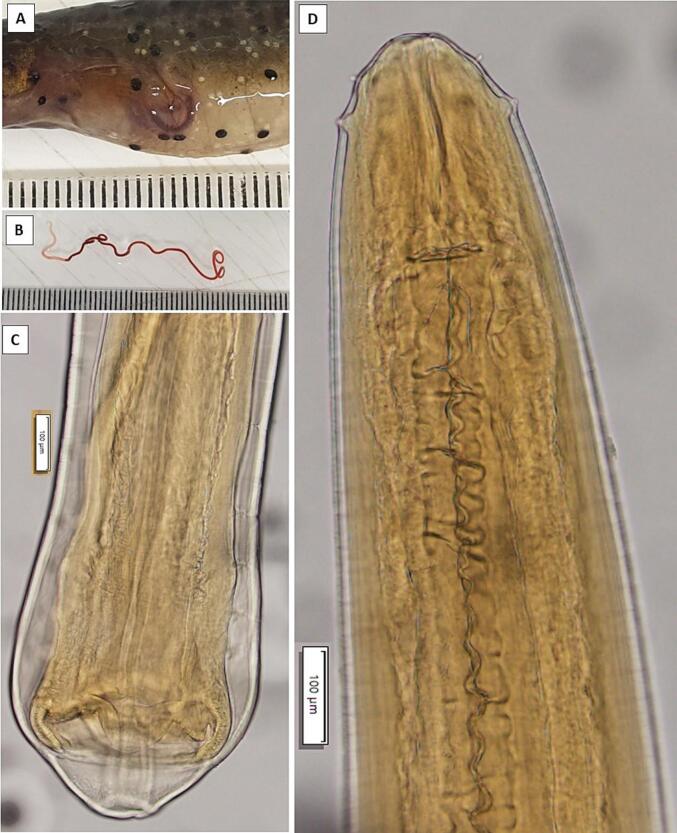
In Australia, nematodes belonging to the genus were believed to be endemic species until the late 20th century when they were all considered to be , invalid or . Although these nematodes have frequently been reported in Australian fish, reptiles, and birds and cause disease or mortality among them, there has been no attempt to date to characterise them genetically. Globally, also, no one has validated or defined suitable genetic markers to distinguish between species of . In this study, adult from little black cormorant (; = 3) and larvae from mountain galaxias ( = 2) and a Murray cod (, = 1), and a Murray cod-trout cod hybrids ( x , n = 1) were available for morphological examination and molecular characterisation. The adult nematodes from cormorants were identified as . Sequences of the 18S and ITS regions were then obtained for all nematodes, which were identical among all specimens (larvae and adults) and also identical to those of available in the GenBank. However, only one base pair difference exists between the 18S sequences of and with limited sequences available in GenBank accompanied with proper morphological data for the nematodes. With that limitation in mind, identifying our specimens as suggests spill-over - that it is an introduced parasite species that has successfully established its life cycle among Australian native species - may have occurred. Our study is the first report of in the little black cormorant, Our results do not exclude the possibility of the occurrence of other species of either native or exotic, in Australia. This parasite is zoonotic and with increasing demand for fish and changing dietary preferences, such as the consumption of raw or undercooked fish, its occurrence in the flesh of the fish is concerning. This parasite is also associated with anthropogenic habitat alteration affecting the reproductive success of the infected hosts. Therefore, awareness among the relevant authorities of the presence of the parasite in Australia and its adverse impact on native animals is crucial for the success of conservation plans such as fish recovery and relocation efforts.
在澳大利亚,属于该属的线虫一直被认为是本土物种,直到20世纪末,它们都被视为无效或未确定的物种。尽管这些线虫在澳大利亚的鱼类、爬行动物和鸟类中经常被报道,并导致它们发病或死亡,但迄今为止尚未有人尝试对其进行基因特征分析。在全球范围内,也没有人验证或定义合适的基因标记来区分该属的物种。在本研究中,有来自小黑鸬鹚(;=3)的成虫、山纹南乳鱼(=2)和墨累鳕鱼(,=1)的幼虫,以及一条墨累鳕鱼 - 鳟鳕鱼杂交种(x,n = 1)可用于形态学检查和分子特征分析。来自鸬鹚的成虫线虫被鉴定为。然后获得了所有线虫的18S和ITS区域序列,所有标本(幼虫和成虫)的序列相同,并且与GenBank中可用的序列也相同。然而,在GenBank中可用序列有限且伴有线虫适当形态学数据的情况下,和的18S序列之间仅存在一个碱基对差异。考虑到这一局限性,将我们的标本鉴定为表明可能发生了溢出——即它是一种引入的寄生虫物种,已在澳大利亚本土物种中成功建立了其生命周期。我们的研究是关于小黑鸬鹚中该物种的首次报告。我们的结果并不排除在澳大利亚存在其他本土或外来物种的可能性。这种寄生虫是人畜共患病的,随着对鱼类需求的增加和饮食偏好的变化,如生食或未煮熟的鱼类消费,其在鱼肉中的出现令人担忧。这种寄生虫还与影响受感染宿主繁殖成功率的人为栖息地改变有关。因此,相关当局了解该寄生虫在澳大利亚的存在及其对本土动物的不利影响,对于鱼类恢复和重新安置等保护计划的成功至关重要。