Floyrac Aymeric, Doumergue Adrien, Legriel Stéphane, Deye Nicolas, Megarbane Bruno, Richard Alexandra, Meppiel Elodie, Masmoudi Sana, Lozeron Pierre, Vicaut Eric, Kubis Nathalie, Holcman David
Applied Mathematics and Computational Biology, Ecole Normale Supérieure-PSL, Paris, France.
Medical-Surgical Intensive Care Department, Centre Hospitalier de Versailles, Le Chesnay, France.
Front Neurosci. 2023 Feb 15;17:988394. doi: 10.3389/fnins.2023.988394. eCollection 2023.
Despite multimodal assessment (clinical examination, biology, brain MRI, electroencephalography, somatosensory evoked potentials, mismatch negativity at auditory evoked potentials), coma prognostic evaluation remains challenging.
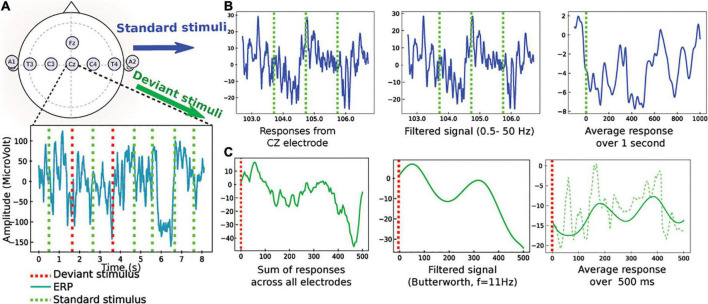
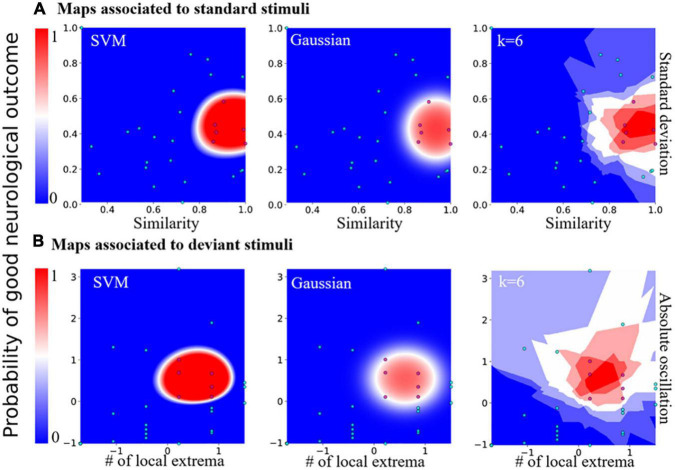
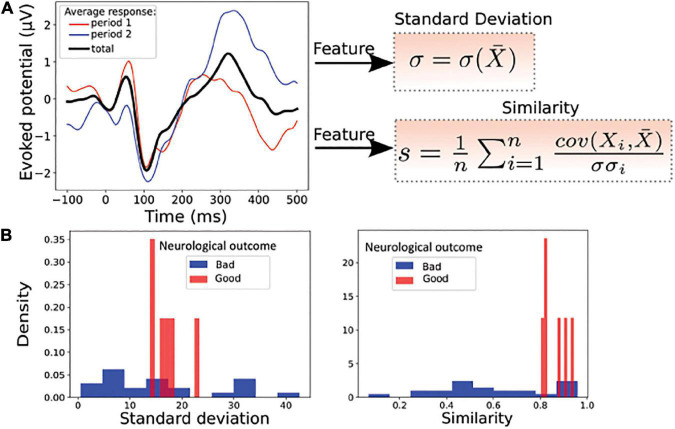
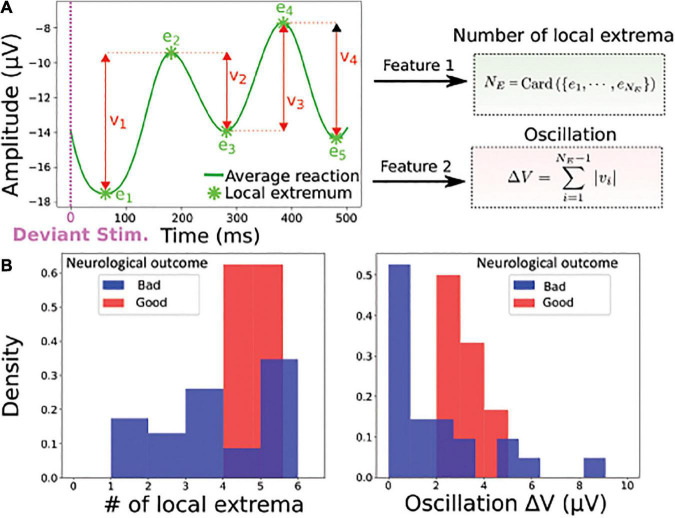
We present here a method to predict the return to consciousness and good neurological outcome based on classification of auditory evoked potentials obtained during an oddball paradigm. Data from event-related potentials (ERPs) were recorded noninvasively using four surface electroencephalography (EEG) electrodes in a cohort of 29 post-cardiac arrest comatose patients (between day 3 and day 6 following admission). We extracted retrospectively several EEG features (standard deviation and similarity for standard auditory stimulations and number of extrema and oscillations for deviant auditory stimulations) from the time responses in a window of few hundreds of milliseconds. The responses to the standard and the deviant auditory stimulations were thus considered independently. By combining these features, based on machine learning, we built a two-dimensional map to evaluate possible group clustering.
Analysis in two-dimensions of the present data revealed two separated clusters of patients with good versus bad neurological outcome. When favoring the highest specificity of our mathematical algorithms (0.91), we found a sensitivity of 0.83 and an accuracy of 0.90, maintained when calculation was performed using data from only one central electrode. Using Gaussian, K-neighborhood and SVM classifiers, we could predict the neurological outcome of post-anoxic comatose patients, the validity of the method being tested by a cross-validation procedure. Moreover, the same results were obtained with one single electrode (Cz).
statistics of standard and deviant responses considered separately provide complementary and confirmatory predictions of the outcome of anoxic comatose patients, better assessed when combining these features on a two-dimensional statistical map. The benefit of this method compared to classical EEG and ERP predictors should be tested in a large prospective cohort. If validated, this method could provide an alternative tool to intensivists, to better evaluate neurological outcome and improve patient management, without neurophysiologist assistance.
尽管采用了多模态评估(临床检查、生物学检查、脑部磁共振成像、脑电图、体感诱发电位、听觉诱发电位失匹配负波),昏迷预后评估仍然具有挑战性。
我们在此介绍一种基于对在oddball范式中获得的听觉诱发电位进行分类来预测意识恢复和良好神经学转归的方法。在29名心脏骤停后昏迷患者队列(入院后第3天至第6天)中,使用四个表面脑电图(EEG)电极以非侵入性方式记录事件相关电位(ERP)数据。我们回顾性地从几百毫秒窗口内的时间反应中提取了几个EEG特征(标准听觉刺激的标准差和相似性以及偏差听觉刺激的极值和振荡数量)。因此,对标准和偏差听觉刺激的反应是独立考虑的。通过结合这些特征,基于机器学习,我们构建了一个二维图来评估可能的组聚类。
对当前数据的二维分析揭示了神经学转归良好与不良的患者分为两个不同的聚类。当倾向于我们数学算法的最高特异性(0.91)时,我们发现敏感性为0.83,准确性为0.90,当仅使用来自一个中央电极的数据进行计算时该结果得以维持。使用高斯、K邻域和支持向量机分类器,我们能够预测缺氧后昏迷患者的神经学转归,该方法的有效性通过交叉验证程序进行测试。此外,使用单个电极(Cz)也获得了相同的结果。
分别考虑标准和偏差反应的统计数据为缺氧昏迷患者的转归提供了互补性和验证性预测,当在二维统计图上结合这些特征时评估效果更佳。与经典EEG和ERP预测指标相比,该方法的优势应在大型前瞻性队列中进行测试。如果得到验证,该方法可为重症监护医生提供一种替代工具,以便在无需神经生理学家协助的情况下更好地评估神经学转归并改善患者管理。