Ito Masaaki, Yajima Satoshi, Suzuki Takashi, Oshima Yoko, Nanami Tatsuki, Sumazaki Makoto, Shiratori Fumiaki, Wang Hao, Hu Liubing, Takizawa Hirotaka, Li Shu-Yang, Iwadate Yasuo, Hiwasa Takaki, Shimada Hideaki
Department of Clinical Oncology, Toho University Graduate School of Medicine, Tokyo 143-8541, Japan.
Department of Gastroenterological Surgery, Toho University School of Medicine, Tokyo 143-8541, Japan.
Med Int (Lond). 2023 Jan 31;3(2):11. doi: 10.3892/mi.2023.71. eCollection 2023 Mar-Apr.
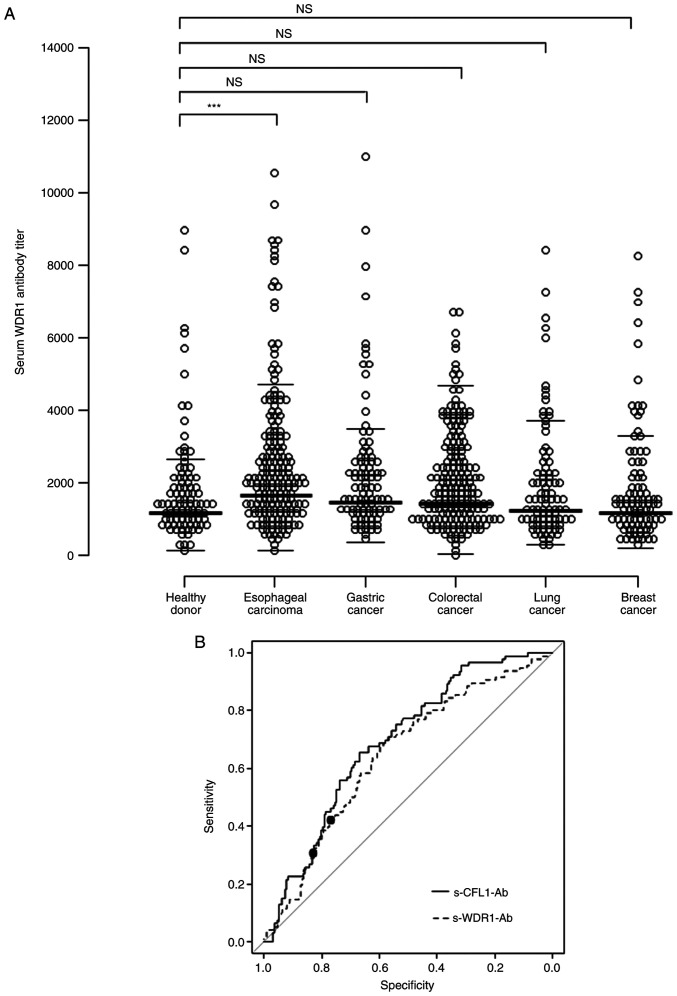
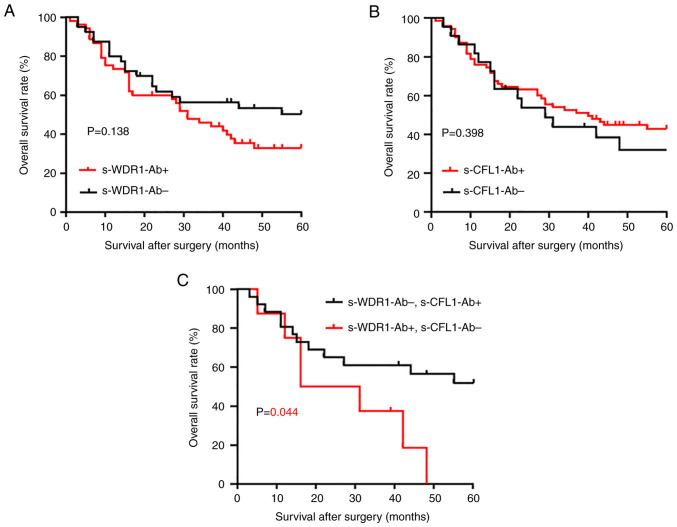
WD repeat-containing protein 1 (WDR1) regulates the cofilin 1 (CFL1) activity, promotes cytoskeleton remodeling, and thus, facilitates cell migration and invasion. A previous study reported that autoantibodies against CFL1 and β-actin were useful biomarkers for diagnosing and predicting the prognosis of patients with esophageal carcinoma. Therefore, the present study aimed to evaluate the serum levels of anti-WDR1 antibodies (s-WDR1-Abs) combined with serum levels of anti-CFL1 antibodies (s-CFL1-Abs) in patients with esophageal carcinoma. Serum samples obtained from 192 patients with esophageal carcinoma and other solid cancers. And s-WDR1-Ab and s-CFL1-Ab titers were analyzed using the amplified luminescent proximity homogeneous assay-linked immunosorbent assay. Compared with those of healthy donors, the s-WDR1-Ab levels were significantly higher in the 192 patients with esophageal, whereas these were not significantly higher in the samples from patients with gastric, colorectal, lung, or breast cancer. In 91 patients treated with surgery, sex, tumor depth, lymph node metastasis, stage and C-reactive protein levels were significantly associated with overall survival, as determined using the log-rank test, whereas the squamous cell carcinoma antigen, p53 antibody and s-WDR1-Ab levels tended to be associated with a worse prognosis. Although no significant difference was observed in the survival between the positive and negative groups of s-WDR1-Abs or s-CFL1-Abs alone in the Kaplan-Meier test, the patients in the s-WDR1-Ab-positive and s-CFL1-Ab-negative groups exhibited a significantly poorer prognosis in the overall survival analysis. On the whole, the present study demonstrates that the combination of positive anti-WDR1 antibodies with negative anti-CFL1 antibodies in serum may be a poor prognostic factor for patients with esophageal carcinoma.
含WD重复序列蛋白1(WDR1)调节丝切蛋白1(CFL1)的活性,促进细胞骨架重塑,从而促进细胞迁移和侵袭。先前的一项研究报道,抗CFL1和β-肌动蛋白自身抗体是诊断和预测食管癌患者预后的有用生物标志物。因此,本研究旨在评估食管癌患者血清抗WDR1抗体(s-WDR1-Abs)水平与血清抗CFL1抗体(s-CFL1-Abs)水平。从192例食管癌患者和其他实体癌患者中获取血清样本。并使用放大发光邻近均相分析-联免疫吸附测定法分析s-WDR1-Ab和s-CFL1-Ab滴度。与健康供体相比,192例食管癌患者的s-WDR1-Ab水平显著更高,而胃癌、结直肠癌、肺癌或乳腺癌患者样本中的s-WDR1-Ab水平没有显著升高。在91例接受手术治疗的患者中,采用对数秩检验确定,性别、肿瘤深度、淋巴结转移、分期和C反应蛋白水平与总生存期显著相关,而鳞状细胞癌抗原、p53抗体和s-WDR1-Ab水平往往与较差的预后相关。虽然在Kaplan-Meier检验中,单独的s-WDR1-Abs或s-CFL1-Abs阳性和阴性组之间的生存率没有显著差异,但在总生存分析中,s-WDR1-Ab阳性和s-CFL1-Ab阴性组的患者预后明显较差。总体而言,本研究表明,血清中抗WDR1抗体阳性与抗CFL1抗体阴性相结合可能是食管癌患者预后不良的一个因素。