Department of Marine Chemistry and Geochemistry, Woods Hole Oceanographic Institution, Woods Hole, MA 02543.
Geochemistry Department, Lamont-Doherty Earth Observatory, Palisades, NY 10964.
Proc Natl Acad Sci U S A. 2023 Mar 14;120(11):e2217946120. doi: 10.1073/pnas.2217946120. Epub 2023 Mar 6.
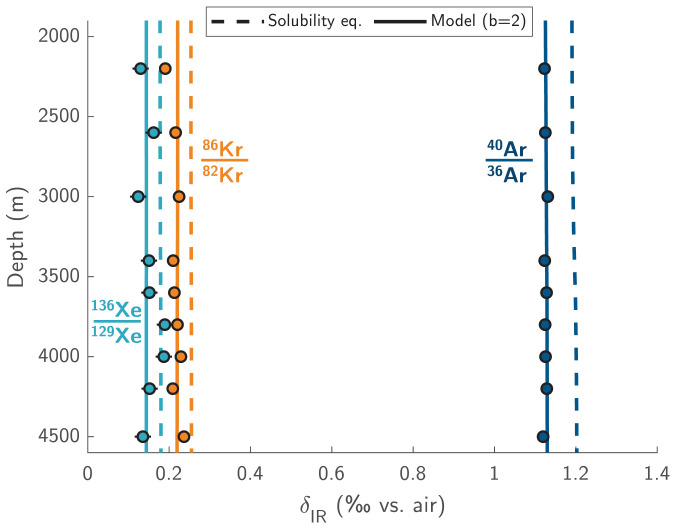
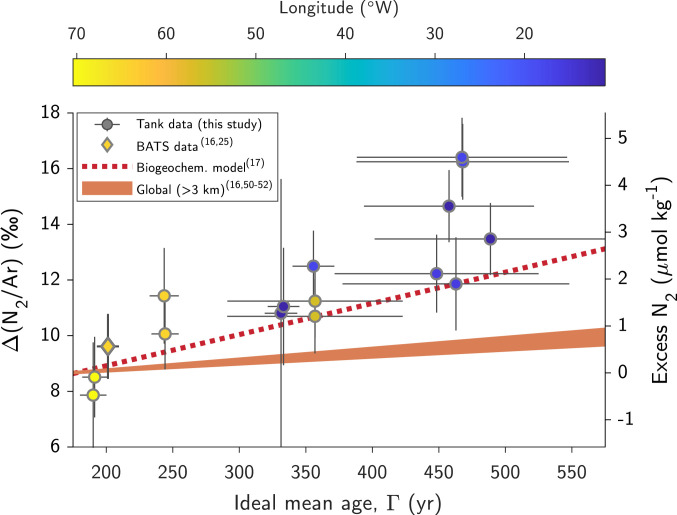
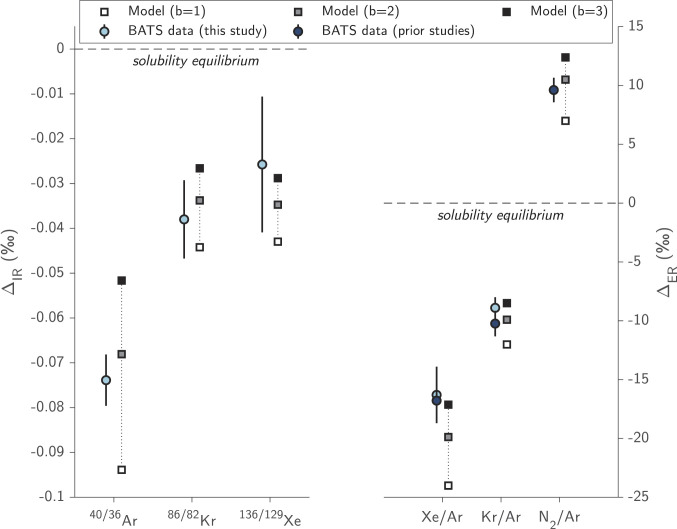
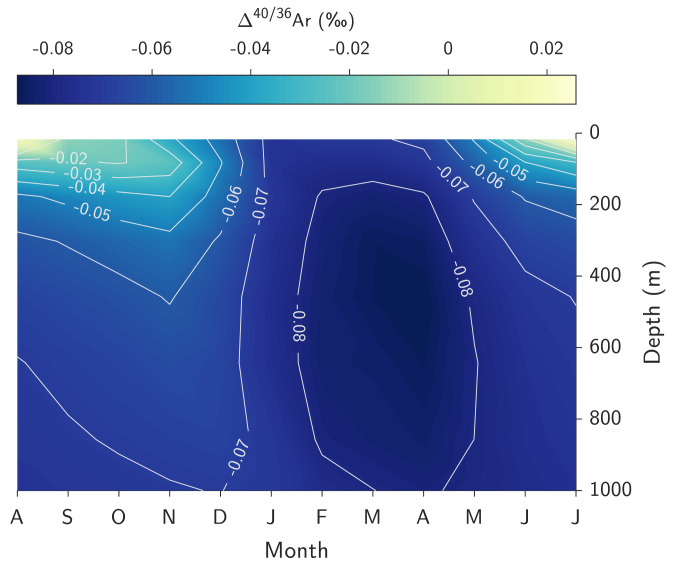
Gas exchange between the atmosphere and ocean interior profoundly impacts global climate and biogeochemistry. However, our understanding of the relevant physical processes remains limited by a scarcity of direct observations. Dissolved noble gases in the deep ocean are powerful tracers of physical air-sea interaction due to their chemical and biological inertness, yet their isotope ratios have remained underexplored. Here, we present high-precision noble gas isotope and elemental ratios from the deep North Atlantic (~32°N, 64°W) to evaluate gas exchange parameterizations using an ocean circulation model. The unprecedented precision of these data reveal deep-ocean undersaturation of heavy noble gases and isotopes resulting from cooling-driven air-to-sea gas transport associated with deep convection in the northern high latitudes. Our data also imply an underappreciated and large role for bubble-mediated gas exchange in the global air-sea transfer of sparingly soluble gases, including O, N, and SF. Using noble gases to validate the physical representation of air-sea gas exchange in a model also provides a unique opportunity to distinguish physical from biogeochemical signals. As a case study, we compare dissolved N/Ar measurements in the deep North Atlantic to physics-only model predictions, revealing excess N from benthic denitrification in older deep waters (below 2.9 km). These data indicate that the rate of fixed N removal in the deep Northeastern Atlantic is at least three times higher than the global deep-ocean mean, suggesting tight coupling with organic carbon export and raising potential future implications for the marine N cycle.
大气与海洋内部之间的气体交换深刻影响着全球气候和生物地球化学。然而,由于缺乏直接观测,我们对相关物理过程的理解仍然有限。深海中的溶解稀有气体由于其化学和生物惰性,是物理海洋-大气相互作用的有力示踪剂,但其同位素比值仍未得到充分探索。在这里,我们展示了北大西洋深处(~32°N,64°W)的高精度稀有气体同位素和元素比值,以使用海洋环流模型评估气体交换参数化。这些数据的空前精度揭示了由于与高纬度北部深层对流相关的冷却驱动的空气-海洋气体输送,导致重稀有气体和同位素在深海中不饱和。我们的数据还表明,在全球对难溶性气体(包括 O、N 和 SF)的空气-海洋传输中,气泡介导的气体交换的作用被低估且很大。利用稀有气体来验证模型中空气-海洋气体交换的物理表示,也为区分物理和生物地球化学信号提供了独特的机会。作为一个案例研究,我们将北大西洋深海中的溶解 N/Ar 测量值与仅基于物理的模型预测值进行了比较,结果表明在较老的深海水中(低于 2.9 公里)存在来自海底脱氮作用的过量 N。这些数据表明,北大西洋东北部深海中固定 N 去除的速率至少比全球深海平均值高三倍,这表明与有机碳输出紧密耦合,并可能对海洋 N 循环的未来产生影响。