Ioannou Yiannis, Beukelman Timothy, Murray Miranda, Erkan Doruk
UCB Pharma, Slough, UK.
Epi Excellence LLC, Garnet Valley, PA, USA.
Eur J Rheumatol. 2023 Jan;10(1):39-44. doi: 10.5152/eurjrheum.2023.22012.
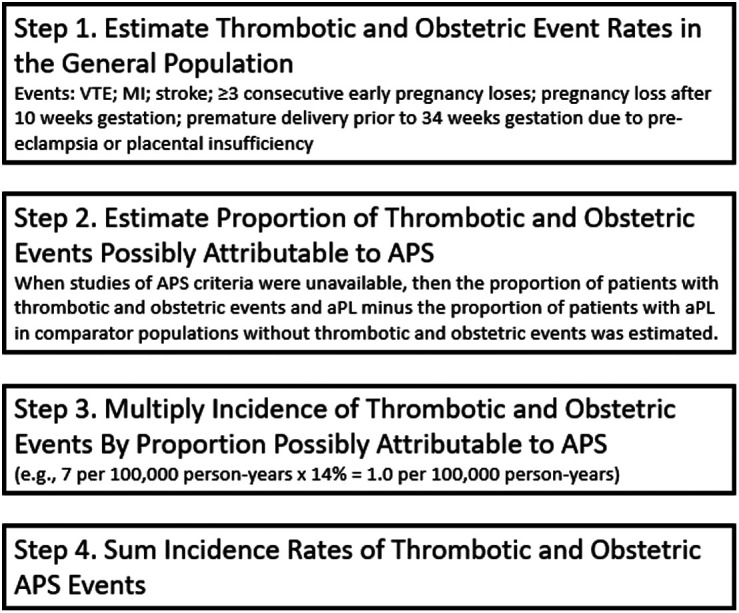
Antiphospholipid syndrome is a systemic autoimmune disorder characterized by vascular thrombosis and/or obstetric events in association with persistently elevated antiphospholipid antibodies. Antiphospholipid syndrome is typically considered a rare disease, but the true incidence is uncertain owing to the diverse antiphospholipid antibody-related clinical manifestations, inconsistent definitions of antiphospholipid antibody positivity, under-recognition of the disease, and limited population-based studies. Published estimates of the incidence of antiphospholipid syndrome range from approximately 2 to 80 per 100 000 person-years. A targeted literature review and applied methodology were performed to derive a best available estimate. Significant limitations of the published literature were observed, some of which have been previously reported. The incidence of antiphospholipid syndrome in the United States was estimated to be approximately 7.1 to 13.7 per 100 000 person-years in the general population. Although this estimate is likely more accurate than previously reported estimates, large, contemporary, population-based studies that reasonably adhere to the antiphospholipid syndrome classification criteria are needed to further refine estimates of the incidence of antiphospholipid syndrome.
抗磷脂综合征是一种全身性自身免疫性疾病,其特征为血管血栓形成和/或产科事件,并伴有抗磷脂抗体持续升高。抗磷脂综合征通常被认为是一种罕见疾病,但由于抗磷脂抗体相关临床表现多样、抗磷脂抗体阳性的定义不一致、对该疾病认识不足以及基于人群的研究有限,其真实发病率尚不确定。已发表的抗磷脂综合征发病率估计范围为每10万人年约2至80例。通过进行有针对性的文献综述和应用方法得出最佳可用估计值。已观察到已发表文献存在重大局限性,其中一些局限性此前已有报道。在美国,普通人群中抗磷脂综合征的发病率估计约为每10万人年7.1至13.7例。尽管这一估计可能比此前报道的估计值更准确,但仍需要大型、当代、基于人群且合理遵循抗磷脂综合征分类标准的研究,以进一步完善抗磷脂综合征发病率的估计。