Department of Physical Medicine and Rehabilitation, Amiens University Hospital, Amiens, France.
Laboratory of Functional Neurosciences, UR UPJV 4559, Jules Verne University of Picardie, Amiens, France.
Trials. 2023 Mar 8;24(1):172. doi: 10.1186/s13063-023-07138-x.
Gait disorders and cognitive impairments are prime causes of disability and institutionalization after stroke. We hypothesized that relative to single-task gait rehabilitation (ST GR), cognitive-motor dual-task (DT) GR initiated at the subacute stage would be associated with greater improvements in ST and DT gait, balance, and cognitive performance, personal autonomy, disability, and quality of life in the short, medium and long terms after stroke.
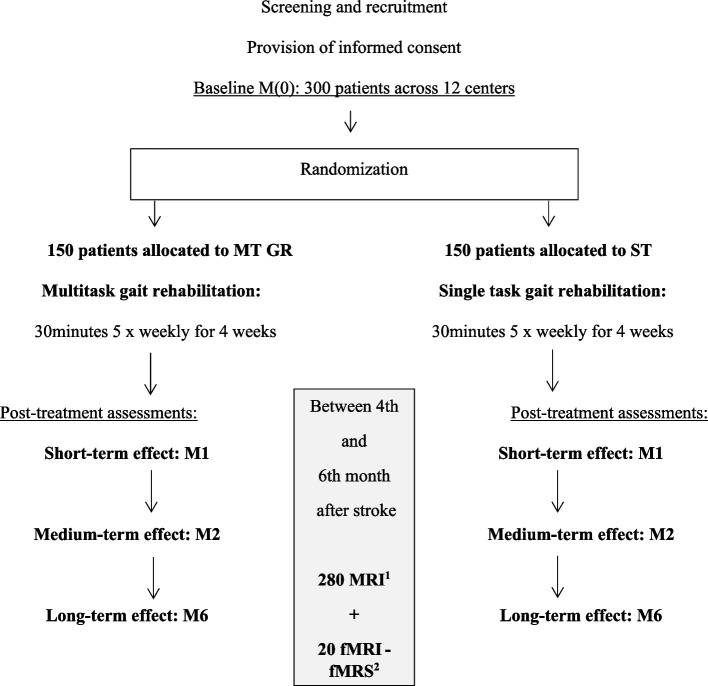
This multicenter (n=12), two-arm, parallel-group, randomized (1:1), controlled clinical study is a superiority trial. With p<0.05, a power of 80%, and an expected loss to follow-up rate of 10%, the inclusion of 300 patients will be required to evidence a 0.1-m.s gain in gait speed. Trial will include adult patients (18-90 years) in the subacute phase (0 to 6 months after a hemispheric stroke) and who are able to walk for 10 m (with or without a technical aid). Registered physiotherapists will deliver a standardized GR program (30 min three times a week, for 4 weeks). The GR program will comprise various DTs (phasic, executive function, praxis, memory, and spatial cognition tasks during gait) in the DT (experimental) group and gait exercises only in the ST (control) group. The primary outcome measure is gait speed 6 months after inclusion. The secondary outcomes are post-stroke impairments (National Institutes of Health Stroke Scale and the motor part of the Fugl-Meyer Assessment of the lower extremity), gait speed (10-m walking test), mobility and dynamic balance (timed up-and-go test), ST and DT cognitive function (the French adaptation of the harmonization standards neuropsychological battery, and eight cognitive-motor DTs), personal autonomy (functional independence measure), restrictions in participation (structured interview and the modified Rankin score), and health-related quality of life (on a visual analog scale). These variables will be assessed immediately after the end of the protocol (probing the short-term effect), 1 month thereafter (the medium-term effect), and 5 months thereafter (the long-term effect).
The main study limitation is the open design. The trial will focus on a new GR program applicable at various stages after stroke and during neurological disease.
NCT03009773 . Registered on January 4, 2017.
步态障碍和认知障碍是中风后残疾和住院的主要原因。我们假设,与单任务步态康复(ST GR)相比,亚急性期开始的认知运动双重任务(DT)GR 会与 ST 和 DT 步态、平衡和认知表现、个人自主、残疾和生活质量的短期、中期和长期改善相关。
这是一项多中心(n=12)、双臂、平行组、随机(1:1)、对照临床试验,是一项优效性试验。预期失访率为 10%,需要纳入 300 例患者,才能证明步态速度提高 0.1m/s。试验将包括亚急性期(半球性中风后 0-6 个月)的成年患者(18-90 岁),且能够行走 10 米(有无辅助设备)。注册物理治疗师将提供标准化的 GR 方案(每周 3 次,每次 30 分钟,持续 4 周)。GR 方案将包括 DT(实验)组中的各种 DT(相位、执行功能、实践、记忆和空间认知任务)和 ST(对照)组中的步态练习。主要结局测量指标是纳入后 6 个月的步态速度。次要结局指标包括中风后损伤(国立卫生研究院中风量表和下肢 Fugl-Meyer 评估的运动部分)、步态速度(10 米步行测试)、移动性和动态平衡(计时起立行走测试)、ST 和 DT 认知功能(法国协调标准神经心理测试和 8 项认知运动 DT)、个人自主(功能独立性测量)、参与限制(结构化访谈和改良 Rankin 评分)和健康相关生活质量(视觉模拟评分)。这些变量将在方案结束后立即进行评估(探究短期效果)、1 个月后(中期效果)和 5 个月后(长期效果)。
主要研究局限性是开放性设计。试验将重点关注适用于中风后和神经疾病各阶段的新 GR 方案。
NCT03009773。于 2017 年 1 月 4 日注册。