Department of Psychiatry, Perelman School of Medicine, University of Pennsylvania, United States.
Department of Psychiatry, Perelman School of Medicine, University of Pennsylvania, United States.
Addict Behav. 2023 Aug;143:107686. doi: 10.1016/j.addbeh.2023.107686. Epub 2023 Mar 5.
Individuals with major depressive disorder (MDD) exhibit high rates of tobacco use and lower responsiveness to tobacco cessation treatments. Treatment adherence is a strong predictor of treatment outcomes in the general population but has not been evaluated in this under-served community of smokers with MDD.
We used data from a randomized clinical trial on smoking cessation treatment among 300 smokers with MDD to examine the rate of adherence (medication and counseling), the association of adherence with cessation outcomes, and factors associated with adherence, including demographic and smoking characteristics, psychiatric characteristics, smoking cessation processes (e.g., withdrawal, reinforcers), and treatment-related side effects (e.g., nausea).
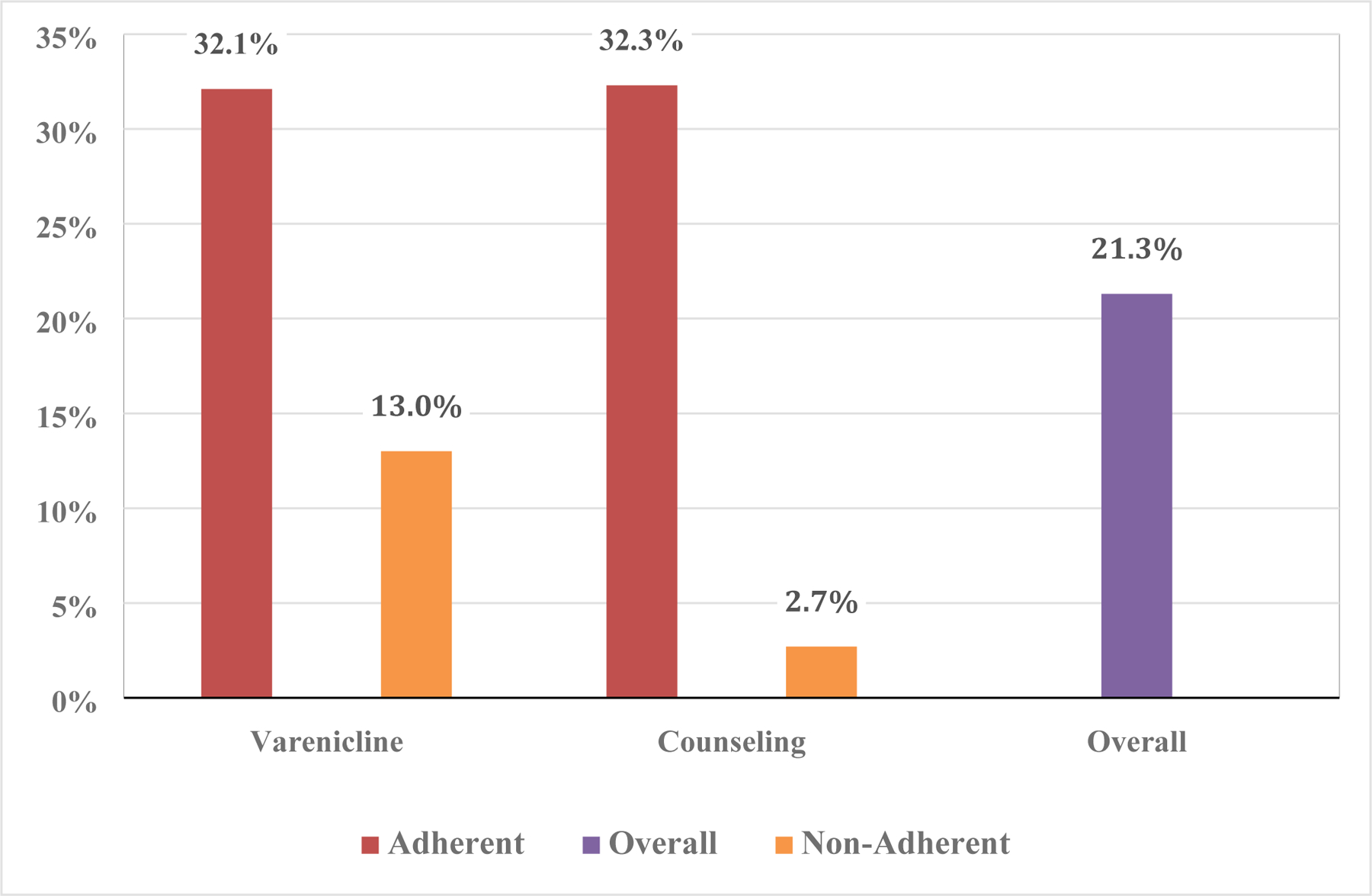
Overall, 43.7% of participants were adherent with medication and 63.0% were adherent with counseling. Medication adherence was significantly associated with cessation, with 32.1% of adherent vs. 13.0% of non-adherent participants quitting smoking at EOT. Counseling adherence was also significantly associated with cessation, with 32.3% of adherent vs. 2.7% of non-adherent participants quitting smoking. Multivariate regression models showed that medication adherence was associated with higher engagement in complementary reinforcers and higher baseline smoking reward, while counseling adherence was associated with identifying as female, lower alcohol use and nicotine dependence, higher baseline smoking reward, and higher engagement in substitute and complementary reinforcers within the first weeks of medication use.
As with the general population of smokers, non-adherence to treatment in smokers experiencing depression is widespread and a significant barrier to cessation. Interventions that target reinforcers may improve rates of treatment adherence.
患有重度抑郁症(MDD)的个体吸烟率较高,对戒烟治疗的反应较低。在普通人群中,治疗依从性是治疗结果的强有力预测因素,但在这个服务不足的 MDD 吸烟人群中尚未得到评估。
我们使用了一项针对 300 名 MDD 吸烟者戒烟治疗的随机临床试验数据,以检查依从性(药物和咨询)的发生率,以及依从性与戒烟结果的关联,以及与依从性相关的因素,包括人口统计学和吸烟特征、精神特征、戒烟过程(如戒断、强化物)和与治疗相关的副作用(如恶心)。
总体而言,43.7%的参与者对药物治疗依从,63.0%的参与者对咨询治疗依从。药物治疗的依从性与戒烟显著相关,在 EOT 时,32.1%的依从者戒烟,而非依从者为 13.0%。咨询治疗的依从性也与戒烟显著相关,32.3%的依从者戒烟,而非依从者为 2.7%。多元回归模型显示,药物治疗的依从性与补充强化物的更高参与度和更高的基线吸烟奖励有关,而咨询治疗的依从性与女性身份、较低的酒精使用和尼古丁依赖、更高的基线吸烟奖励以及在药物使用的头几周内更高地参与替代和补充强化物有关。
与普通吸烟者一样,患有抑郁症的吸烟者对治疗的不依从是普遍存在的,也是戒烟的一个重要障碍。针对强化物的干预措施可能会提高治疗依从性的比率。