Department of Global Health and Population, Harvard T.H. Chan School of Public Health, Boston, Massachusetts.
Department of Global Health and Population, Harvard T.H. Chan School of Public Health, Boston, Massachusetts.
Am J Prev Med. 2023 Sep;65(3):458-466. doi: 10.1016/j.amepre.2023.03.001. Epub 2023 Mar 8.
The study assessed the relationship between COVID-19 and influenza (flu) vaccination and voting patterns during the pandemic and the time trends between flu vaccination and voting patterns.
Flu and COVID-19 vaccination coverage were analyzed using National Immunization Surveys for flu (Years 2010-2022) and COVID-19 (National Immunization Surveys Adult COVID-19 Module 2021-2022), Centers for Disease Control and Prevention surveillance of COVID-19 vaccination coverage (2021-2022) and U.S. COVID-19 Trends and Impact Survey (2021-2022). The study described the correlations between state-level COVID-19 and flu vaccination coverage, examined individual-level characteristics of vaccination for COVID-19 and for flu using logistic regression (COVID-19 Trends and Impact Survey May-June 2022), and analyzed flu vaccination coverage by age (National Immunization Surveys for flu 2010-2022) and its relationship with voting patterns.
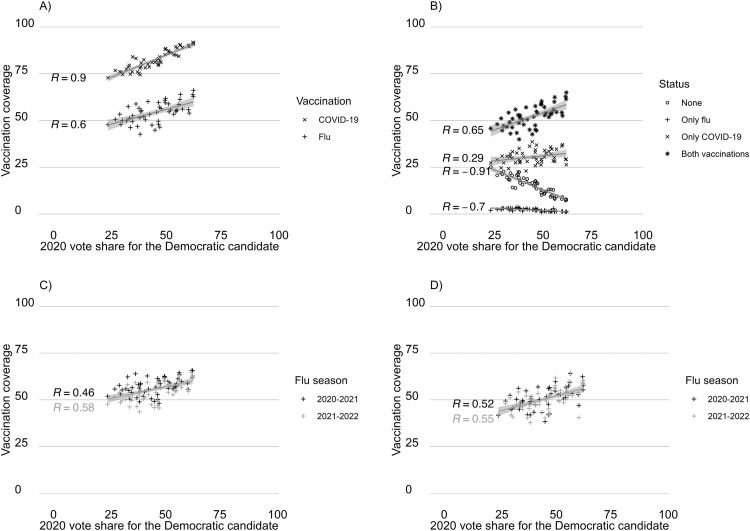
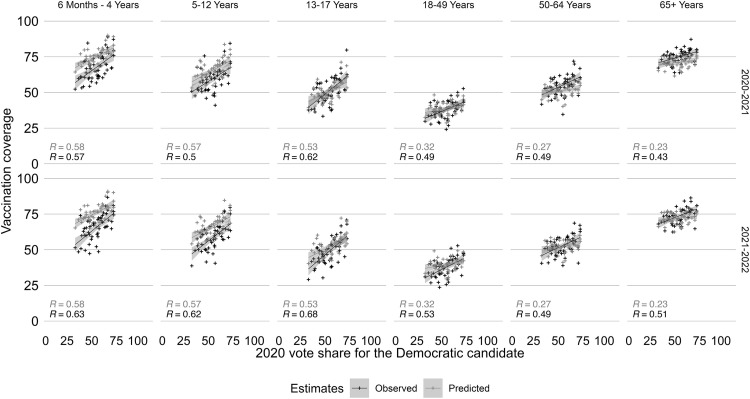
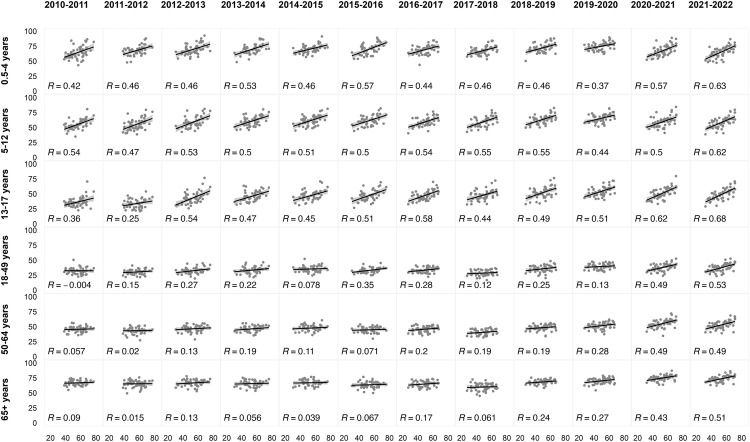
There was a strong correlation between state-level COVID-19 vaccination coverage and voting share for the Democratic candidate in the 2020 presidential elections. COVID-19 vaccination coverage in June 2022 was higher than flu vaccination coverage, and it had a stronger correlation with voting patterns (R=0.90 vs R=0.60 in COVID-19 Trends and Impact Survey). Vaccinated people were more likely to be living in a county where the majority voted for the Democratic candidate in 2020 elections both for COVID-19 (adjusted OR=1.77, 95% CI=1.71, 1.84) and for flu (adjusted OR=1.27, 95% CI=1.23, 1.31). There is a longstanding correlation between voting patterns and flu vaccination coverage, which varies by age, with the strongest correlation in the youngest ages.
There are existing prepandemic patterns between vaccination coverage and voting patterns. The findings align with research that has identified an association between adverse health outcomes and the political environment in the U.S.
本研究评估了 COVID-19 和流感(流感)疫苗接种与大流行期间的投票模式之间的关系,以及流感疫苗接种与投票模式之间的时间趋势。
使用国家流感免疫调查(2010-2022 年)和 COVID-19 国家免疫调查成人 COVID-19 模块(2021-2022 年)、疾病控制和预防中心 COVID-19 疫苗接种覆盖情况监测(2021-2022 年)和美国 COVID-19 趋势和影响调查(2021-2022 年)分析流感和 COVID-19 疫苗接种率。该研究描述了州级 COVID-19 和流感疫苗接种率之间的相关性,使用逻辑回归(COVID-19 趋势和影响调查 2022 年 5-6 月)检查了 COVID-19 和流感疫苗接种的个体特征,并分析了国家流感免疫调查(2010-2022 年)中按年龄划分的流感疫苗接种率及其与投票模式的关系。
2020 年总统选举中,州级 COVID-19 疫苗接种率与民主党候选人的投票份额之间存在很强的相关性。2022 年 6 月 COVID-19 疫苗接种率高于流感疫苗接种率,与投票模式的相关性更强(COVID-19 趋势和影响调查中的 R=0.90 与 R=0.60)。对于 COVID-19(调整后的 OR=1.77,95%CI=1.71,1.84)和流感(调整后的 OR=1.27,95%CI=1.23,1.31),接种疫苗的人更有可能居住在 2020 年选举中大多数人投票给民主党候选人的县。在不同年龄段,投票模式与流感疫苗接种率之间存在长期相关性,在最年轻的年龄段相关性最强。
在疫苗接种率和投票模式之间存在大流行前存在的模式。这些发现与研究结果一致,该研究表明美国不良健康结果与政治环境之间存在关联。