Mancini Manuela, Monaldi Cecilia, De Santis Sara, Papayannidis Cristina, Rondoni Michela, Sartor Chiara, Bruno Samantha, Pagano Livio, Criscuolo Marianna, Zanotti Roberta, Bonifacio Massimiliano, Tosi Patrizia, Arock Michel, Valent Peter, Cavo Michele, Soverini Simona
IRCCS Azienda Ospedaliero-Universitaria Di Bologna, Istituto Di Ematologia "Seràgnoli", Bologna, Italy.
Dipartimento Di Medicina Specialistica, Diagnostica E Sperimentale, Università Di Bologna, Bologna, Italy.
Biomark Res. 2023 Mar 10;11(1):29. doi: 10.1186/s40364-023-00468-7.
The SETD2 tumor suppressor gene encodes a histone methyltransferase that safeguards transcription fidelity and genomic integrity via trimethylation of histone H3 lysine 36 (H3K36Me3). SETD2 loss of function has been observed in solid and hematologic malignancies. We have recently reported that most patients with advanced systemic mastocytosis (AdvSM) and some with indolent or smoldering SM display H3K36Me3 deficiency as a result of a reversible loss of SETD2 due to reduced protein stability.
Experiments were conducted in SETD2-proficient (ROSA) and -deficient (HMC-1.2) cell lines and in primary cells from patients with various SM subtypes. A short interfering RNA approach was used to silence SETD2 (in ROSA cells), MDM2 and AURKA (in HMC-1.2 cells). Protein expression and post-translational modifications were assessed by WB and immunoblotting. Protein interactions were tested by using co-immunoprecipitation. Apoptotic cell death was evaluated by flow cytometry after annexin V and propidium iodide staining, respectively. Drug cytotoxicity in in vitro experiments was evaluated by clonogenic assays.
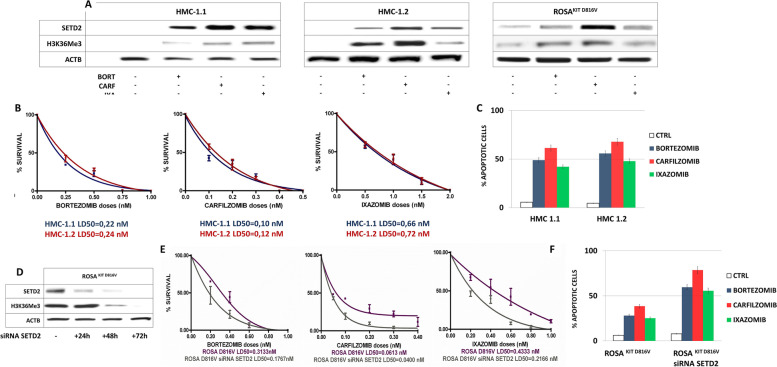
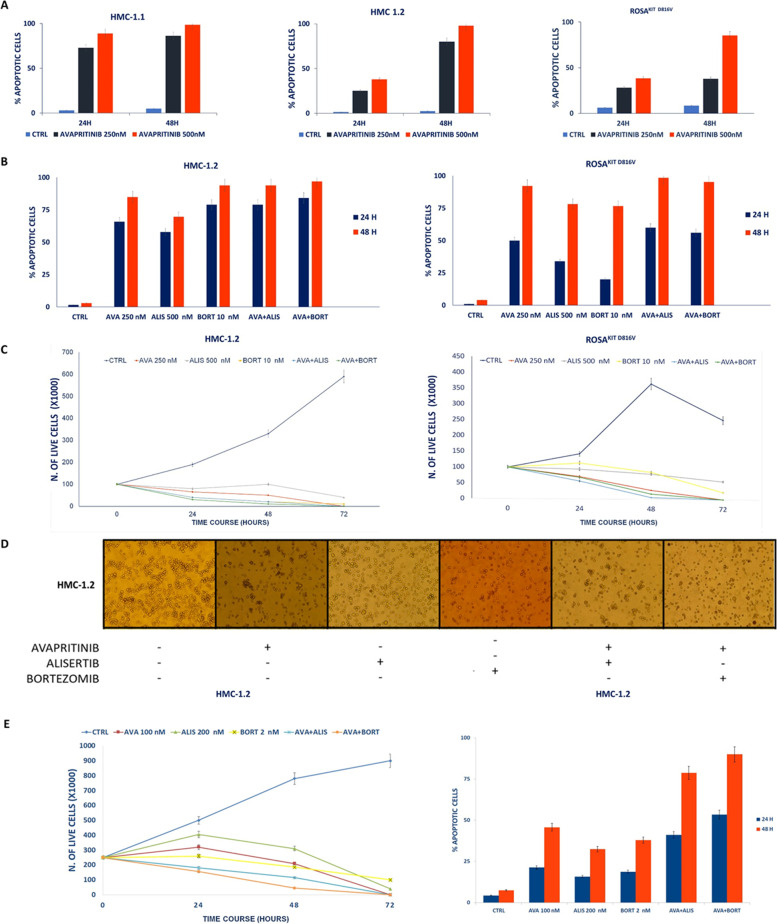
Here, we show that the proteasome inhibitors suppress cell growth and induce apoptosis in neoplastic mast cells by promoting SETD2/H3K36Me3 re-expression. Moreover, we found that Aurora kinase A and MDM2 are implicated in SETD2 loss of function in AdvSM. In line with this observation, direct or indirect targeting of Aurora kinase A with alisertib or volasertib induced reduction of clonogenic potential and apoptosis in human mast cell lines and primary neoplastic cells from patients with AdvSM. Efficacy of Aurora A or proteasome inhibitors was comparable to that of the KIT inhibitor avapritinib. Moreover, combination of alisertib (Aurora A inhibitor) or bortezomib (proteasome inhibitor) with avapritinib allowed to use lower doses of each drug to achieve comparable cytotoxic effects.
Our mechanistic insights into SETD2 non-genomic loss of function in AdvSM highlight the potential value of novel therapeutic targets and agents for the treatment of patients who fail or do not tolerate midostaurin or avapritinib.
SETD2肿瘤抑制基因编码一种组蛋白甲基转移酶,该酶通过组蛋白H3赖氨酸36(H3K36Me3)的三甲基化来保障转录保真度和基因组完整性。在实体瘤和血液系统恶性肿瘤中已观察到SETD2功能丧失。我们最近报道,大多数晚期系统性肥大细胞增多症(AdvSM)患者以及一些惰性或冒烟型SM患者由于蛋白质稳定性降低导致SETD2可逆性缺失,从而表现出H3K36Me3缺乏。
在SETD2功能正常(ROSA)和功能缺陷(HMC - 1.2)的细胞系以及来自不同SM亚型患者的原代细胞中进行实验。采用短干扰RNA方法使SETD2(在ROSA细胞中)、MDM2和AURKA(在HMC - 1.2细胞中)沉默。通过蛋白质印迹(WB)和免疫印迹评估蛋白质表达及翻译后修饰。使用免疫共沉淀检测蛋白质相互作用。分别用膜联蛋白V和碘化丙啶染色后,通过流式细胞术评估凋亡细胞死亡情况。在体外实验中,通过克隆形成试验评估药物细胞毒性。
在此,我们表明蛋白酶体抑制剂通过促进SETD2/H3K36Me3重新表达来抑制肿瘤性肥大细胞的生长并诱导其凋亡。此外,我们发现极光激酶A(Aurora kinase A)和MDM2与AdvSM中SETD2功能丧失有关。与此观察结果一致,用alisertib或volasertib直接或间接靶向极光激酶A可诱导人肥大细胞系以及AdvSM患者的原发性肿瘤细胞的克隆形成潜力降低和凋亡。极光激酶A抑制剂或蛋白酶体抑制剂的疗效与KIT抑制剂阿伐替尼相当。此外,alisertib(极光激酶A抑制剂)或硼替佐米(蛋白酶体抑制剂)与阿伐替尼联合使用可使用较低剂量的每种药物来达到相当的细胞毒性效果。
我们对AdvSM中SETD2非基因组功能丧失的机制性见解突出了新型治疗靶点和药物对于治疗对米哚妥林或阿伐替尼治疗失败或不耐受患者的潜在价值。