Li Yana, Wang Yangfan, Yin Xingfu, Zhang Zeyang
College of Locomotive and Rolling Stock Engineering,Dalian Jiaotong University, Dalian, 116028, China.
CRRC Beijing Nankou Co., Ltd, Beijing, 102202, China.
Heliyon. 2023 Feb 23;9(3):e13835. doi: 10.1016/j.heliyon.2023.e13835. eCollection 2023 Mar.
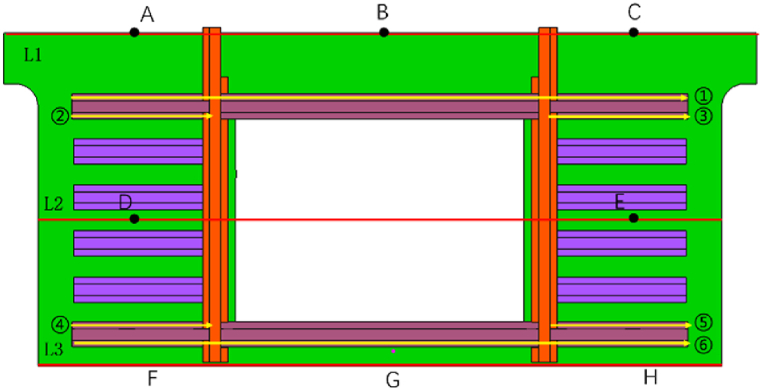
Due to the advantageous characteristics of laser welding technology, it is being increasingly used for constructing stainless steel rail vehicles. It can improve the appearance of a vehicle, enable designs with a relatively high degree of flatness, and ensure higher-quality connections between different parts of a vehicle. Moreover, it can improve the strength and stiffness of the components of the vehicle. In this study, a large-scale assembly module of a stainless steel side-wall was considered as the research object. The combined heat source model of a Gaussian heat source and a cylindrical volume heat source was used to obtain the heat source parameters of laser welding to match the experimental data. Based on the thermal cycle curve method (TCCM), the influence of the number of weld segments and mesh divisions of the local model on the efficiency and accuracy of laser welding simulations was investigated. Thereafter, the research results were applied to the welding simulation of the whole side-wall module. The shape of the molten pool obtained using the combined heat source was closer to that of the experiments (error < 10%), demonstrating the accuracy and effectiveness of the developed the heat source model for laser welding simulation. For local model laser welding using the TCCM, a coarse mesh was used, and the weld was divided into four segments, and highly accurate results were obtained. This calculation time was only 5.97% of that of a moving heat source in case of the thermo-elastic-plastic method (TEPM). Residual stress and welding deformation of the stainless steel side-wall module were calculated according to actual process parameters and the results of local model simulation. Residual stress was discontinuously distributed at the weld segments, and it only slightly influenced the overall stress distribution. The maximum residual stress (462.15 MPa) occurred at the weld of the large crossbeam. Welding eight small and two large crossbeams influenced the deformation change and the maximum deformation (1.26 mm) appeared in the middle position of the left side-wall. The findings of this study show that the TCCM has high calculation accuracy and is sufficiently economical for predicting laser welding of large structures.
由于激光焊接技术具有诸多优势特性,其在不锈钢轨道车辆制造中的应用日益广泛。它能够提升车辆外观,实现具有较高平整度的设计,并确保车辆不同部件之间的连接质量更高。此外,它还能提高车辆部件的强度和刚度。在本研究中,将一个不锈钢侧墙的大型装配模块作为研究对象。采用高斯热源与柱体体积热源的组合热源模型来获取激光焊接的热源参数,以使其与实验数据相匹配。基于热循环曲线法(TCCM),研究了局部模型的焊缝段数量和网格划分对激光焊接模拟效率和精度的影响。随后,将研究结果应用于整个侧墙模块的焊接模拟。使用组合热源得到的熔池形状与实验结果更为接近(误差<10%),这表明所开发的用于激光焊接模拟的热源模型具有准确性和有效性。对于采用TCCM的局部模型激光焊接,使用了粗网格,焊缝被划分为四段,并获得了高精度的结果。此计算时间仅为热弹塑性法(TEPM)中移动热源计算时间的5.97%。根据实际工艺参数和局部模型模拟结果,计算了不锈钢侧墙模块的残余应力和焊接变形。残余应力在焊缝段处呈间断分布,对整体应力分布的影响较小。最大残余应力(462.15MPa)出现在大横梁的焊缝处。焊接八根小横梁和两根大横梁影响了变形变化,最大变形(1.26mm)出现在左侧墙的中间位置。本研究结果表明,TCCM具有较高的计算精度,在预测大型结构的激光焊接方面具有足够的经济性。