Malik Faizan, Cooper Kumarasen
Department of Pathology and Laboratory Medicine, Perelman School of Medicine, Hospital of the University of Pennsylvania, Philadelphia, PA, USA.
Int J Surg Pathol. 2023 Dec;31(8):1632-1637. doi: 10.1177/10668969231157779. Epub 2023 Mar 10.
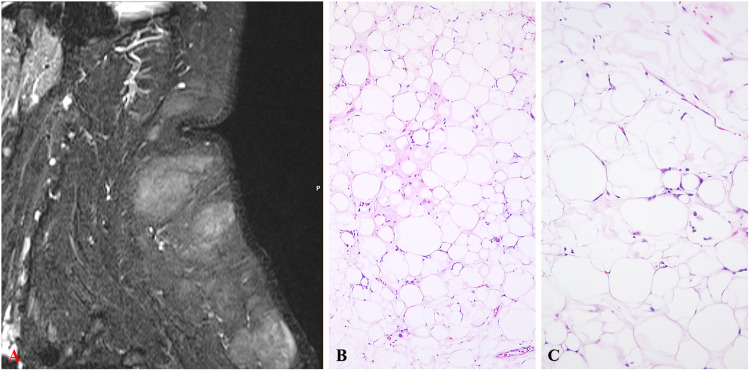
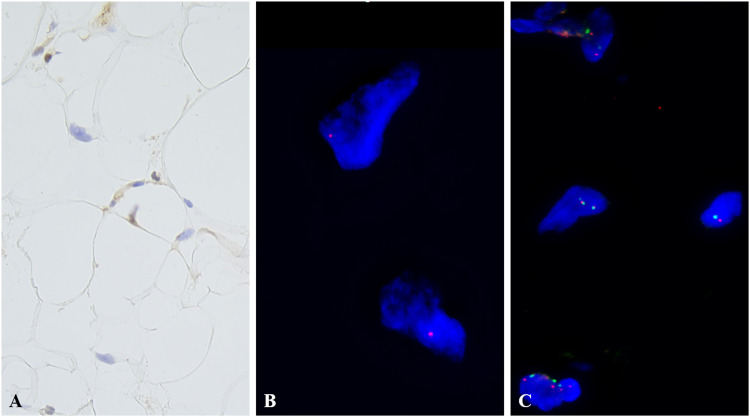
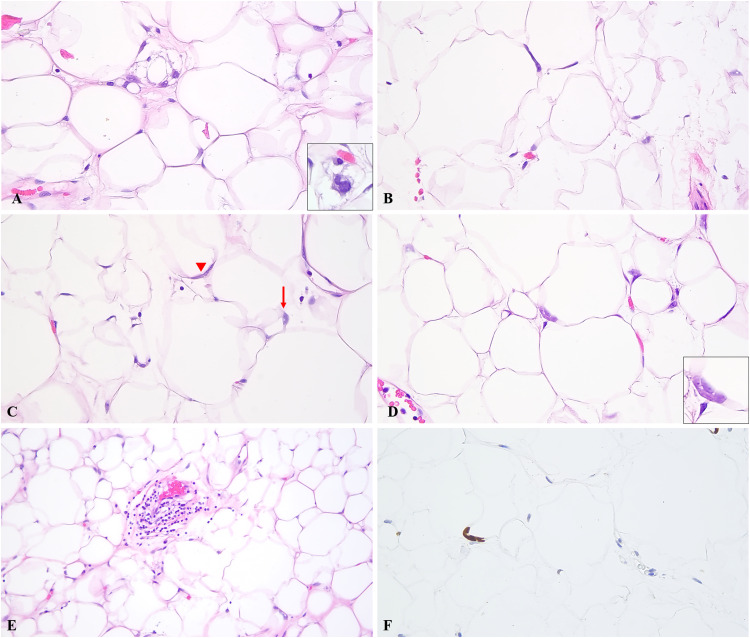
Different authors have recently described a subtype of lipoma characterized by variation of adipocyte size, single cell fat necrosis, and a subset with minimal to mild nuclear atypia, and termed these as anisometric cell/dysplastic lipoma (AC/DL). These lipomas follow a benign course and rarely recur. In 3 examples, AC/DL has occurred in patients with childhood retinoblastoma (RB). We report another such example where multiple AC/DL occurred in the neck and back of a 30-year-old male who had germline gene deletion and bilateral RB in infancy. On excision, all tumors histologically showed similar morphology of adipocyte anisometry, focal single cell necrosis with surrounding binucleated or multinucleated histiocytes, hyperchromatic and minimally atypical lipocyte nuclei, vacuolated change, rare foci of fibromyxoid change, occasional mononuclear cell clusters around capillaries, and loss of RB1 immunostaining. Unequivocal atypical cells, lipoblasts, floret-nucleated or multinucleated giant cells were absent. Molecular analysis of tumor cells showed monoallelic gene loss without amplification of and genes. Short-term follow up did not show tumor recurrence. AC/DLs in RB survivors are characterized by multiplicity, unifying histology, and benign course. Their biology appears distinct from ordinary lipomas, spindle cell lipomas, and atypical lipomatous tumors.
不同作者最近描述了一种脂肪瘤亚型,其特征为脂肪细胞大小各异、单细胞脂肪坏死,以及一部分伴有轻微至中度核异型性的情况,并将这些称为不等量细胞/发育异常性脂肪瘤(AC/DL)。这些脂肪瘤病程呈良性,很少复发。在3个病例中,AC/DL发生于儿童视网膜母细胞瘤(RB)患者。我们报告了另一例这样的病例,一名30岁男性颈部和背部出现多发AC/DL,该男性在婴儿期存在种系基因缺失和双侧RB。切除后,所有肿瘤在组织学上均显示出相似的形态,即脂肪细胞不等量、局灶性单细胞坏死伴周围双核或多核组织细胞、核深染且轻度异型的脂肪细胞核、空泡化改变、罕见的纤维黏液样改变灶、毛细血管周围偶尔出现单核细胞簇,以及RB1免疫染色缺失。未发现明确的非典型细胞、脂肪母细胞、花环状核或多核巨细胞。肿瘤细胞的分子分析显示单等位基因缺失,且 和 基因无扩增。短期随访未显示肿瘤复发。RB幸存者中的AC/DL具有多发、统一的组织学表现和良性病程的特点。它们的生物学特性似乎与普通脂肪瘤、梭形细胞脂肪瘤及非典型脂肪瘤性肿瘤不同。