Department of Epidemiology and Biostatistics, School of Public Health, Tehran University of Medical Sciences, Tehran, Iran.
Endocrinology and Metabolism Research Center, Endocrinology and Metabolism Clinical Sciences Institute, Tehran University of Medical Sciences, Tehran, Iran.
BMC Cardiovasc Disord. 2023 Mar 11;23(1):130. doi: 10.1186/s12872-023-03163-5.
Diabetes Mellitus (DM) is a rapidly growing disorder worldwide, especially in the Middle East. A higher incidence of coronary artery diseases requiring coronary artery bypass graft (CABG) surgery has been reported in patients with diabetes. We assessed the association between type 2 diabetes mellitus (T2DM) and in-hospital major adverse cardiac and cerebrovascular events (MACCEs) and postoperative complications among patients who underwent on-pump isolated CABG.
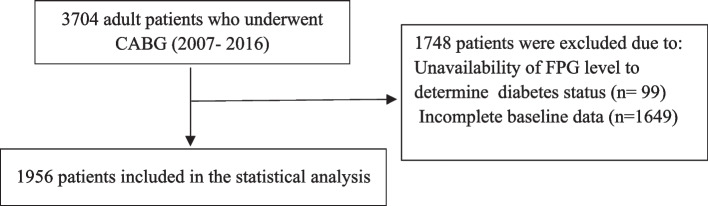
In this retrospective cohort study, we used the data registered for CABG patients from two heart centers in the Golestan province (North of Iran) between 2007 and 2016. The study population included 1956 patients divided into two groups: 1062 non-diabetic patients and 894 patients with diabetes (fasting plasma glucose ≥126 mg/dl or using antidiabetic medications). The study outcome was in-hospital MACCEs, a composite outcome of myocardial infarction (MI), stroke and cardiovascular death, and postoperative complications, including postoperative arrhythmia, acute atrial fibrillation (AF), major bleeding (defined as reoperation due to bleeding), and acute kidney injury (AKI).
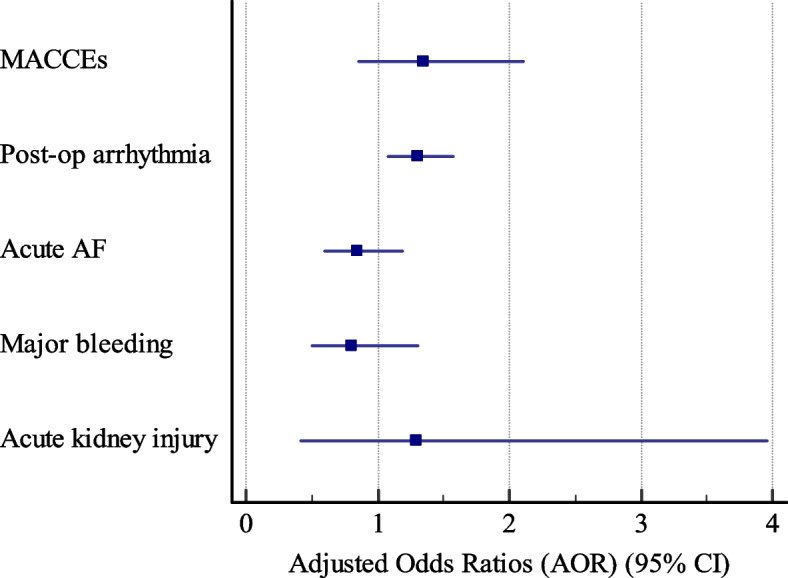
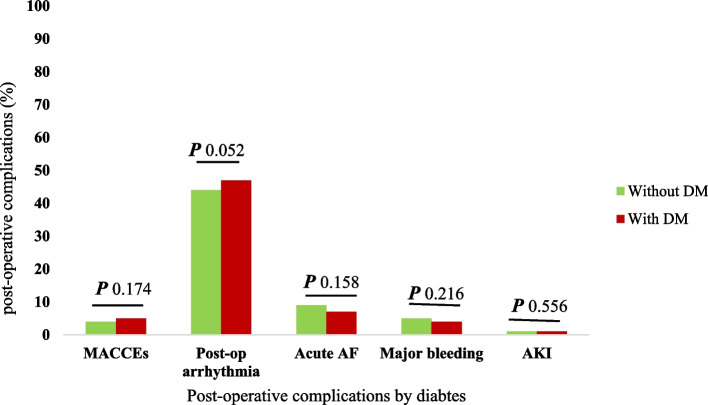
During the 10-year study period, 1956 adult patients with a mean (SD) age of 59.0 (9.60) years were included. After adjustment for age, gender, ethnicity, obesity, opium consumption, and smoking, diabetes was a predictor of postoperative arrhythmia (AOR 1.30, 95% CI 1.08-1.57; P = 0.006). While it was not a predictor of in-hospital MACCEs (AOR 1.35, 95% CI 0.86, 2.11; P = 0.188), AF (AOR 0.85, 95% CI 0.60-1.19; P = 0.340), major bleeding (AOR 0.80, 95% CI 0.50, 1.30; P = 0.636) or AKI (AOR 1.29, 95% CI 0.42, 3.96; P 0.656) after CABG surgery.
Findings indicated that diabetes increased the risk of postoperative arrhythmia by 30%. However, we found similar in-hospital MACCEs, acute AF, major bleeding, and AKI following CABG surgery in both diabetic and non-diabetic patients.
糖尿病(DM)是一种在全球范围内迅速增长的疾病,尤其是在中东地区。有报道称,患有糖尿病的患者需要进行冠状动脉旁路移植术(CABG)的冠状动脉疾病发病率更高。我们评估了 2 型糖尿病(T2DM)与接受体外循环下单纯 CABG 手术的患者围手术期主要不良心脑血管事件(MACCE)和术后并发症之间的关联。
在这项回顾性队列研究中,我们使用了 2007 年至 2016 年期间戈勒斯坦省(伊朗北部)两个心脏中心 CABG 患者的数据。研究人群包括 1956 名患者,分为两组:1062 名非糖尿病患者和 894 名糖尿病患者(空腹血糖≥126mg/dl 或使用降糖药物)。研究结果是围手术期 MACCE,即心肌梗死(MI)、中风和心血管死亡的复合结果,以及术后并发症,包括术后心律失常、急性心房颤动(AF)、大出血(定义为因出血而再次手术)和急性肾损伤(AKI)。
在 10 年的研究期间,共纳入 1956 名平均(标准差)年龄为 59.0(9.60)岁的成年患者。在调整年龄、性别、种族、肥胖、鸦片类药物使用和吸烟后,糖尿病是术后心律失常的预测因素(AOR 1.30,95%CI 1.08-1.57;P=0.006)。然而,它不是围手术期 MACCE 的预测因素(AOR 1.35,95%CI 0.86,2.11;P=0.188)、AF(AOR 0.85,95%CI 0.60-1.19;P=0.340)、大出血(AOR 0.80,95%CI 0.50,1.30;P=0.636)或 CABG 手术后的 AKI(AOR 1.29,95%CI 0.42,3.96;P 0.656)。
研究结果表明,糖尿病使术后心律失常的风险增加了 30%。然而,我们发现,糖尿病和非糖尿病患者 CABG 手术后的围手术期 MACCE、急性 AF、大出血和 AKI 发生率相似。