Labronici Pedro José, Belangero William Dias, Zublin Carlos Miguel, Gonçalves Lucas Braga Jaques, Fajardo Humberto, Pires Robinson Esteves, Giordano Vincenzo
Departamento de Ortopedia e Traumatologia, Universidade Federal Fluminense (UFF), Av. Marquês do Paraná, 303, Niterói 24220-000, RJ, Brazil.
Serviço de Ortopedia e Traumatologia Prof. Dr. Donato D´Ângelo, Hospital Santa Teresa, R. Paulino Afonso, 477, Petrópolis 25680-003, RJ, Brazil.
Healthcare (Basel). 2023 Feb 26;11(5):693. doi: 10.3390/healthcare11050693.
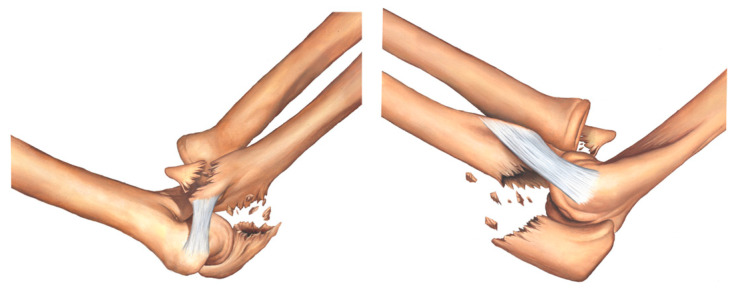
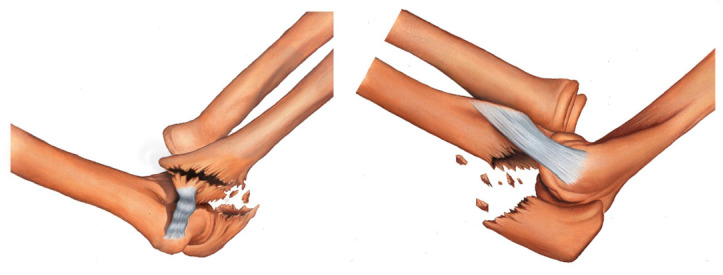
Historically, proximal ulna fractures have been simplistically diagnosed and treated as simple olecranon fractures, leading to an unacceptable number of complications. Our hypothesis was that the recognition of lateral, intermediate, and medial stabilizers of the proximal ulna and ulnohumeral and proximal radioulnar joints would facilitate decision-making, including the choice of approach and type of fixation. The primary aim was to propose a new classification for complex fractures of the proximal ulna based on morphological characteristics seen on three-dimensional computed tomography (3D CT). The secondary aim was to validate the proposed classification regarding its intra- and inter-rater agreement. Three raters with different levels of experience analyzed 39 cases of complex fractures of the proximal ulna using radiographs and 3D CT scans. We presented the proposed classification (divided into four types with subtypes) to the raters. In this classification, the medial column of the ulna involves the sublime tubercle and is where the anterior medial collateral ligament is inserted, the lateral column contains the supinator crest and is where the lateral ulnar collateral ligament is inserted, and the intermediate column involves the coronoid process of the ulna, olecranon, and anterior capsule of the elbow. Intra- and inter-rater agreement was analyzed for two different rounds, and the results were evaluated according to Fleiss kappa, Cohen kappa, and Kendall coefficient. Intra- and inter-rater agreement values were very good (0.82 and 0.77, respectively). Good intra- and inter-rater agreement attested to the stability of the proposed classification among the raters, regardless of the level of experience of each one. The new classification proved to be easy to understand and had very good intra- and inter-rater agreement, regardless of the level of experience of each rater.
从历史上看,近端尺骨骨折一直被简单地诊断和治疗为单纯的鹰嘴骨折,导致出现了数量多得令人无法接受的并发症。我们的假设是,认识到近端尺骨以及尺肱关节和近端桡尺关节的外侧、中间和内侧稳定结构将有助于决策,包括手术入路的选择和固定类型。主要目的是基于三维计算机断层扫描(3D CT)显示的形态特征,为近端尺骨复杂骨折提出一种新的分类方法。次要目的是验证所提出分类方法在评分者内和评分者间的一致性。三名经验水平不同的评分者使用X线片和3D CT扫描分析了39例近端尺骨复杂骨折病例。我们向评分者展示了所提出的分类方法(分为四种类型及亚型)。在这种分类中,尺骨的内侧柱包括小结节,是前内侧副韧带的附着处;外侧柱包含旋后肌嵴,是尺侧副韧带的附着处;中间柱包括尺骨冠突、鹰嘴和肘关节前关节囊。对两个不同轮次的评分者内和评分者间一致性进行了分析,并根据Fleiss κ系数、Cohen κ系数和肯德尔系数评估结果。评分者内和评分者间一致性值都非常好(分别为0.82和0.77)。良好的评分者内和评分者间一致性证明了所提出的分类方法在评分者中具有稳定性,无论每个评分者的经验水平如何。新的分类方法被证明易于理解,并且无论每个评分者的经验水平如何,都具有非常好的评分者内和评分者间一致性。