Yoshida Kensaku, Iwashita Takuji, Mita Naoki, Iwasa Yuhei, Uemura Shinya, Shimizu Masahito
First Department of Internal Medicine, Gifu University Hospital, Gifu 501-1194, Japan.
J Clin Med. 2023 Mar 5;12(5):2054. doi: 10.3390/jcm12052054.
Contrast-enhanced endoscopic ultrasound (CE-EUS) is a promising diagnostic modality for differentiating malignant and benign lymph nodes. This study aimed to evaluate the diagnostic capability of CE-EUS in differentiating indolent non-Hodgkin's lymphoma (NHL) from aggressive NHL.
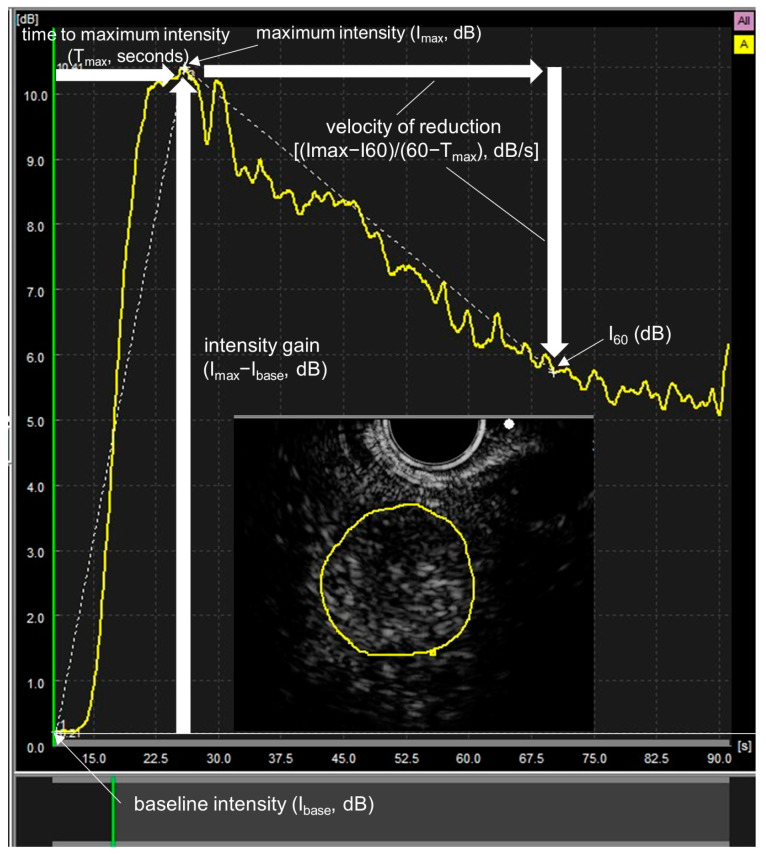
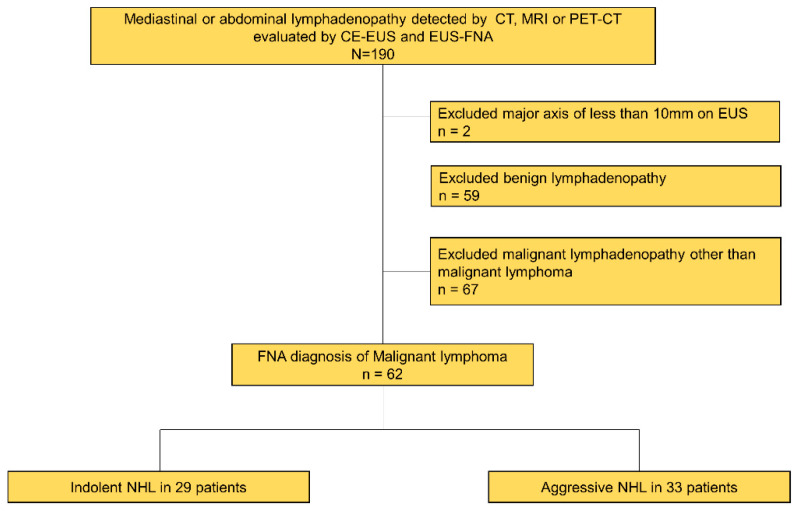
Patients who underwent CE-EUS and endoscopic ultrasound-guided fine needle aspiration (EUS-FNA) for lymphadenopathy and were diagnosed with NHL were included in this study. Echo features on B-mode endoscopic ultrasound (EUS) and vascular and enhancement patterns on CE-EUS were qualitatively evaluated. The enhancement intensity of the lymphadenopathy on CE-EUS over 60 s was also quantitatively evaluated using time-intensity curve (TIC) analysis.
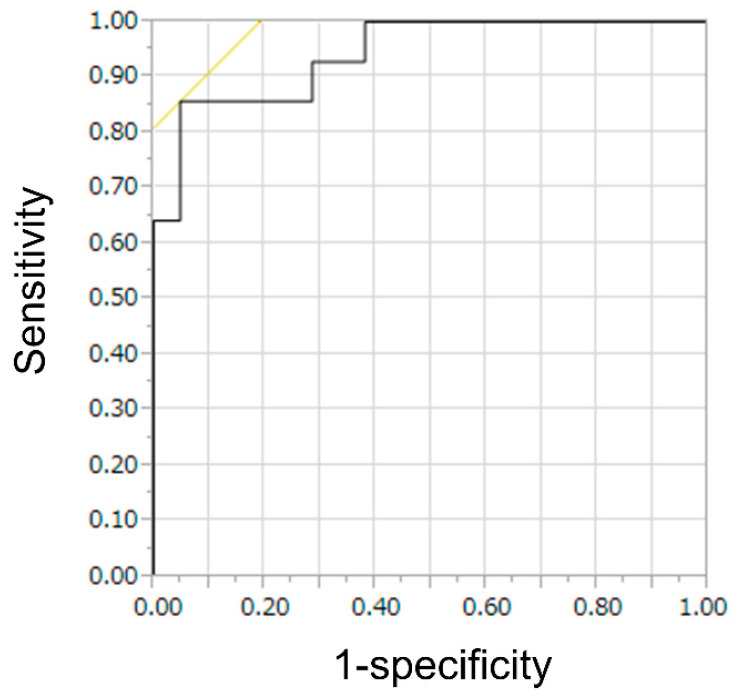
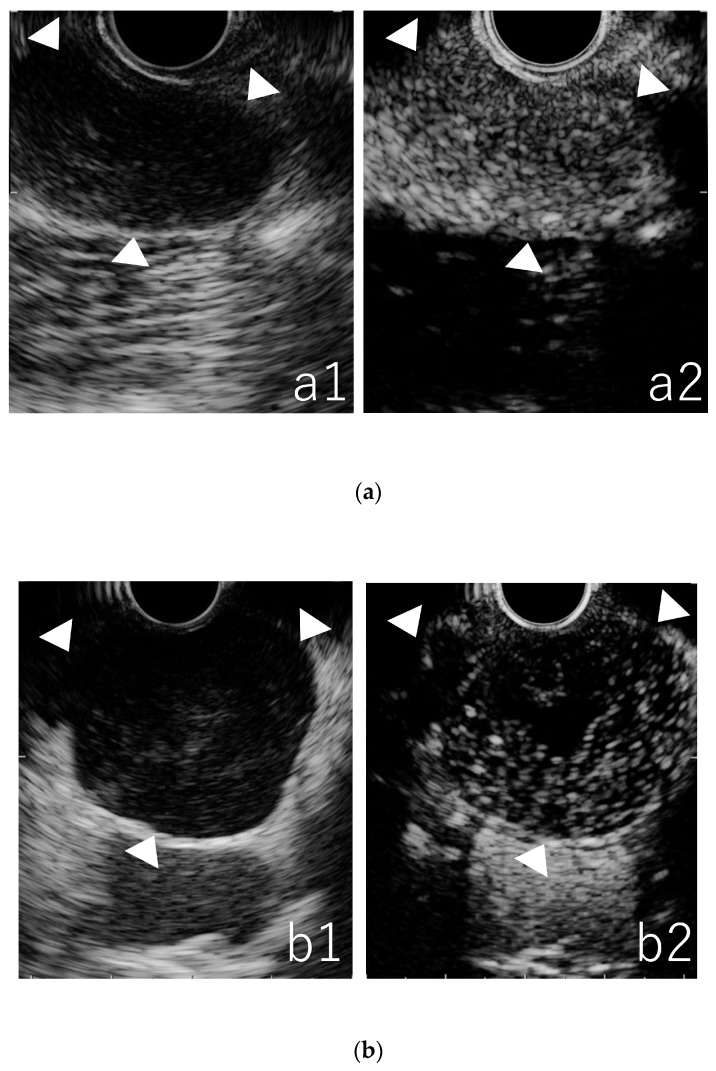
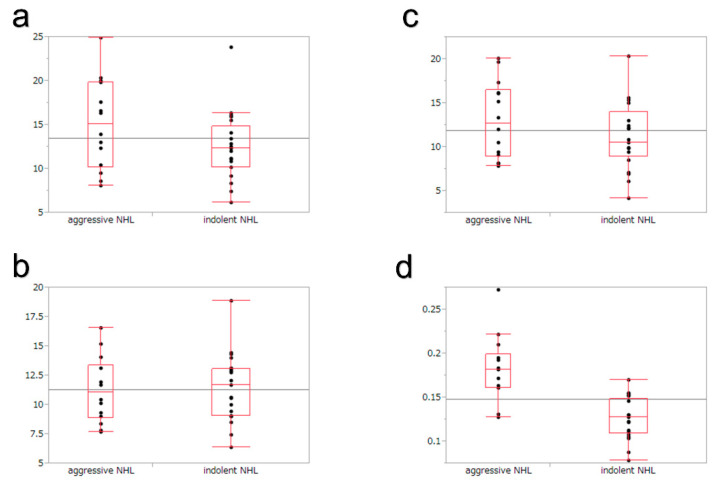
A total of 62 patients who were diagnosed with NHL were enrolled in this study. Regarding qualitative evaluation using B-mode EUS, there were no significant differences in the echo features between aggressive NHL and indolent NHL. With regard to qualitative evaluation using CE-EUS, aggressive NHL showed a heterogeneous enhancement pattern that is significantly more frequent than indolent NHL (95% confidence interval: 0.57 to 0.79, = 0.0089). When heterogeneous enhancement was defined as aggressive NHL, the sensitivity, specificity, and accuracy of the qualitative evaluation when using CE-EUS were 61%, 72%, and 66%, respectively. In TIC analysis, the velocity of reduction for homogeneous lesions was significantly higher in aggressive NHL than in indolent NHL ( < 0.0001). The sensitivity, specificity, and accuracy of CE-EUS in differentiating indolent NHL from aggressive NHL improved to 94%, 69%, and 82%, respectively, when combined with qualitative and quantitative evaluations.
CE-EUS before EUS-FNA for mediastinal or abdominal lymphadenopathy may be useful for improving the diagnostic capability of differentiating between indolent NHL and aggressive NHL (clinical trial registration number: UMIN000047907).
对比增强内镜超声(CE-EUS)是一种用于鉴别恶性和良性淋巴结的有前景的诊断方法。本研究旨在评估CE-EUS在鉴别惰性非霍奇金淋巴瘤(NHL)与侵袭性NHL方面的诊断能力。
本研究纳入了因淋巴结病接受CE-EUS和内镜超声引导下细针穿刺抽吸(EUS-FNA)并被诊断为NHL的患者。对B型内镜超声(EUS)的回声特征以及CE-EUS的血管和增强模式进行定性评估。还使用时间-强度曲线(TIC)分析对CE-EUS上淋巴结病在60秒内的增强强度进行定量评估。
本研究共纳入62例被诊断为NHL的患者。关于使用B型EUS的定性评估,侵袭性NHL和惰性NHL的回声特征无显著差异。关于使用CE-EUS的定性评估,侵袭性NHL表现出不均匀增强模式,其频率显著高于惰性NHL(95%置信区间:0.57至0.79,P = 0.0089)。当将不均匀增强定义为侵袭性NHL时,使用CE-EUS进行定性评估的敏感性、特异性和准确性分别为61%、72%和66%。在TIC分析中,侵袭性NHL中均匀病变的消退速度显著高于惰性NHL(P < 0.0001)。当结合定性和定量评估时,CE-EUS在鉴别惰性NHL与侵袭性NHL方面的敏感性、特异性和准确性分别提高到94%、69%和82%。
在对纵隔或腹部淋巴结病进行EUS-FNA之前进行CE-EUS,可能有助于提高鉴别惰性NHL和侵袭性NHL的诊断能力(临床试验注册号:UMIN000047907)。