UPMC Hillman Cancer Center, University of Pittsburgh, Pittsburgh.
Department of Biostatistics and Bioinformatics, Duke University School of Medicine, Durham.
ESMO Open. 2023 Apr;8(2):101183. doi: 10.1016/j.esmoop.2023.101183. Epub 2023 Mar 9.
For patients with stage IV non-small-cell lung cancer with epidermal growth factor receptor (EGFR) exon 19 deletions and exon 21 L858R mutations, osimertinib is the standard of care. Investigating the activity and safety of osimertinib in patients with EGFR exon 18 G719X, exon 20 S768I, or exon 21 L861Q mutations is of clinical interest.
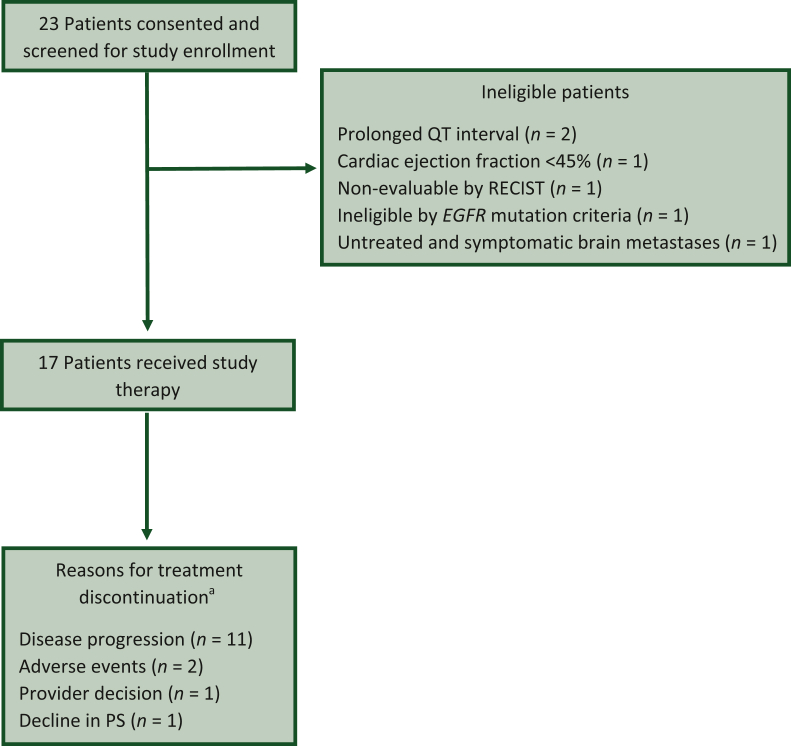
Patients with stage IV non-small-cell lung cancer with confirmed EGFR exon 18 G719X, exon 20 S768I, or exon 21 L861Q mutations were eligible. Patients were required to have measurable disease, an Eastern Cooperative Oncology Group performance status of 0 or 1, and adequate organ function. Patients were required to be EGFR tyrosine kinase inhibitor-naive. The primary objective was objective response rate, and secondary objectives were progression-free survival, safety, and overall survival. The study used a two-stage design with a plan to enroll 17 patients in the first stage, and the study was terminated after the first stage due to slow accrual.
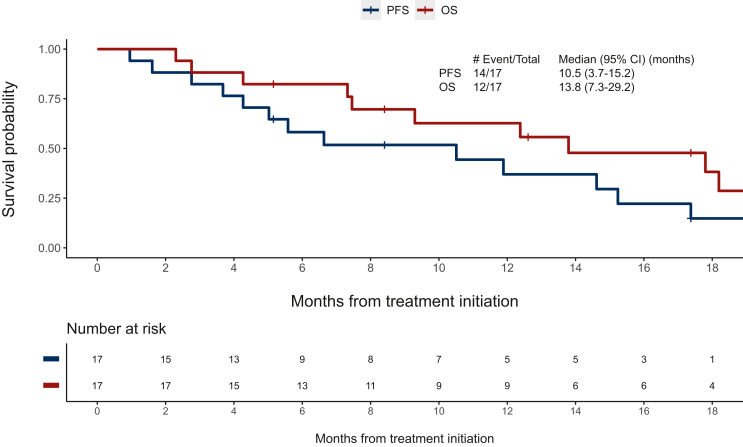
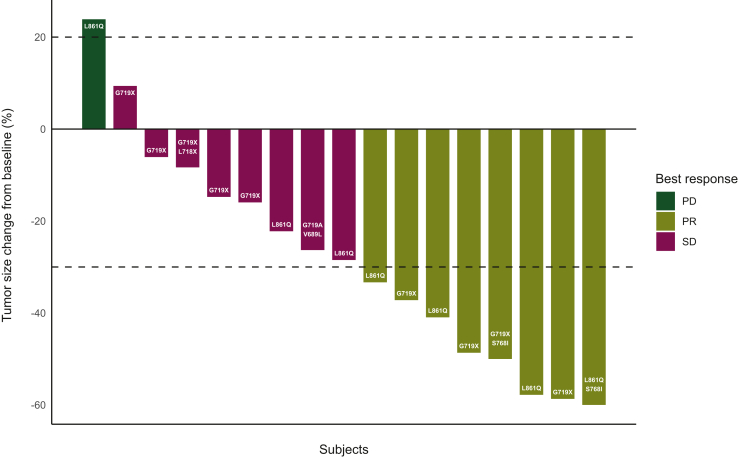
Between May 2018 and March 2020, 17 patients were enrolled and received study therapy. The median age of patients was 70 years (interquartile range 62-76), the majority were female (n = 11), had a performance status of 1 (n = 10), and five patients had brain metastases at baseline. The objective response rate was 47% [95% confidence interval (CI) 23% to 72%], and the radiographic responses observed were partial response (n = 8), stable disease (n = 8), and progressive disease (n = 1). The median progression-free survival was 10.5 months (95% CI 5.0-15.2 months), and the median OS was 13.8 months (95% CI 7.3-29.2 months). The median duration on treatment was 6.1 months (range 3.6-11.9 months), and the most common adverse events (regardless of attribution) were diarrhea, fatigue, anorexia, weight loss, and dyspnea.
This trial suggests osimertinib has activity in patients with these uncommon EGFR mutations.
对于存在表皮生长因子受体(EGFR)外显子 19 缺失和外显子 21 L858R 突变的 IV 期非小细胞肺癌患者,奥希替尼是标准治疗方法。研究奥希替尼在 EGFR 外显子 18 G719X、外显子 20 S768I 或外显子 21 L861Q 突变患者中的活性和安全性具有临床意义。
符合条件的患者为患有经确认的 EGFR 外显子 18 G719X、外显子 20 S768I 或外显子 21 L861Q 突变的 IV 期非小细胞肺癌患者。患者必须具有可测量的疾病、东部合作肿瘤学组(ECOG)体能状态 0 或 1 级,且器官功能充分。患者必须为 EGFR 酪氨酸激酶抑制剂初治。主要研究终点为客观缓解率,次要研究终点为无进展生存期、安全性和总生存期。该研究采用两阶段设计,计划在第一阶段招募 17 名患者,但由于入组速度较慢,研究在第一阶段后即终止。
2018 年 5 月至 2020 年 3 月,共纳入 17 名患者接受研究治疗。患者的中位年龄为 70 岁(四分位距 62-76),大多数为女性(n=11),体能状态为 1 级(n=10),基线时有 5 名患者存在脑转移。客观缓解率为 47%[95%置信区间(CI)23%至 72%],观察到的放射学缓解包括部分缓解(n=8)、疾病稳定(n=8)和疾病进展(n=1)。中位无进展生存期为 10.5 个月(95%CI 5.0-15.2 个月),中位总生存期为 13.8 个月(95%CI 7.3-29.2 个月)。中位治疗持续时间为 6.1 个月(范围 3.6-11.9 个月),最常见的(无论归因如何)不良反应为腹泻、疲劳、厌食、体重减轻和呼吸困难。
本试验提示奥希替尼在这些罕见的 EGFR 突变患者中具有活性。