Desmet David M, Kazanski Meghan E, Cusumano Joseph P, Dingwell Jonathan B
Department of Kinesiology, Pennsylvania State University, University Park, Pennsylvania, United States of America.
Department of Medicine, Division of Geriatrics and Gerontology, Emory University School of Medicine, Atlanta, Georgia, United States of America.
bioRxiv. 2023 Feb 27:2023.02.24.529927. doi: 10.1101/2023.02.24.529927.
Walking requires frequent maneuvers to navigate changing environments with shifting goals. Humans accomplish maneuvers and simultaneously maintain balance primarily by modulating their foot placement, but a direct trade-off between these two objectives has been proposed. As older adults rely more on foot placement to maintain lateral balance, they may be less able to adequately adapt stepping to perform lateral maneuvers.
How do older adults adapt stepping to enact lateral lane-change maneuvers, and how do physical and perceived ability influence their task performance?
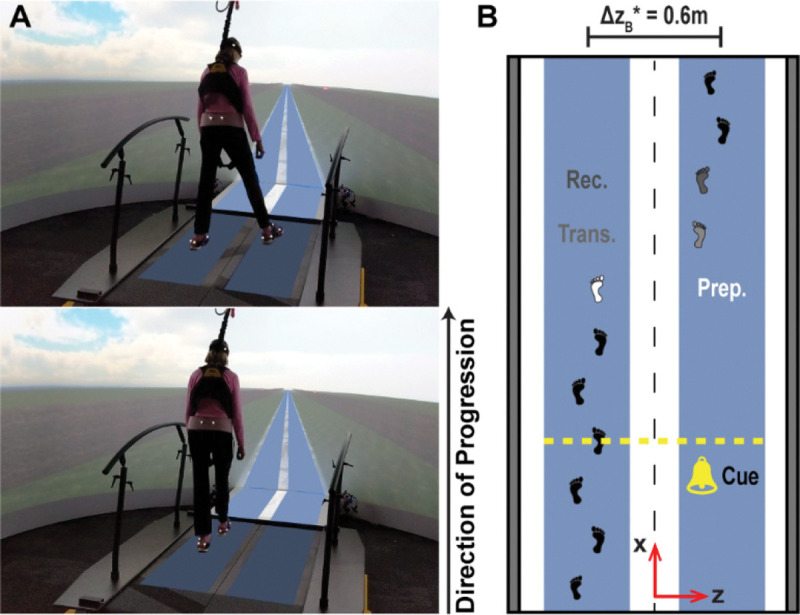
Twenty young (21.7 ± 2.6 yrs) and 18 older (71.6 ± 6.0 yrs) adults walked on a motorized treadmill in a virtual environment. Following an audible and visual cue, participants switched between two parallel paths, centered 0.6m apart, to continue walking on their new path. We quantified when participants initiated the maneuver following the cue, as well as their step width, lateral position, and stepping variability ellipses at each maneuver step.
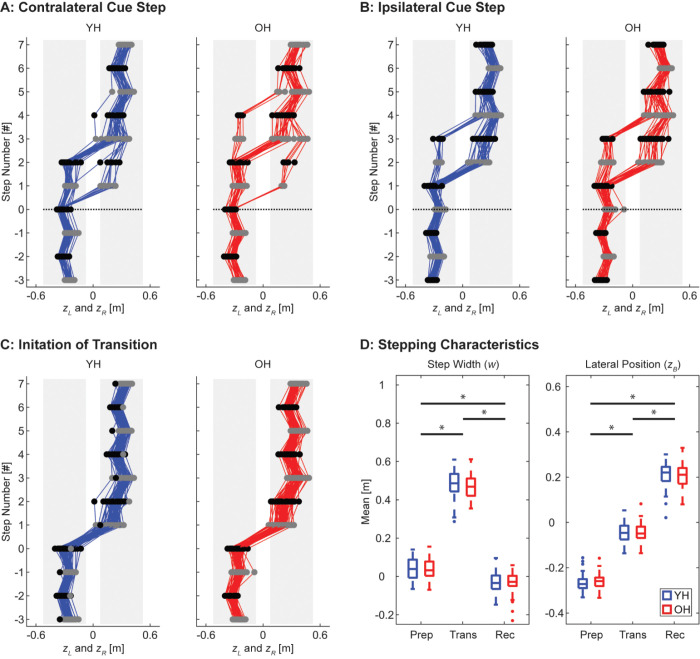
Young and older adults did not differ in when they initiated the maneuver, but participants with lower perceived ability took longer to do so. Young and older adults also did not exhibit differences in step width or lateral positions at any maneuver step, but participants with greater physical ability reached their new path faster. While only older adults exhibited stepping adaptations prior to initiating the maneuver, both groups traded-off stability for maneuverability to enact the lateral maneuver.
Physical and perceived balance ability, rather than age , differentially influenced maneuver task performance. Humans must make decisions related to the task of walking itself and do so based on both physical and perceived factors. Understanding and targeting these interactions may help improve walking performance among older adults.
行走需要频繁调整动作以在不断变化的环境中实现不断变化的目标。人类主要通过调整脚部位置来完成动作并同时保持平衡,但有人提出这两个目标之间存在直接的权衡关系。随着老年人更多地依靠脚部位置来保持侧向平衡,他们可能较难充分调整步伐以进行侧向动作。
老年人如何调整步伐以进行侧向变道动作,身体能力和感知能力如何影响他们的任务表现?
20名年轻人(21.7±2.6岁)和18名老年人(71.6±6.0岁)在虚拟环境中的电动跑步机上行走。在听到听觉和视觉提示后,参与者在两条平行路径之间切换,两条路径相距0.6米,然后继续在新路径上行走。我们对参与者在听到提示后何时开始动作、以及他们在每个动作步骤的步幅宽度、侧向位置和步幅变化椭圆进行了量化。
年轻人和老年人开始动作的时间没有差异,但感知能力较低的参与者开始动作的时间更长。年轻人和老年人在任何动作步骤的步幅宽度或侧向位置也没有差异,但身体能力较强的参与者更快到达新路径。虽然只有老年人在开始动作之前表现出步伐调整,但两组都为了进行侧向动作而在稳定性和机动性之间进行了权衡。
身体和感知平衡能力而非年龄对动作任务表现有不同影响。人类必须做出与行走本身任务相关的决策,并且要基于身体和感知因素来做出这些决策。理解并针对这些相互作用可能有助于改善老年人的行走表现。