College of Physical Education, Shandong Normal University, Jinan, 250014, China.
College of Physical Education, Shandong University, Jinan, 250011, China.
Trials. 2023 Mar 13;24(1):186. doi: 10.1186/s13063-023-07187-2.
The purpose of this study is to verify the improvement of remote qigong intervention on the quality of life and physical fitness of breast cancer patients after surgery by means of a randomized controlled trial and to compare it with the conventional exercise combination of aerobic exercise and resistance training.
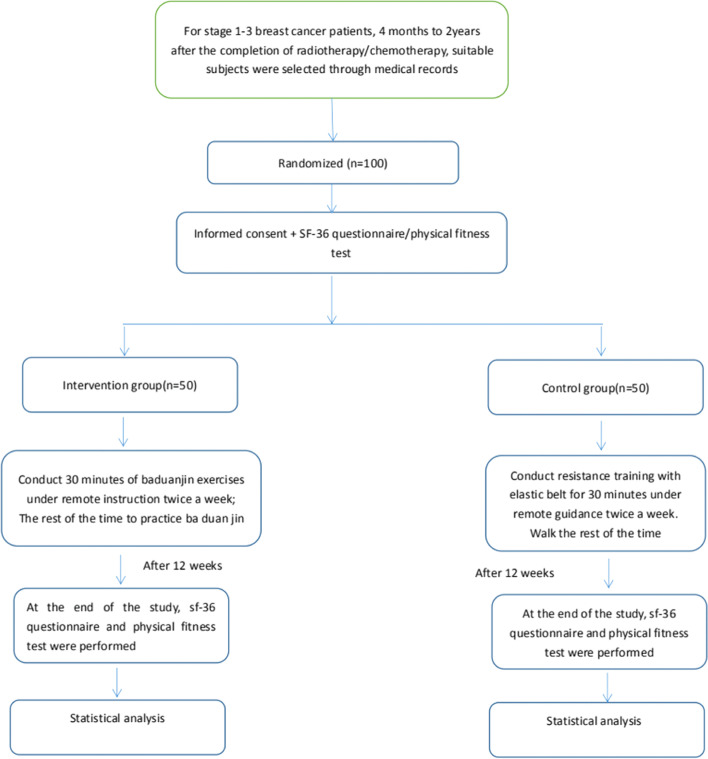
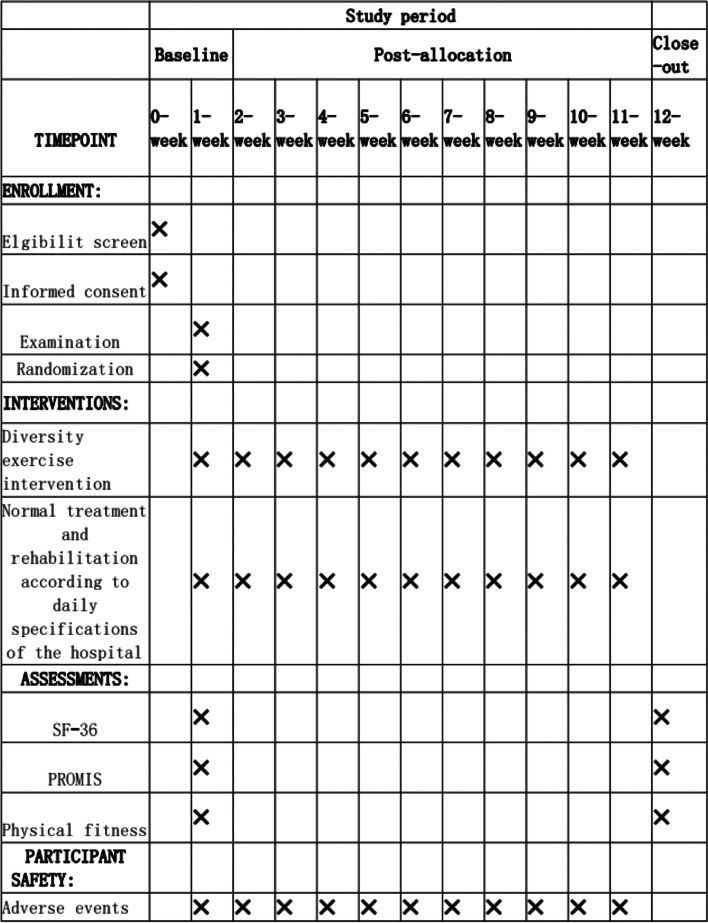
METHODS/DESIGN: The research approach applied in this study is a randomized controlled trial. After completing the baseline questionnaire and physical fitness test, participants were randomly assigned to either the qigong group or the combined exercise rehabilitation group. Patients in the qigong group performed Qigong-Baduanjin twice a week for 30 min each time under remote guidance and practiced Baduanjin by themselves at other times. Patients in the combined exercise rehabilitation group were given resistance training twice a week for 30 min under remote guidance, and walking the rest of the time. At the end of the 12-week intervention, outcomes testing and data collection were carried out. The primary outcomes are quality of life, measured using the Medical Outcomes Study 36-Item Short-Form Health Survey (SF-36), and the Functional Assessment of Cancer Therapy-Breast (FATC-B). The secondary outcomes include cardiopulmonary endurance, upper limb strength, lower limb strength, and skinfold thickness.
The importance of postoperative exercise rehabilitation for breast cancer has been gradually accepted by more and more doctors and patients, but further research and development of simple and practical means of exercise rehabilitation are necessary. Remote qigong intervention for breast cancer patients via the Internet will be a great alternative.
Chinese Clinical Trial Registry ChiCTR1900027989. Registered on December 7, 2019.
本研究旨在通过随机对照试验验证远程气功干预对乳腺癌术后患者生活质量和身体适应能力的改善,并与常规有氧运动和抗阻训练相结合的运动康复进行比较。
方法/设计:本研究采用随机对照试验的研究方法。完成基线问卷和体能测试后,将参与者随机分配到气功组或联合运动康复组。气功组患者在远程指导下每周进行 2 次气功-八段锦,每次 30 分钟,其余时间自行练习八段锦。联合运动康复组患者在远程指导下每周进行 2 次抗阻训练,其余时间步行。干预 12 周后进行结局测试和数据收集。主要结局指标是生活质量,采用医疗结局研究 36 项简短健康调查量表(SF-36)和癌症治疗功能评估-乳房(FATC-B)进行评估。次要结局指标包括心肺耐力、上肢力量、下肢力量和体脂厚度。
术后运动康复对乳腺癌的重要性已逐渐被越来越多的医生和患者所接受,但仍需要进一步研究和开发简单实用的运动康复手段。通过互联网对乳腺癌患者进行远程气功干预将是一种很好的选择。
中国临床试验注册中心 ChiCTR1900027989。注册于 2019 年 12 月 7 日。