Fidanza Andrea, Necozione Stefano, Garagnani Lorenzo
Unit of Orthopaedics and Traumatology - Department of life, Health & Environmental Sciences, University of L'Aquila, Italy.
Hand Unit, Guy's and St Thomas' NHS Foundation Trust, London, UK.
EFORT Open Rev. 2023 Mar 14;8(3):110-116. doi: 10.1530/EOR-22-0089.
Partial wrist denervation can be performed by isolated posterior interosseous nerve (PIN) or combined PIN plus (+) anterior interosseous nerve (AIN) neurectomy procedures. The purpose of the current systematic review is to investigate any differences in clinical outcomes and failures in patients undergoing AIN + PIN vs isolated PIN neurectomy.
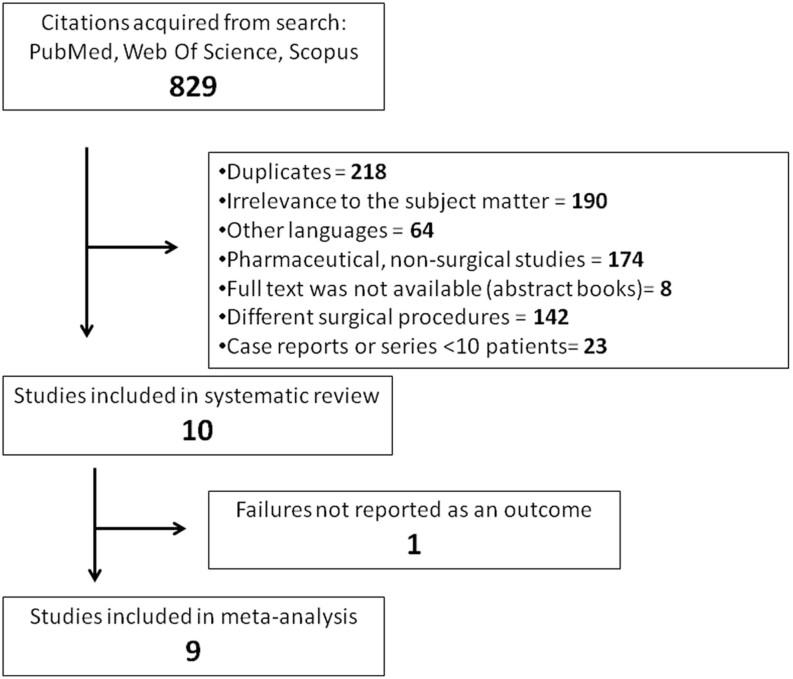
A review of the English Literature was performed on Medline, WOS and Scopus according to PRISMA protocol combining 'wrist denervation', 'PIN neurectomy', 'AIN neurectomy', anterior interosseous nerve neurectomy' and 'posterior interosseous nerve neurectomy'. Studies were assessed with a modified Coleman Methodology Score (CMS). The primary outcome for meta-analysis was 'Failures', including all patients who have required a second surgery or those who are left with pain (defined as 'bad').
Overall, 10 studies totalling 347 wrists were included in this systematic review, with a 'moderate' CMS. The isolated PIN neurectomy technique showed a 15.1% pooled failure rate at a median follow-up of 22 months, while the combined AIN+PIN denervation had a pooled failure rate of 23.6% at a follow-up with a median of 29 months. The combined analysis of both procedures did not show significantly better results in favour of either technique, with a general failure rate of 21.6% (P = 0.0501).
Partial denervation for chronic wrist pain is a salvage procedure that leads to an overall success of 78.4% for pain relief, with no substantial complications. Apparently, performing the neurectomy also of the AIN does not offer greater advantages compared to the isolated PIN neurectomy.
部分腕部去神经支配术可通过单独的骨间后神经(PIN)或联合骨间后神经加(+)骨间前神经(AIN)切除术来进行。本系统评价的目的是研究接受AIN + PIN手术与单独PIN切除术的患者在临床结局和手术失败情况方面的差异。
根据PRISMA方案,在Medline、WOS和Scopus数据库中对英文文献进行检索,检索词组合为“腕部去神经支配术”“PIN切除术”“AIN切除术”“骨间前神经切除术”和“骨间后神经切除术”。采用改良的科尔曼方法学评分(CMS)对研究进行评估。荟萃分析的主要结局指标为“手术失败”,包括所有需要二次手术的患者或仍有疼痛(定义为“差”)的患者。
总体而言,本系统评价纳入了10项研究,共347例腕部病例,CMS评分为“中等”。单独的PIN切除术技术在中位随访22个月时的汇总失败率为15.1%,而联合AIN + PIN去神经支配术在中位随访29个月时的汇总失败率为23.6%。两种手术方法的综合分析未显示出哪种技术有明显更好的结果,总体失败率为21.6%(P = 0.0501)。
对于慢性腕部疼痛,部分去神经支配术是一种补救性手术,疼痛缓解的总体成功率为78.4%,且无严重并发症。显然,与单独的PIN切除术相比,同时进行AIN切除术并没有更大的优势。